AI Assortment Planning Market Size, Share, Growth & Forecast by Revenue Stream (Software: Enterprise Planning Suite, AI Native Specialist, Retail Operations Suite, Category Management Suite; Services: Implementation and Integration, Advisory and Managed Services), Deployment Mode (Cloud, Hybrid, On-Premise), Buyer Type, End User Vertical (Fashion and Apparel, Grocery and Convenience), and Sales Channel (Direct, Partner Led, Embedded or OEM, Other Sales Channel) — Global Analysis 2025–2035
Industry: ICT & Media | Publishing Date: July 6, 2026 | Last Updated: September 30, 2026 | No of Pages: N/A | No. of Tables: N/A | No. of Figures: N/A | Format: PDF | Report Code: IC4957
What Is the AI Assortment Planning Market Size?
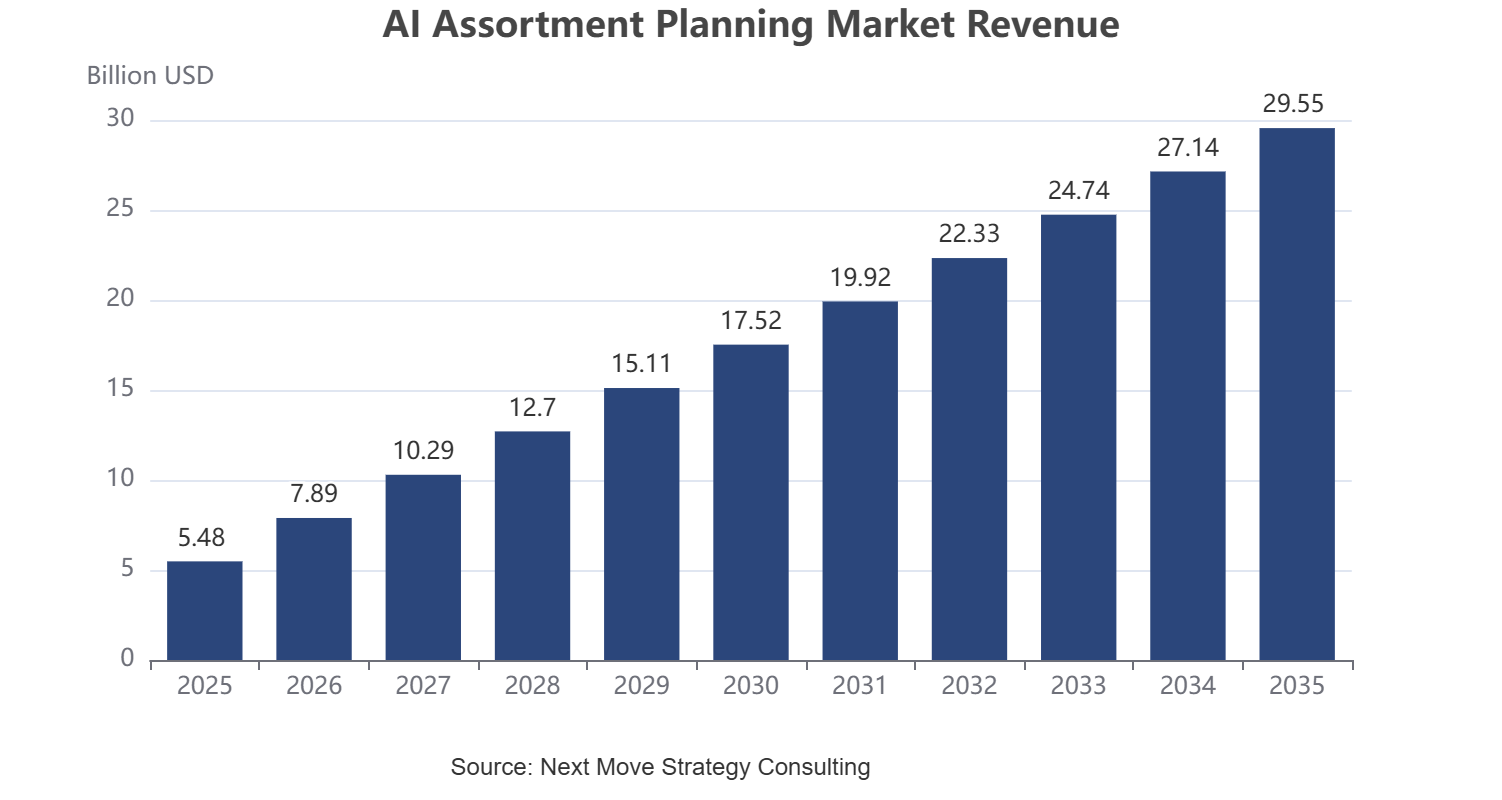
The global AI Assortment Planning Market was valued at USD 5.48 billion in 2025 and is projected to reach USD 6.46 billion in 2026. Driven by retailer adoption of generative AI for demand sensing, expanding category management automation, rising pressure to reduce markdowns and stockouts, and accelerating cloud-native retail software modernisation, the market is forecast to reach USD 29.55 billion by 2035, registering a CAGR of 18.39% from 2026 to 2035. Software solutions retain revenue dominance, while AI Native Specialist platforms are emerging as the fastest-growing product category within the broader assortment planning market report scope.
|
Parameters |
Details |
|
Market Size in 2025 |
USD 5.48 Billion |
|
Market Size in 2026 |
USD 6.46 Billion |
|
Revenue Forecast in 2035 |
USD 29.55 Billion |
|
Growth Rate |
CAGR of 18.39% from 2026 to 2035 |
|
Analysis Period |
2025–2035 |
|
Base Year Considered |
2025 |
|
Forecast Period |
2026–2035 |
|
Market Size Estimation |
USD Billion |
|
Companies Profiled |
20 |
|
Countries Covered |
33 |
|
Market Share |
Top 10 |
AI Assortment Planning Market Overview
What Is the Scope of the AI Assortment Planning Market Report?
The AI assortment planning market report covers software and services that apply machine learning and generative AI to retail merchandising decisions, including product mix selection, demand forecasting, inventory allocation, and category-level performance optimization. NMSC's analysis indicates that the market scope spans enterprise planning suites, AI native specialist platforms, retail operations suites, and category management software, alongside implementation, integration, advisory, and managed services delivered to retailers, brand manufacturers, and wholesale distributors across fashion, grocery, general merchandise, and specialty retail verticals globally.
How Has the AI Assortment Planning Market Evolved Structurally?
The AI assortment planning market has progressed through three structural phases. The first phase relied on rules-based and statistical forecasting embedded within legacy enterprise resource planning systems. The second phase introduced machine learning-enhanced demand forecasting modules from established retail planning vendors. Through NMSC's assessment, we found that the current phase is defined by generative AI copilots, natural language merchandising interfaces, and AI native platforms built specifically for assortment optimization, replacing rules-based logic with continuously learning models trained on transactional, supply chain, and external signal data.
How Is the Regulatory Environment Shaping the AI Assortment Planning Market?
Regulatory developments are beginning to shape vendor and retailer decisions within the AI assortment planning market. The European Union's Artificial Intelligence Act classifies certain automated decision-making systems used in commercial contexts under transparency and risk-documentation obligations applicable to retail AI deployments. The U.S. Federal Trade Commission's guidance on automated decision-making and algorithmic pricing requires retailers to maintain explainability and non-discrimination safeguards. These frameworks are compelling AI assortment planning vendors to invest in model governance, audit trails, and explainable AI features to satisfy enterprise buyer compliance requirements.
How Is Technology Adoption Reshaping the AI Assortment Planning Market?
Technology adoption across the AI assortment planning market is accelerating as retailers integrate generative AI copilots into merchandising workflows and migrate legacy planning systems to cloud-native architectures. Based on NMSC's research, we found that retailers are increasingly combining internal point-of-sale and inventory data with external signals including weather, social trends, and macroeconomic indicators to improve assortment accuracy. Cloud deployment is becoming the default delivery model, while API-based integration with existing retail operations suites is reducing implementation timelines and accelerating time-to-value for AI assortment planning software deployments.
|
Key Takeaways |
|
Software holds the largest share of the AI assortment planning market at USD 4.18 billion in 2025, reflecting retailer preference for licensed and subscription-based planning platforms over outsourced advisory engagements across enterprise merchandising functions. |
|
Services are the fastest-growing revenue stream at a CAGR of 21.85% from 2026 to 2035, growing from USD 1.30 billion in 2025 to USD 7.70 billion by 2035, as retailers increasingly require implementation and advisory support to operationalize AI assortment planning models. |
|
Enterprise Planning Suite is the dominant software sub-segment at USD 1.55 billion in 2025, supported by established vendor relationships and deep integration with existing retail merchandising and supply chain systems. |
|
AI Native Specialist platforms are the fastest-growing software sub-segment at a CAGR of 22.56% from 2026 to 2035, advancing from USD 1.05 billion in 2025 to USD 6.55 billion by 2035, as retailers adopt purpose-built generative AI assortment tools. |
|
Cloud deployment dominates the AI assortment planning market at USD 3.65 billion in 2025, as retailers prioritize scalable, continuously updated AI models over on-premise infrastructure for assortment planning workloads. |
|
Cloud deployment is also the fastest-growing deployment mode at a CAGR of 21.72% from 2026 to 2035, reaching USD 21.40 billion by 2035, while Hybrid deployment supports retailers managing data residency requirements alongside cloud-based AI processing. |
|
Retailers represent the dominant buyer type at USD 3.55 billion in 2025, given their direct ownership of assortment decisions, shelf space allocation, and category performance accountability across store and e-commerce channels. |
|
Brand or Manufacturer buyers are the fastest-growing buyer type at a CAGR of 21.78% from 2026 to 2035, as consumer brands adopt AI assortment planning tools to optimize retailer-specific product mix recommendations and trade promotion strategies. |
|
Fashion and Apparel is the leading end user vertical at USD 1.85 billion in 2025, driven by the sector's high SKU complexity, frequent seasonal turnover, and acute sensitivity to markdown and stockout risk. |
|
Other Retail is the fastest-growing vertical at a CAGR of 25.09% from 2026 to 2035, while Specialty Retail follows closely as niche and direct-to-consumer retailers adopt AI assortment planning to compete with larger merchandising organizations. |
|
North America dominates the AI assortment planning market at USD 2.35 billion in 2025, forecast to reach USD 11.85 billion by 2035 at a CAGR of 19.69%, supported by concentrated vendor headquarters and early enterprise retail AI adoption. |
|
Asia-Pacific is the fastest-growing major region, advancing from USD 1.18 billion in 2025 to USD 7.65 billion by 2035 at a CAGR of 23.08%, propelled by China's retail technology modernisation and India's expanding organized retail sector. |
|
The United States is the leading individual country market, accounting for the majority of North American revenue in 2025, driven by the headquarters presence of leading AI assortment planning vendors and large enterprise retail technology budgets. |
|
India is among the fastest-growing national markets at a CAGR exceeding 26% from 2026 to 2035, supported by rapid organized retail expansion and growing enterprise cloud software adoption across Indian retail chains. |
Key Emerging Trends in the AI Assortment Planning Market
How Is Generative AI Reshaping Merchandising Decision-Making in the AI Assortment Planning Market?
Generative AI is fundamentally transforming how merchandisers interact with assortment planning systems, replacing static dashboards with conversational interfaces capable of generating scenario analyses on demand. NMSC's analysis indicates that retailers are deploying natural language copilots that allow category managers to query historical performance, simulate markdown scenarios, and generate localized assortment recommendations without specialized data science skills. SAP's integration of generative AI copilots into its retail planning modules exemplifies this shift, reducing the technical barrier for mid-market retailers adopting AI-assisted merchandising workflows.
How Is Hyper-Localized Assortment Planning Becoming a Competitive Differentiator?
Hyper-localization is emerging as a defining capability within the AI assortment planning market, as retailers move from regional or banner-level assortments toward store-specific and even micro-zone product mix optimization. Through our market assessment, we observed that grocery and convenience retailers are leveraging AI models trained on hyperlocal demographic, weather, and competitive data to tailor assortments at the individual store level. This trend is increasing demand for AI native specialist platforms capable of processing granular, location-specific signals at a scale legacy enterprise planning suites were not originally designed to support.
How Is Sustainability-Linked Assortment Optimization Gaining Adoption Among Retailers?
Sustainability considerations are increasingly embedded within AI assortment planning algorithms, as retailers seek to balance commercial performance with environmental and supply chain transparency goals. Our findings suggest that AI models are being trained to incorporate carbon footprint, supplier ethics scoring, and packaging waste metrics alongside traditional sales velocity and margin inputs when generating assortment recommendations. The growing influence of the EU's Corporate Sustainability Reporting Directive on retail supply chain disclosure is creating additional demand for AI assortment tools capable of integrating sustainability data into core merchandising decisions.
How Is Embedded and OEM Distribution Expanding the Reach of AI Assortment Planning Technology?
Embedded and OEM distribution models are extending AI assortment planning capabilities into adjacent retail technology platforms, including point-of-sale systems, e-commerce platforms, and supply chain management software. NMSC's analysis indicates that this trend allows smaller retailers and brand manufacturers to access AI-driven assortment recommendations without procuring a standalone planning suite. Vendors including Impact Analytics and First Insight are pursuing embedded partnership strategies, integrating assortment intelligence directly into partner platforms to capture demand from buyers who would otherwise remain outside the addressable market for dedicated planning software.
What Are the Key Market Drivers, Breakthroughs, and Investment Opportunities that Will Shape the AI Assortment Planning Industry in the Next Decade?
|
Drivers / Trends / Restraints |
(+/-) % Impact on CAGR Forecast |
Geographic Relevance |
Impact Timeline |
|
Generative AI Copilot Adoption in Retail Merchandising |
+2.6% |
Global (led by North America, Europe) |
2025–2030 |
|
Cloud-Native Retail Planning Migration |
+2.0% |
North America, Europe, APAC |
2025–2032 |
|
Organized Retail Expansion in Emerging Markets |
+1.7% |
Asia-Pacific, LATAM, MEA |
2026–2035 |
|
Markdown and Stockout Cost Pressure on Retailers |
+1.4% |
Global |
2025–2030 |
|
Embedded and OEM Partnership Distribution Growth |
+1.1% |
North America, Europe, APAC |
2026–2035 |
|
Legacy System Integration Complexity |
-1.0% |
All regions |
Ongoing |
|
Data Quality and Governance Constraints |
-0.8% |
All regions |
Ongoing |
|
High Total Cost of Ownership for Mid-Market Retailers |
-0.6% |
Emerging markets |
Ongoing |
|
AI Explainability and Regulatory Compliance Requirements |
-0.5% |
Europe, North America |
2025–2030 |
|
Cross-Sector AI Talent and Implementation Capacity |
+1.2% |
Global |
2026–2035 |
What Are the Growth Drivers of the AI Assortment Planning Market?
How Is Rising Retailer Demand for Markdown and Stockout Reduction Driving the AI Assortment Planning Market?
Persistent markdown losses and stockout-related revenue leakage represent a foundational demand driver for the AI assortment planning market. The U.S. Census Bureau's retail inventory and sales data demonstrate the continued sensitivity of retail margins to inventory imbalances, creating measurable commercial incentive for AI-driven precision in assortment decisions. Retailers adopting AI assortment planning report improved alignment between forecasted and actual demand, directly reducing both excess inventory liquidation costs and lost sales from unavailable products, reinforcing the business case for continued AI assortment planning market investment.
How Is Cloud-Native Retail Technology Migration Accelerating the AI Assortment Planning Market?
The broader enterprise shift toward cloud-native retail technology infrastructure is a structural growth driver for the AI assortment planning market, as cloud architecture enables the continuous model retraining and large-scale data processing that AI-driven planning requires. Our findings suggest that the U.S. National Institute of Standards and Technology's cloud computing reference architecture has become a widely referenced framework guiding enterprise cloud migration strategies across retail and other sectors. Retailers migrating core merchandising systems to cloud platforms are simultaneously adopting AI assortment planning capabilities as part of consolidated technology modernisation programs.
How Is Organized Retail Expansion in Emerging Markets Creating New Demand for AI Assortment Planning?
The expansion of organized, multi-format retail chains across Asia-Pacific, Latin America, and the Middle East is generating new addressable demand for AI assortment planning software. Through NMSC's assessment, we found that India's Department for Promotion of Industry and Internal Trade has documented continued foreign and domestic investment inflows into organized retail infrastructure, creating a growing base of multi-store retail operations requiring centralized, AI-supported assortment decision-making. As organized retail penetration increases in these markets, retailers are bypassing legacy rules-based systems in favor of AI-native planning platforms from the outset.
What Are the Growth Inhibitors of the AI Assortment Planning Market?
How Does Legacy System Integration Complexity Constrain AI Assortment Planning Market Adoption?
Integration complexity between AI assortment planning software and legacy enterprise resource planning, point-of-sale, and supply chain systems remains a significant constraint on the AI assortment planning market. Many large retailers operate decades-old core systems with fragmented data architectures that complicate the clean data pipelines AI models require for accurate training and inference. Our assessment indicates that implementation timelines for enterprise-scale AI assortment planning deployments frequently extend beyond initial project estimates due to data cleansing, system reconciliation, and change management requirements, slowing the realization of AI-driven planning benefits across large retail organizations.
How Do Data Governance and Quality Constraints Limit the AI Assortment Planning Market?
Data quality and governance limitations constrain the accuracy and reliability of AI assortment planning outputs, directly affecting retailer confidence in AI-generated merchandising recommendations. The Federal Trade Commission's guidance on AI and algorithmic decision-making requires that businesses maintain accurate, well-governed data inputs to avoid deceptive or unsubstantiated automated claims. Our market evaluation indicates that retailers with fragmented historical sales data, inconsistent product taxonomy, or incomplete supply chain visibility experience materially slower AI assortment planning model performance improvement, creating a governance-driven adoption barrier particularly among mid-market and smaller retail organizations.
What Are the Growth Opportunities in the AI Assortment Planning Market?
How Does AI Native Specialist Platform Innovation Create a High-Growth Opportunity in the AI Assortment Planning Market?
AI native specialist platforms, purpose-built for assortment optimization rather than retrofitted from legacy enterprise planning systems, represent the highest-growth opportunity segment within the AI assortment planning market. Our analysis shows that vendors including Lokad and Impact Analytics are demonstrating measurable differentiation through continuous learning architectures designed specifically for retail demand patterns. As retailers increasingly prioritize speed of deployment and model accuracy over legacy vendor relationships, AI native specialists are capturing disproportionate new-customer growth relative to incumbent enterprise planning suite providers across the forecast period.
How Does Embedded and OEM Distribution Expansion Represent a Strategic AI Assortment Planning Market Opportunity?
Embedded and OEM distribution partnerships present a structurally significant opportunity for AI assortment planning vendors to reach buyers who would not independently procure a standalone planning suite. Our market evaluation indicates that integrating AI assortment intelligence directly into point-of-sale, e-commerce, and supply chain platforms allows vendors to monetize a substantially larger addressable buyer base, particularly among small and mid-market retailers and brand manufacturers. This distribution approach reduces customer acquisition costs while expanding AI assortment planning market penetration into segments historically underserved by traditional enterprise software sales models.
How Does Vertical-Specific AI Model Development Create Differentiated Growth Opportunities?
Vertical-specific AI model development tailored to the distinct assortment dynamics of fashion, grocery, and specialty retail represents a meaningful growth opportunity within the AI assortment planning market. NMSC's analysis indicates that grocery and convenience retailers require models optimized for perishability and high-frequency replenishment, while fashion and apparel retailers require models tuned for seasonal cycles and trend volatility. Vendors developing vertical-specific training data and model architectures, rather than horizontal one-size-fits-all platforms, are achieving superior forecast accuracy and capturing premium pricing within their specialized end user vertical segments.
How Is the AI Assortment Planning Market Segmented in This Report, and What Are the Key Insights from the Segmentation Analysis?
How Do Software and Services Compare in Driving Revenue Across the AI Assortment Planning Market?
|
Revenue Stream Segment |
2025 (USD Bn) |
2035 (USD Bn) |
CAGR (%) |
|
Software |
4.18 |
21.85 |
20.17% |
|
Services |
1.30 |
7.70 |
21.85% |
Based on our analysis of buyer procurement patterns, we observed that the AI assortment planning market is segmented by revenue stream into Software and Services. Software holds the larger share at USD 4.18 billion in 2025, reflecting sustained retailer investment in licensed and subscription-based planning platforms across enterprise merchandising operations. Services, encompassing Implementation and Integration, Advisory and Managed Services, and Other Services, are the faster-growing stream at a CAGR of 21.85%, as retailers increasingly require specialized support to configure AI models, integrate data pipelines, and operationalize assortment recommendations within existing merchandising workflows.
How Does Deployment Mode Influence Revenue Distribution in the AI Assortment Planning Market?
|
Deployment Mode Segment |
2025 (USD Bn) |
2035 (USD Bn) |
CAGR (%) |
|
Cloud |
3.65 |
21.40 |
21.72% |
|
Hybrid |
1.20 |
6.10 |
19.80% |
|
On Premise |
0.50 |
1.55 |
13.40% |
|
Other Deployment Mode |
0.13 |
0.50 |
16.15% |
In our assessment of infrastructure preferences, we found that the AI assortment planning market is segmented by deployment mode into Cloud, Hybrid, On Premise, and Other Deployment Mode. Cloud dominates at USD 3.65 billion in 2025 and is also the fastest-growing mode at a CAGR of 21.72%, as retailers prioritize the scalability and continuous model updating that cloud infrastructure enables. Hybrid deployment serves retailers balancing data residency requirements with cloud-based AI processing. On Premise retains relevance among retailers with stringent data control mandates but is growing at a comparatively measured pace.
How Do Buyer Type Categories Reveal Purchasing Patterns Across the AI Assortment Planning Market?
|
Buyer Type Segment |
2025 (USD Bn) |
2035 (USD Bn) |
CAGR (%) |
|
Retailer |
3.55 |
18.65 |
20.24% |
|
Brand or Manufacturer |
1.35 |
7.95 |
21.78% |
|
Wholesale Distributor |
0.45 |
2.30 |
19.87% |
|
Other Buyer Type |
0.13 |
0.65 |
19.58% |
Based on NMSC's research, we found that the AI assortment planning market is segmented by buyer type into Retailer, Brand or Manufacturer, Wholesale Distributor, and Other Buyer Type. Retailers dominate at USD 3.55 billion in 2025, given their direct accountability for shelf space allocation and category performance. Brand or Manufacturer is the fastest-growing buyer type at a CAGR of 21.78%, as consumer brands adopt AI assortment planning tools to generate retailer-specific product mix recommendations and strengthen trade negotiation positions. Wholesale Distributor adoption is growing steadily as multi-retailer supply relationships demand more sophisticated planning support.
Which End User Verticals Are Driving Demand Across the AI Assortment Planning Market?
|
End User Vertical Segment |
2025 (USD Bn) |
2035 (USD Bn) |
CAGR (%) |
|
Fashion and Apparel |
1.85 |
9.45 |
19.87% |
|
Grocery and Convenience |
1.45 |
7.60 |
20.21% |
|
General Merchandise |
1.20 |
6.55 |
20.75% |
|
Specialty Retail |
0.78 |
4.45 |
21.35% |
|
Other Retail |
0.20 |
1.50 |
25.09% |
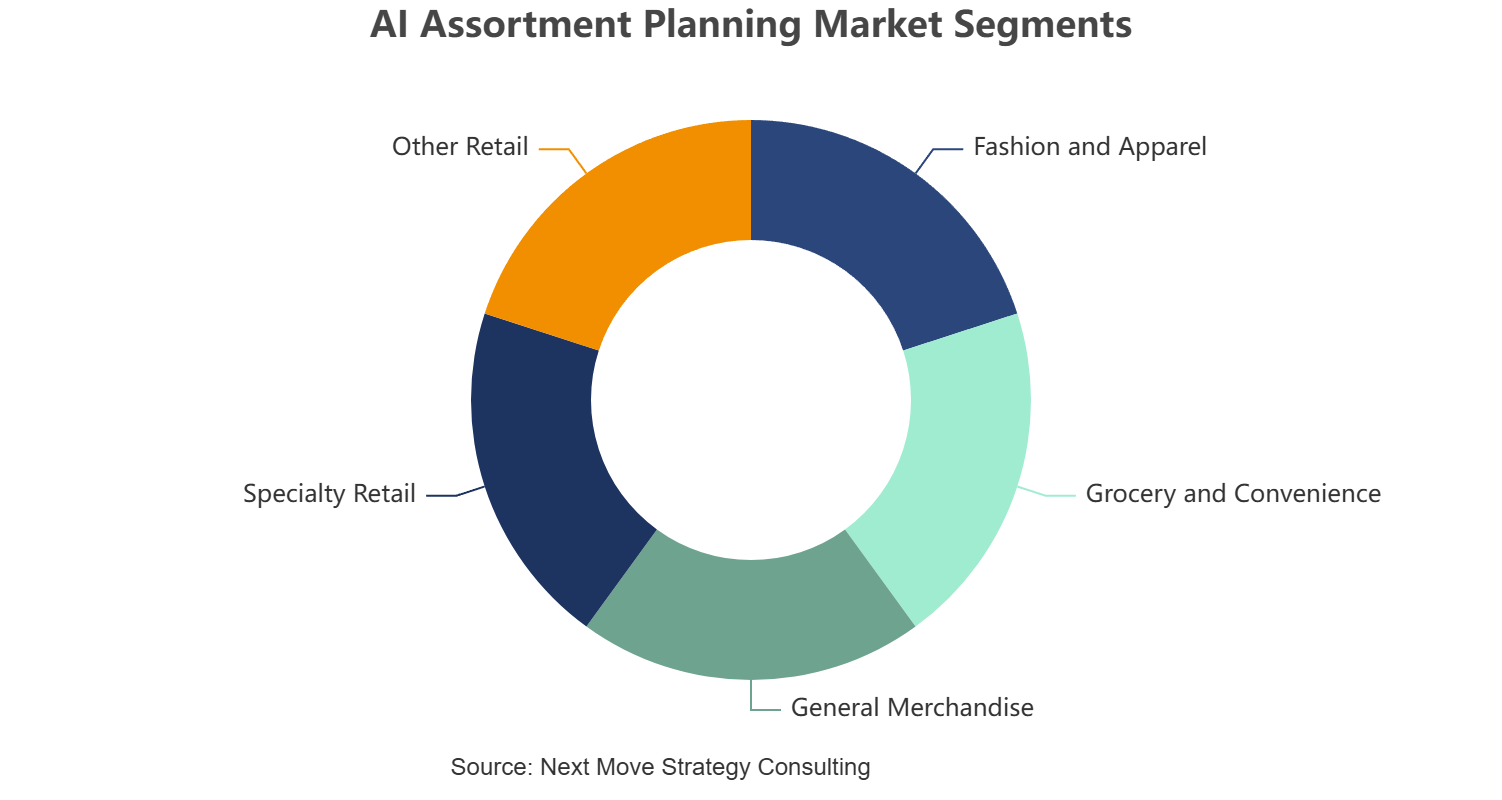
Our analysis shows that the AI assortment planning market is segmented by end user vertical into Fashion and Apparel, Grocery and Convenience, General Merchandise, Specialty Retail, and Other Retail. Fashion and Apparel leads at USD 1.85 billion in 2025, driven by the sector's high SKU complexity and acute seasonal markdown risk. Other Retail is the fastest-growing vertical at a CAGR of 25.09%, while Specialty Retail follows at 21.35% as niche and direct-to-consumer retailers adopt AI assortment planning to compete against larger merchandising organizations with greater historical data advantages.
How Do Sales Channels Shape Commercial Distribution Within the AI Assortment Planning Market?
|
Sales Channel Segment |
2025 (USD Bn) |
2035 (USD Bn) |
CAGR (%) |
|
Direct |
2.95 |
14.55 |
19.40% |
|
Partner Led |
1.85 |
10.95 |
21.84% |
|
Embedded or OEM |
0.55 |
3.30 |
22.03% |
|
Other Sales Channel |
0.13 |
0.75 |
21.50% |
Through NMSC's assessment, we found that the AI assortment planning market is segmented by sales channel into Direct, Partner Led, Embedded or OEM, and Other Sales Channel. Direct remains the largest channel at USD 2.95 billion in 2025, reflecting vendor preference for managing large enterprise retail accounts through dedicated sales teams. Embedded or OEM is the fastest-growing channel at a CAGR of 22.03%, as vendors integrate assortment intelligence into partner platforms to reach smaller retailers and brand manufacturers. Partner-led distribution supports geographic expansion through systems integrators and regional resellers.
Consumer Behaviour Analysis of the AI Assortment Planning Market
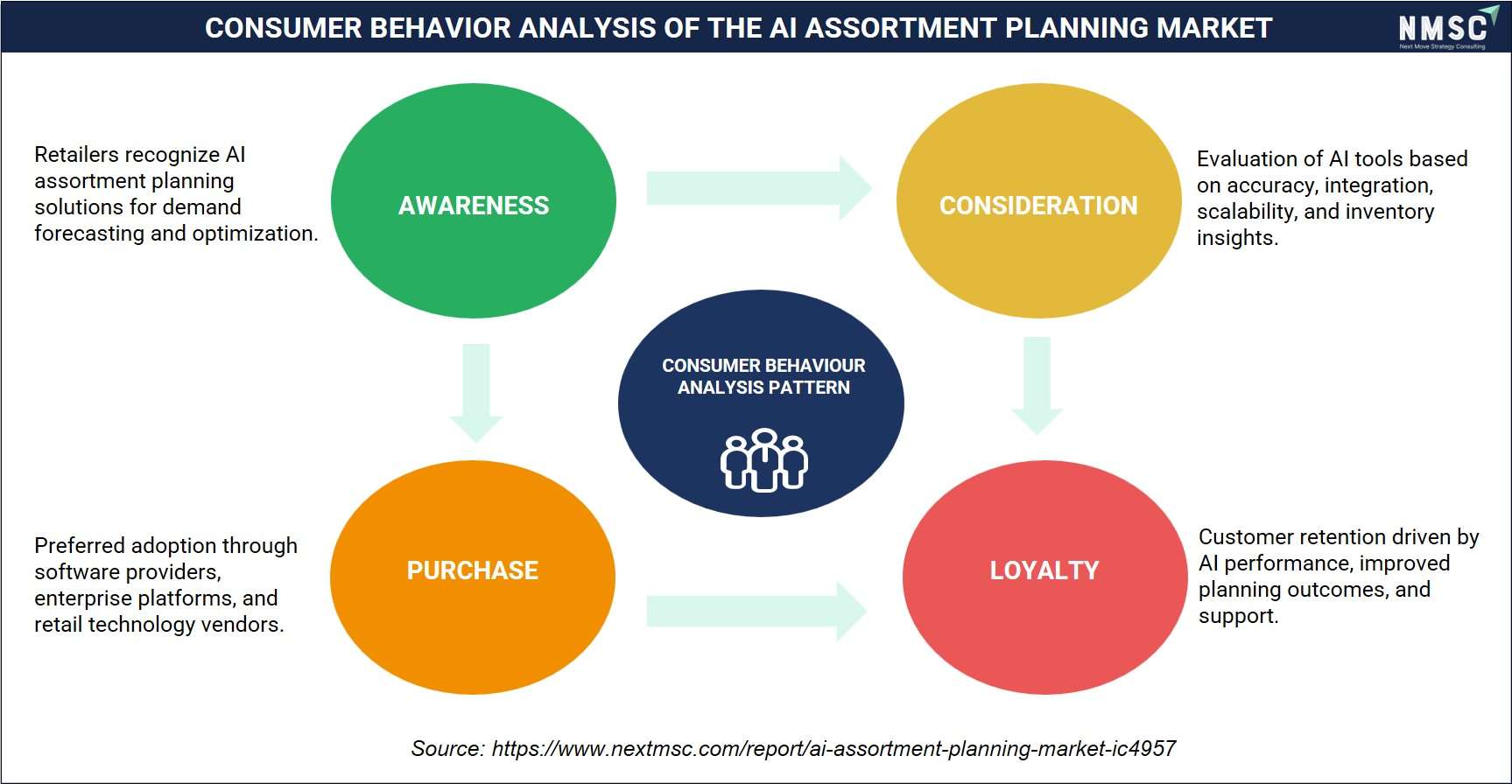
The above framework maps the consumer journey across awareness, consideration, purchase, and loyalty within the AI Assortment Planning Market. We observed that retailers recognize AI solutions for demand forecasting and optimization, while consideration hinges on integration ease, scalability, and ROI potential. Adoption occurs through software providers, enterprise platforms, and retail technology vendors, with loyalty ultimately driven by AI performance, improved planning outcomes, and ongoing support.
Regional Outlook
Geographic Performance Snapshot
|
Region |
2025 (USD Bn) |
2035 (USD Bn) |
CAGR (%) |
Key Driver |
|
North America |
2.35 |
11.85 |
19.69% |
Vendor headquarters concentration, early enterprise AI adoption |
|
Europe |
1.55 |
7.95 |
19.92% |
Regulatory transparency requirements, organized retail modernisation |
|
Asia-Pacific |
1.18 |
7.65 |
23.08% |
China retail tech modernisation, India organized retail growth |
|
Middle East & Africa |
0.22 |
1.20 |
20.74% |
GCC retail diversification, South Africa enterprise adoption |
|
Latin America |
0.18 |
0.90 |
19.58% |
Brazil retail digitization, regional e-commerce growth |
North America AI Assortment Planning Market
North America leads the AI assortment planning market at USD 2.35 billion in 2025, forecast to reach USD 11.85 billion by 2035 at a CAGR of 19.69%. The region's dominance stems from the headquarters presence of leading vendors including Blue Yonder, Oracle, Manhattan Associates, and Impact Analytics, combined with early enterprise retail AI adoption and substantial retail technology budgets. The U.S. Federal Trade Commission's algorithmic accountability guidance is shaping vendor governance practices, while large retail chains across the U.S. and Canada continue to expand cloud-based AI assortment planning deployments.
U.S. AI Assortment Planning Market
Based on our engagements, the United States represents the substantial majority of North American AI assortment planning market revenue in 2025, anchored by the headquarters presence of Blue Yonder, Oracle, Manhattan Associates, Logility, Aptos, and SAS Institute. The U.S. Census Bureau's retail trade data continues to highlight inventory management as a persistent margin pressure point, reinforcing retailer investment in AI-driven assortment precision. The Federal Trade Commission's ongoing scrutiny of algorithmic decision-making is prompting U.S. retailers to prioritize vendors offering transparent, explainable AI assortment recommendations.
Canada AI Assortment Planning Market
Through our analysis, Canada is a steadily growing AI assortment planning market, supported by major national grocery and general merchandise chains investing in AI-enabled merchandising tools. Innovation, Science and Economic Development Canada's digital adoption programs for retail and supply chain technology have supported broader enterprise software modernisation, including assortment planning capabilities. Canadian retailers are increasingly partnering with U.S.-headquartered AI assortment planning vendors to access cloud-based platforms while maintaining compliance with Canadian data residency expectations under federal privacy guidance.
Mexico AI Assortment Planning Market
From our assessment, Mexico represents a developing AI assortment planning market within North America, driven by the expansion of organized retail chains and growing enterprise software adoption among large Mexican retailers. Mexico's Secretaria de Economia has supported digital transformation initiatives relevant to retail technology modernisation. Mexican retailers are increasingly adopting cloud-based AI assortment planning tools to manage cross-border supply chain complexity and improve category performance across both physical store networks and growing e-commerce channels.
Europe AI Assortment Planning Market
Europe is the second-largest region in the AI assortment planning market at USD 1.55 billion in 2025, forecast to reach USD 7.95 billion by 2035 at a CAGR of 19.92%. The region's growth is shaped by the European Union's Artificial Intelligence Act, which imposes transparency and risk-documentation requirements on automated decision-making systems used in commercial retail contexts. SAP's strong European retail customer base and growing adoption of AI-enabled category management tools among major grocery and fashion retailers are reinforcing sustained regional AI assortment planning market expansion.
U.K. AI Assortment Planning Market
Based on our engagements, the United Kingdom is one of Europe's largest individual AI assortment planning markets, supported by a sophisticated grocery and fashion retail sector and strong enterprise software adoption. The UK's Competition and Markets Authority has issued guidance on algorithmic transparency in commercial decision-making, shaping vendor compliance practices. Dunnhumby, headquartered in London, represents a globally significant AI-driven retail analytics company with deep UK grocery sector penetration supporting assortment and category management decisions.
Germany AI Assortment Planning Market
According to our evaluation, Germany is a leading European AI assortment planning market, anchored by SAP's global headquarters in Walldorf and the company's deep integration with German retail and consumer goods enterprises. The Federal Office for Information Security's cloud security guidelines shape enterprise AI software procurement standards across German retail organizations. German grocery and general merchandise retailers are increasingly adopting AI-enabled category management tools to optimize assortment decisions across complex multi-format store networks.
France AI Assortment Planning Market
Through our analysis, France represents a significant AI assortment planning market within Europe, supported by major retail groups investing in AI-enabled merchandising technology. France's data protection authority, the CNIL, has issued guidance on AI system transparency that influences vendor compliance approaches for French retail deployments. French fashion and specialty retailers are notable adopters of AI assortment planning tools given the sector's exposure to seasonal demand volatility and markdown risk management requirements.
Italy AI Assortment Planning Market
From our assessment, Italy is a growing AI assortment planning market, with adoption concentrated among fashion, apparel, and general merchandise retailers managing complex seasonal assortments. Italy's data protection authority enforces GDPR-aligned AI transparency expectations relevant to automated retail decision systems. Italian retailers are gradually transitioning from legacy planning tools toward cloud-based AI assortment platforms to improve forecast accuracy across the country's distinctive regional retail formats and consumer preferences.
Spain AI Assortment Planning Market
Based on our evaluation, Spain demonstrates steady growth in the AI assortment planning market, supported by large grocery and general merchandise retail groups investing in digital transformation. The Spanish Data Protection Agency's guidance on automated decision-making informs vendor compliance practices for AI assortment tools deployed across Spanish retail networks. Spanish retailers are increasingly adopting cloud-based assortment planning software to manage assortment complexity across both physical stores and growing e-commerce operations.
Sweden AI Assortment Planning Market
Based on our engagements, Sweden represents a technology-forward AI assortment planning market within the Nordic region, supported by high enterprise software adoption rates and a sophisticated retail sector. Sweden's Authority for Privacy Protection enforces transparency standards relevant to AI-driven retail decision systems. Swedish retailers, including major fashion and general merchandise chains, are early adopters of cloud-native AI assortment planning platforms as part of broader digital retail transformation strategies.
Denmark AI Assortment Planning Market
Through our analysis, Denmark is a mature digital economy with growing AI assortment planning market adoption, particularly among grocery and specialty retail chains. The Danish Data Protection Agency's active enforcement of GDPR-aligned AI governance standards shapes vendor compliance requirements. Danish retailers benefit from high digital infrastructure maturity, supporting efficient integration of cloud-based AI assortment planning tools with existing retail technology environments.
Finland AI Assortment Planning Market
From our assessment, Finland represents a niche but technologically advanced AI assortment planning market, supported by strong digital infrastructure and government-backed innovation programs. Business Finland's support for enterprise digitalization has indirectly benefited retail technology adoption, including AI-enabled merchandising tools. Finnish retailers are gradually adopting cloud-based assortment planning platforms to improve category performance across the country's concentrated retail landscape.
Netherlands AI Assortment Planning Market
According to our evaluation, the Netherlands is a significant AI assortment planning market hub, benefiting from its role as a European logistics and retail distribution center. The Dutch Data Protection Authority's enforcement of AI transparency standards under GDPR shapes vendor governance practices. Dutch retailers and consumer goods companies are notable adopters of AI-enabled assortment and category management tools, supported by strong digital infrastructure and proximity to major European retail markets.
Rest of Europe AI Assortment Planning Market
The Rest of Europe, comprising Poland, Belgium, Switzerland, Austria, Portugal, and other nations, collectively represents a growing segment of the European AI assortment planning market. Poland's expanding organized retail sector and Switzerland's concentration of premium fashion and specialty retailers are notable contributors to regional demand. Belgium, hosting key EU regulatory institutions, remains an active policy environment shaping AI governance standards that influence assortment planning vendor compliance practices across the broader European market.
Asia-Pacific AI Assortment Planning Market
Asia-Pacific is the fastest-growing major region in the AI assortment planning market, advancing from USD 1.18 billion in 2025 to USD 7.65 billion by 2035 at a CAGR of 23.08%. China's large-scale retail technology modernisation, India's rapidly expanding organized retail sector, and Japan and South Korea's advanced enterprise software adoption are primary growth drivers. Regional governments are supporting digital retail transformation through various enterprise technology adoption programs, while local and international AI assortment planning vendors are expanding regional presence to capture this above-global-average growth trajectory.
China AI Assortment Planning Market
Based on our engagements, China is the largest AI assortment planning market in Asia-Pacific, driven by the scale of its retail sector and rapid technology adoption among leading domestic retail groups. China's Ministry of Commerce has promoted retail digitalization initiatives supporting enterprise technology modernisation. Chinese retailers are increasingly adopting AI-enabled merchandising tools to manage assortment complexity across both physical retail and the country's extensive e-commerce ecosystem.
India AI Assortment Planning Market
Through our analysis, India is among the fastest-growing national AI assortment planning markets in Asia-Pacific, supported by rapid organized retail expansion and increasing enterprise cloud software adoption. India's Department for Promotion of Industry and Internal Trade has documented sustained investment inflows into the retail and e-commerce sector. Indian retail chains are increasingly transitioning from manual and rules-based assortment processes directly to cloud-based AI assortment planning platforms as part of broader retail technology modernisation efforts.
Japan AI Assortment Planning Market
According to our evaluation, Japan represents a mature AI assortment planning market, supported by a sophisticated retail sector with high enterprise software penetration. Japan's Ministry of Economy, Trade and Industry has promoted digital transformation initiatives relevant to retail technology adoption. Japanese retailers, particularly in general merchandise and specialty retail, are adopting AI-enabled assortment tools to address demographic shifts and changing consumer preferences across the country's distinctive retail formats.
South Korea AI Assortment Planning Market
From our assessment, South Korea demonstrates strong AI assortment planning market growth, supported by advanced digital infrastructure and high enterprise technology adoption rates. South Korea's Ministry of Trade, Industry and Energy has supported retail sector digitalization programs. South Korean retailers are notable early adopters of AI-enabled merchandising tools, leveraging the country's strong technology ecosystem to implement sophisticated assortment planning capabilities across fashion, grocery, and general merchandise categories.
Taiwan AI Assortment Planning Market
Based on our engagements, Taiwan represents a growing AI assortment planning market, supported by a technology-oriented business culture and increasing retail sector digitalization. Taiwan's Ministry of Economic Affairs has promoted enterprise digital transformation initiatives applicable to retail technology adoption. Taiwanese retailers are gradually adopting cloud-based AI assortment planning tools to improve category performance across the island's concentrated and competitive retail landscape.
Indonesia AI Assortment Planning Market
Through our analysis, Indonesia is an emerging AI assortment planning market, supported by rapid e-commerce growth and expanding organized retail presence. Indonesia's Ministry of Trade has promoted digital retail transformation initiatives relevant to enterprise technology adoption. Indonesian retailers are increasingly exploring cloud-based AI assortment planning tools to manage assortment complexity across the country's large and geographically dispersed consumer market.
Vietnam AI Assortment Planning Market
From our assessment, Vietnam represents a developing but promising AI assortment planning market, supported by rapid retail sector modernisation and growing foreign investment in organized retail. Vietnam's Ministry of Industry and Trade has supported digital transformation initiatives relevant to retail technology adoption. Vietnamese retailers are beginning to adopt cloud-based assortment planning tools as organized retail chains expand across the country's growing urban centers.
Australia AI Assortment Planning Market
According to our evaluation, Australia is a mature AI assortment planning market, supported by a concentrated and technologically sophisticated retail sector. The Australian Competition and Consumer Commission has issued guidance on algorithmic transparency relevant to AI-driven retail decision systems. Australian retailers, particularly in grocery and general merchandise, are notable adopters of cloud-based AI assortment planning platforms to optimize category performance across the country's geographically dispersed store networks.
Philippines AI Assortment Planning Market
Based on our engagements, the Philippines represents a developing AI assortment planning market, supported by growing organized retail presence and increasing enterprise software adoption. The Philippine Department of Trade and Industry has promoted digital transformation initiatives relevant to retail sector modernisation. Philippine retailers are gradually adopting cloud-based assortment planning tools as larger retail chains expand across the country's growing urban consumer base.
Malaysia AI Assortment Planning Market
Through our analysis, Malaysia is a growing AI assortment planning market, supported by an expanding organized retail sector and government-backed digital economy initiatives. The Malaysia Digital Economy Corporation has supported enterprise technology adoption programs relevant to retail digitalization. Malaysian retailers are increasingly exploring AI-enabled assortment planning tools to improve category performance across the country's diverse multi-format retail landscape.
Rest of Asia-Pacific AI Assortment Planning Market
The Rest of Asia-Pacific, comprising Thailand, Singapore, Bangladesh, New Zealand, and smaller markets, collectively represents a growing segment of the regional AI assortment planning market. Singapore functions as a regional headquarters hub for several AI assortment planning vendors serving Southeast Asian retail clients. Thailand's expanding organized retail sector and New Zealand's mature enterprise software adoption further contribute to this segment's steady growth across the broader Asia-Pacific AI assortment planning market.
Middle East and Africa AI Assortment Planning Market
The Middle East and Africa AI assortment planning market is advancing from USD 0.22 billion in 2025 to USD 1.20 billion by 2035 at a CAGR of 20.74%, supported by GCC retail sector diversification under national economic transformation programs, South Africa's mature enterprise retail technology adoption, and growing organized retail presence across Nigeria and Egypt. Government-led economic diversification initiatives across Saudi Arabia and the UAE are supporting broader retail infrastructure investment that includes enterprise software modernisation relevant to AI assortment planning adoption.
Saudi Arabia AI Assortment Planning Market
Based on our engagements, Saudi Arabia is the largest AI assortment planning market in the Middle East and Africa region, driven by Vision 2030's retail sector diversification objectives. The Saudi Ministry of Commerce has supported retail technology modernisation programs as part of broader economic transformation initiatives. Saudi retailers are increasingly adopting cloud-based AI assortment planning tools as large-format and organized retail chains expand across the Kingdom's growing urban centers.
UAE AI Assortment Planning Market
Through our analysis, the UAE represents a significant AI assortment planning market within MEA, supported by Dubai and Abu Dhabi's sophisticated retail sectors and strong enterprise technology adoption. The UAE Ministry of Economy has promoted digital transformation initiatives relevant to retail technology modernisation. UAE retailers, particularly in fashion and general merchandise, are notable adopters of AI-enabled assortment planning tools given the market's concentration of premium and international retail brands.
Egypt AI Assortment Planning Market
From our assessment, Egypt is an emerging AI assortment planning market, supported by a large population base and growing organized retail presence. Egypt's Ministry of Trade and Industry has supported retail sector modernisation initiatives. Egyptian retailers are gradually adopting cloud-based AI assortment planning tools as organized retail chains expand across Cairo and other major urban centers, supporting the country's growing formal retail sector.
Israel AI Assortment Planning Market
According to our evaluation, Israel represents a technology-advanced AI assortment planning market, supported by a sophisticated enterprise software ecosystem and high digital infrastructure maturity. Israel's Ministry of Economy and Industry has supported broader technology sector development relevant to enterprise software adoption. Israeli retailers benefit from strong domestic technology talent availability, supporting efficient implementation and customization of AI assortment planning platforms across the country's retail sector.
Turkey AI Assortment Planning Market
Based on our engagements, Turkey is a significant AI assortment planning market within MEA, supported by a large and dynamic retail sector. Turkey's Ministry of Trade has supported digital transformation initiatives relevant to retail technology adoption. Turkish retailers, particularly in fashion and general merchandise, are increasingly adopting AI-enabled assortment planning tools to manage the country's complex and rapidly evolving consumer retail landscape.
Nigeria AI Assortment Planning Market
Through our analysis, Nigeria is Sub-Saharan Africa's largest AI assortment planning market opportunity, supported by a large population base and growing organized retail presence in Lagos and other major cities. Nigeria's Federal Ministry of Industry, Trade and Investment has supported retail sector modernisation initiatives. Nigerian retailers are gradually adopting enterprise software tools, including early-stage AI assortment planning capabilities, as the country's formal retail sector continues to expand.
South Africa AI Assortment Planning Market
From our assessment, South Africa is the most mature AI assortment planning market in Sub-Saharan Africa, supported by a sophisticated retail sector with established enterprise software adoption. South Africa's Department of Trade, Industry and Competition has supported digital economy initiatives relevant to retail technology modernisation. South African retail groups are notable adopters of AI-enabled merchandising tools, leveraging the country's relatively advanced retail technology infrastructure.
Rest of MEA AI Assortment Planning Market
The Rest of MEA, encompassing Kuwait, Qatar, Bahrain, Oman, Jordan, Morocco, Kenya, Ghana, and other nations, collectively represents a growing segment of the regional AI assortment planning market. Gulf state markets outside Saudi Arabia and the UAE are investing in retail infrastructure aligned with broader economic diversification programs. Kenya's expanding formal retail sector and Morocco's growing organized retail presence are notable contributors to this segment's gradual AI assortment planning market development.
Latin America AI Assortment Planning Market
Latin America is a growing region in the AI assortment planning market, advancing from USD 0.18 billion in 2025 to USD 0.90 billion by 2035 at a CAGR of 19.58%. Brazil accounts for the largest share of regional revenue, supported by its large retail sector and growing enterprise software adoption. Regional e-commerce growth and increasing organized retail penetration across Argentina, Chile, and Colombia are contributing to steady AI assortment planning market expansion throughout the forecast period.
Brazil AI Assortment Planning Market
Based on our engagements, Brazil is the largest AI assortment planning market in Latin America, supported by a large and increasingly digitized retail sector. Brazil's Ministry of Development, Industry, Trade and Services has supported digital transformation initiatives relevant to retail technology adoption. Brazilian retailers are increasingly adopting cloud-based AI assortment planning tools to manage assortment complexity across the country's large and geographically dispersed consumer market.
Argentina AI Assortment Planning Market
Through our analysis, Argentina is the second-largest AI assortment planning market in Latin America, supported by a sophisticated retail sector despite macroeconomic volatility. Argentina's Secretariat of Commerce has supported digital economy initiatives relevant to retail technology adoption. Argentine retailers are gradually adopting cloud-based AI assortment planning tools to improve category performance amid the country's challenging but resilient consumer retail environment.
Chile AI Assortment Planning Market
From our assessment, Chile represents a stable and growing AI assortment planning market, supported by one of Latin America's most developed retail sectors. Chile's Ministry of Economy, Development and Tourism has supported digital transformation initiatives relevant to enterprise technology adoption. Chilean retailers are notable adopters of cloud-based assortment planning tools, leveraging the country's relatively advanced digital infrastructure and enterprise software maturity.
Colombia AI Assortment Planning Market
According to our evaluation, Colombia is a growing AI assortment planning market, supported by an expanding organized retail sector and increasing urban consumer sophistication. Colombia's Ministry of Commerce, Industry and Tourism has supported digital economy initiatives relevant to retail technology modernisation. Colombian retailers are gradually adopting cloud-based AI assortment planning tools as larger retail chains continue to expand across the country's major urban centers.
Rest of LATAM AI Assortment Planning Market
The Rest of Latin America, comprising Peru, Ecuador, Uruguay, Costa Rica, Panama, and other nations, collectively represents a smaller but growing component of the regional AI assortment planning market. Peru's expanding organized retail sector and Uruguay's relatively advanced digital infrastructure are notable contributors. Central American markets are gradually adopting cloud-based retail technology, including early-stage AI assortment planning capabilities, as formal retail sectors continue to develop across the region.
Strategic Framework of the AI Assortment Planning Market
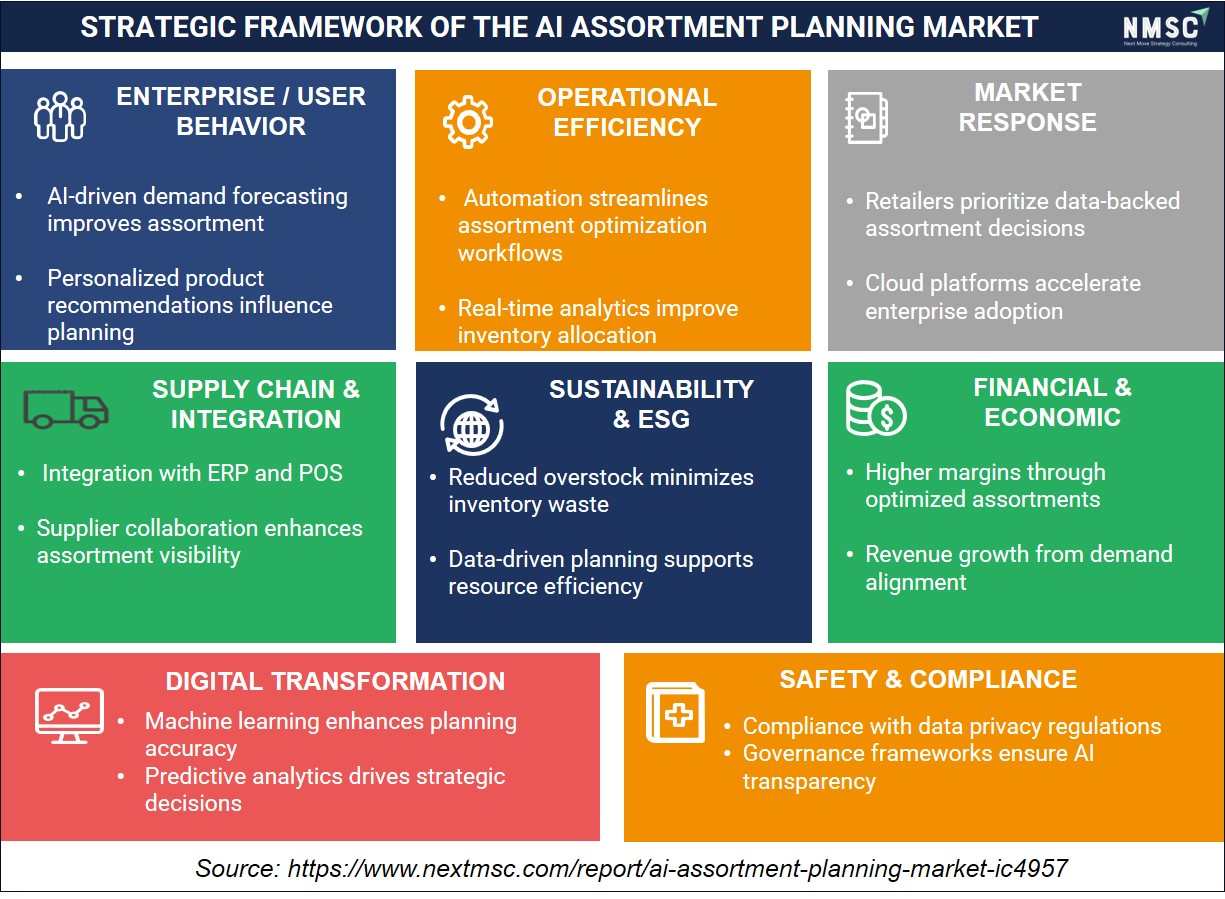
The above framework outlines key forces shaping the AI Assortment Planning Market across behaviour, operations, integration, sustainability, compliance, and financial outcomes. We observed that AI-driven demand forecasting and personalized recommendations are transforming assortment decisions, while automation and real-time analytics streamline planning and inventory allocation. Integration with ERP and POS systems enhances supplier collaboration, and reduced overstock supports ESG goals. Machine learning and predictive analytics drive accuracy, as retailers prioritize data-backed decisions and cloud adoption accelerates. Compliance with data privacy and AI governance frameworks ensures transparency, while optimized assortments deliver higher margins and revenue growth.
Competitive Landscape
Competitive Dynamics and M&A Landscape
|
Key Takeaways |
Details |
|
Market Structure |
The AI assortment planning market features a moderately fragmented competitive structure spanning established enterprise planning vendors including Blue Yonder, Oracle, SAP, and Manhattan Associates, AI native specialists including o9 Solutions, RELEX Solutions, Lokad, and Impact Analytics, and category management and analytics specialists including Dunnhumby, First Insight, and Centric Software. Competition centers on AI model accuracy, integration breadth, and vertical-specific specialization across fashion, grocery, and general merchandise retail segments. |
|
Innovation Focus |
Innovation within the AI assortment planning market centers on generative AI copilot integration, hyper-localized store-level optimization, explainable AI for regulatory compliance, and embedded AI capabilities distributed through partner platforms. Vendors are increasingly investing in natural language interfaces that allow non-technical merchandisers to interact directly with AI assortment recommendations without specialized data science support. |
|
M&A Activity |
M&A activity within the AI assortment planning market reflects continued consolidation as larger enterprise software vendors seek to acquire AI-native capabilities and specialized retail analytics expertise. SAP and Oracle have historically expanded retail planning capabilities through both internal development and complementary acquisitions, while AI native specialists are attracting strategic investor interest given their differentiated technology positioning relative to legacy enterprise planning incumbents. |
How Do Companies Compete in the AI Assortment Planning Market?
Competition in the AI assortment planning market operates across three primary dimensions. Established enterprise planning vendors compete on integration breadth, existing customer relationships, and comprehensive retail operations functionality beyond assortment planning alone. AI native specialists compete on model accuracy, deployment speed, and purpose-built architecture designed specifically for assortment optimization rather than retrofitted legacy logic. Category management and analytics specialists compete on deep vertical expertise, particularly within grocery and fashion retail, where nuanced demand patterns require specialized model training and domain-specific data assets.
Which Kind of Companies Dominate the AI Assortment Planning Market?
The AI assortment planning market is currently dominated by two company archetypes. First, large enterprise software incumbents including Oracle, SAP, and Blue Yonder leverage existing retail customer relationships and broad platform integration to retain dominant market share among large, complex retail organizations. Second, AI native specialists including o9 Solutions, RELEX Solutions, and SymphonyAI are capturing disproportionate new-customer growth through purpose-built generative AI architectures, positioning themselves as the preferred choice for retailers prioritizing rapid deployment and continuous model improvement over legacy vendor relationships.
AI-Native Differentiation and Open Standards Drive Market Success in the AI Assortment Planning Market
NMSC's analysis indicates that vendors achieving the strongest competitive positioning within the AI assortment planning market combine AI-native technical architecture with open integration standards that allow seamless connection to existing retail technology stacks. This dual approach allows vendors to differentiate on model performance while minimizing the integration friction that has historically slowed enterprise software adoption. Vendors that successfully balance proprietary AI differentiation with interoperability are demonstrating measurably faster customer acquisition relative to closed, single-vendor ecosystem competitors within the market.
Market Players to Opt for Merger and Acquisition Strategies to Expand Their Presence in the AI Assortment Planning Market
Our assessment indicates that M&A activity within the AI assortment planning market is expected to intensify through the forecast period as enterprise software incumbents seek to acquire AI-native technology capabilities and specialized retail analytics expertise. Larger vendors including Oracle, SAP, and Infor possess the balance sheet capacity to pursue strategic acquisitions of smaller AI-native specialists, while private equity-backed platforms may pursue roll-up strategies consolidating regional or vertical-specific assortment planning specialists to build broader, more comprehensive retail AI platform offerings.
Who Are the Key Market Players in the AI Assortment Planning Market?
-
RELEX Solutions
-
o9 Solutions
-
Blue Yonder
-
Oracle
-
SAP
-
SymphonyAI
-
Anaplan
-
Manhattan Associates
-
Infor
-
Centric Software
-
Impact Analytics
-
ToolsGroup
-
Logility
-
Aptos
-
Dunnhumby
-
First Insight
-
Lokad
-
SAS Institute
-
TIBCO Software
-
Vision Group Retail Technologies
What Are the Latest Developments in the AI Assortment Planning Industry?
|
Date |
Event |
|
March 2025 |
Oracle Retail was recognized as a Leader in the IDC MarketScape for AI-driven Retail Assortment Planning Solutions. The win matters because Oracle’s assortment planning plus Oracle AI Foundation gives retailers an integrated path from planning to replenishment, helping them build targeted assortments while tightening inventory investment |
Expert Insights

“Increasing customer demands for speed, personalization and convenience are driving the need for connected, data-driven supply chain solutions that deliver speed and precision while protecting a company’s bottom line.”
— Duncan Angove, CEO of Blue Yonder
Statement made during the announcement of Blue Yonder’s AI-driven innovations for unified planning and execution.
Market Interpretation
The comment highlights the increasing importance of AI-enabled, data-driven planning capabilities in retail operations as consumer expectations for personalization and convenience continue to rise. It indicates that retailers are increasingly adopting integrated AI platforms to improve assortment decisions, respond to demand volatility, optimize inventory and resources, and deliver more customer-centric merchandising strategies. Consequently, the adoption of AI assortment planning solutions is expected to accelerate across the retail sector.
What Are the Investment Opportunities in the AI Assortment Planning Market?
Capital Inflows and Venture Activity
The AI assortment planning market continues to attract venture and growth equity investment directed toward AI native specialist platforms. o9 Solutions has raised substantial growth capital to expand its AI-driven retail planning platform globally. RELEX Solutions has similarly attracted significant investment to scale its retail and supply chain planning capabilities. Our findings suggest that continued investor interest in enterprise AI software broadly is translating into sustained capital availability for AI assortment planning specialists demonstrating measurable retailer adoption and retention metrics.
Infrastructure Investment
Cloud infrastructure investment by major hyperscalers directly supports the scalability requirements of AI assortment planning platforms. Continued data center capacity expansion by leading cloud providers lowers the per-unit infrastructure cost of delivering AI-driven retail planning services at scale. The U.S. National Institute of Standards and Technology's cloud computing frameworks continue to inform enterprise infrastructure procurement standards, indirectly supporting the infrastructure foundation upon which AI assortment planning vendors build their cloud-native platforms.
ESG and Sustainability Considerations
Environmental and social governance considerations are increasingly relevant to AI assortment planning market investment decisions, as AI-driven assortment optimization can directly reduce inventory waste and associated environmental impact from unsold and liquidated merchandise. The U.S. Environmental Protection Agency's Sustainable Materials Management Program highlights the environmental cost of retail inventory waste, creating an indirect policy alignment between AI assortment planning adoption and broader corporate sustainability reporting objectives for retailers and brand manufacturers.
Digital Transformation Enablement
AI assortment planning platforms serve as a core component of broader retail digital transformation programs, positioning the market within durable, multi-year enterprise technology investment cycles. Retailers undertaking comprehensive supply chain and merchandising system modernisation consistently include AI-enabled assortment planning as a foundational capability. This integration with broader digital transformation initiatives creates structural investment demand that extends beyond standalone assortment planning procurement decisions into comprehensive enterprise retail technology modernisation budgets.
Private Equity and Strategic M&A Activity
Private equity and strategic corporate investment activity within the AI assortment planning market is expected to continue as larger enterprise software companies and financial sponsors seek exposure to high-growth retail AI capabilities. Established enterprise software vendors possess the balance sheet capacity to pursue strategic acquisitions of AI-native specialists, while private equity-backed consolidation of regional or vertical-specific assortment planning providers represents an additional avenue for capital deployment within this expanding market segment.
Key Benefits for Stakeholders
For Retailers
Retailers gain access to a comprehensive and vendor-neutral assessment of the AI Assortment Planning Market, including quantitative sizing across revenue stream, deployment mode, buyer type, and end user vertical segments. The analysis enables merchandising and category management teams to evaluate platform alternatives, prioritize implementation roadmaps, and allocate technology budgets more effectively. Regional and country-level forecasts further provide geographic context for omnichannel merchandising and retail modernisation initiatives.
For Brand and Consumer Goods Manufacturers
Brand owners and consumer goods manufacturers obtain competitive intelligence on how AI assortment planning adoption is transforming retailer category management and merchandising decisions. The analysis provides visibility into evolving retailer planning frameworks and assortment optimization practices, enabling manufacturers to refine product mix recommendations, strengthen category collaboration, and support more effective trade negotiations with retail partners.
For Investors and Financial Analysts
Investors and venture capital firms gain a structured and data-driven assessment of the AI Assortment Planning Market's growth outlook, competitive landscape, and segment-level opportunities through 2035. Detailed CAGR analysis across regions and segments enables informed portfolio allocation and valuation modelling. Coverage of AI-native vendors, service expansion trends, and Asia-Pacific growth dynamics provides an early indication of emerging investment opportunities within the market.
For AI Assortment Planning Vendors and Technology Providers
AI assortment planning vendors and technology providers receive actionable intelligence on competitive positioning and untapped growth opportunities across end-user industries and sales channels. The segmentation analysis highlights high-growth demand pockets, while regional and country-level market forecasts support go-to-market prioritization, product roadmap refinement, and expansion strategies across major geographic markets.
For Wholesale distributors
Wholesale distributors and supply chain partners gain insights into how increasing adoption of AI assortment planning among retailers and consumer goods companies is reshaping demand visibility and inventory management requirements. The analysis helps supply chain stakeholders align replenishment strategies, improve demand planning coordination, and strengthen inventory allocation capabilities across complex multi-retailer distribution networks.
For Government and Policy Makers
Government agencies and policy makers gain an evidence-based understanding of how evolving AI governance frameworks, including the EU AI Act and algorithmic accountability initiatives, are influencing vendor compliance requirements and retailer adoption patterns. Country-level insights provide policymakers with perspectives on how regulatory developments, digital transformation programs, and responsible AI practices are shaping the long-term evolution of the AI Assortment Planning Market.
Key Market Segments
By Revenue Stream
-
Software
-
Enterprise Planning Suite
-
AI Native Specialist
-
Retail Operations Suite
-
Category Management Suite
-
Other Software
-
-
Services
-
Implementation and Integration
-
Advisory and Managed Services
-
Other Services
-
By Deployment Mode
-
Cloud
-
Hybrid
-
On-Premise
-
Other Deployment Mode
By Buyer Type
-
Retailer
-
Brand or Manufacturer
-
Wholesale Distributor
-
Other Buyer Type
By End User Vertical
-
Fashion and Apparel
-
Grocery and Convenience
-
General Merchandise
-
Specialty Retail
-
Other Retail
By Sales Channel
-
Direct
-
Partner Led
-
Embedded or OEM
-
Other Sales Channel
By Region
-
North America: U.S., Canada, and Mexico.
-
Europe: UK, Germany, France, Italy, Spain, Sweden, Denmark, Finland, the Netherlands, and the rest of Europe.
-
Asia Pacific: China, India, Japan, South Korea, Taiwan, Indonesia, Vietnam, Australia, Philippines, Malaysia and the rest of APAC.
-
Middle East & Africa (MEA): Saudi Arabia, UAE, Egypt, Israel, Turkey, Nigeria, South Africa, and the rest of MEA.
-
Latin America: Brazil, Argentina, Chile, Colombia, and the rest of LATAM.
Conclusion and Recommendations
Long-Term Outlook for the AI Assortment Planning Market
The AI assortment planning market is positioned for sustained high-growth expansion through 2035, advancing from USD 5.48 billion in 2025 to USD 29.55 billion by 2035 at a CAGR of 18.39%. This trajectory reflects the structural convergence of generative AI maturation, cloud-native retail technology adoption, and persistent retailer pressure to reduce markdown and stockout losses. NMSC's long-term assessment indicates that AI native specialist platforms will continue gaining share relative to legacy enterprise planning suites as retailers prioritize deployment speed and continuous model accuracy improvement.
Strategic Positioning Recommendations
Vendors should prioritize generative AI copilot development and explainable AI features to satisfy both retailer adoption preferences and emerging regulatory transparency requirements under frameworks including the EU AI Act. Retailers evaluating AI assortment planning investments should prioritize platforms offering strong integration capabilities with existing retail operations and supply chain systems to minimize implementation complexity. Strategic positioning around vertical-specific model specialization, particularly within fashion and grocery retail, will likely yield superior competitive differentiation relative to horizontal, one-size-fits-all platform approaches.
Investment Attractiveness of the AI Assortment Planning Market
The AI assortment planning market presents a compelling investment thesis combining durable secular demand drivers with multiple high-growth sub-segment opportunities. NMSC's assessment identifies the highest-conviction investment themes as AI Native Specialist software growth at 22.56% CAGR, Services expansion at 21.85% CAGR, Asia-Pacific regional growth at 23.08% CAGR, and Brand or Manufacturer buyer type expansion at 21.78% CAGR. Vendors achieving demonstrated AI model accuracy improvements and strong customer retention metrics represent the highest-return investment opportunities within this expanding market.
Key Market Shifts Reshaping the AI Assortment Planning Market
The most significant market shift underway is the transition from periodic, seasonal assortment planning cycles toward continuous, AI-informed decision-making embedded within daily merchandising workflows. This shift is fundamentally altering the competitive basis for vendor differentiation, moving emphasis away from comprehensive feature breadth toward demonstrated AI model accuracy and decision velocity. A parallel shift toward embedded and OEM distribution is expanding the addressable buyer base beyond enterprise retailers with dedicated technology budgets to smaller retailers accessing AI capabilities through partner platforms.
Key Risks for the AI Assortment Planning Market
The primary risks facing the AI assortment planning market include legacy system integration complexity continuing to extend implementation timelines beyond retailer expectations, data governance limitations constraining AI model accuracy among retailers with fragmented historical data, and evolving AI regulatory requirements under frameworks including the EU AI Act potentially increasing compliance costs for vendors operating across multiple jurisdictions. Talent availability for AI implementation and model governance also represents a constraint on adoption pace, particularly among mid-market retailers lacking dedicated data science resources.
Growth Pathways for Stakeholders
Stakeholders maximizing value from the AI assortment planning market should pursue a phased approach. In the near term, retailers should prioritize cloud migration and data quality improvement initiatives that establish the foundation for effective AI model training. In the mid-term, organizations should invest in AI native specialist platforms or generative AI-enhanced enterprise suites to capture demonstrated forecast accuracy improvements. In the long term, retailers should pursue organizational restructuring around continuous decision cycles to fully realize the commercial value AI assortment planning platforms are designed to deliver.
Forecast Summary for the AI Assortment Planning Market
The AI assortment planning market is forecast to demonstrate consistent compound growth through 2035, underpinned by three structural drivers: generative AI technology maturation enabling more accurate and accessible assortment recommendations, cloud-native infrastructure adoption supporting scalable AI deployment, and persistent retailer financial pressure to reduce markdown and stockout losses. Our assessment confirms that organizations entering this market in 2025 through 2027 are positioned at an advantageous point between proven AI assortment planning value demonstration and continued vendor platform maturation through the remainder of the forecast period.
About the Author
 Mayurima Roy
— Mayurima Roy is Research Analyst at Next Move Strategy Consulting, where she has spent 4 years working across the firm's full industry coverage rather than a single fixed vertical. Her work centers on structured research, ongoing trend tracking, competitive assessment, and insight-led content development, translating complex market data into clear, decision-ready narratives that support informed client decision-making across diverse global industries, market sectors, and world regions every day.
Mayurima Roy
— Mayurima Roy is Research Analyst at Next Move Strategy Consulting, where she has spent 4 years working across the firm's full industry coverage rather than a single fixed vertical. Her work centers on structured research, ongoing trend tracking, competitive assessment, and insight-led content development, translating complex market data into clear, decision-ready narratives that support informed client decision-making across diverse global industries, market sectors, and world regions every day.
About the Reviewer
 Supradip Baul
— Supradip Baul is an accomplished business consultant and strategist with over a decade of rich experience in market intelligence, strategy, technology, and business transformation. His work has included rigorous qualitative and quantitative analysis across multiple industries, helping clients shape investment decisions and long-term roadmaps. Earlier in his career, he was associated with Gartner, where he contributed to industry-leading reports and market share analyses. He has worked with leading global companies and holds an MBA with a dual specialization in Marketing and Finance.
Supradip Baul
— Supradip Baul is an accomplished business consultant and strategist with over a decade of rich experience in market intelligence, strategy, technology, and business transformation. His work has included rigorous qualitative and quantitative analysis across multiple industries, helping clients shape investment decisions and long-term roadmaps. Earlier in his career, he was associated with Gartner, where he contributed to industry-leading reports and market share analyses. He has worked with leading global companies and holds an MBA with a dual specialization in Marketing and Finance.
At Next Move Strategy Consulting, we understand that insightful market research is the cornerstone of successful business decisions. That's why we employ a robust and multifaceted approach, combining various methodologies to deliver the most accurate and actionable data for our clients.

Research Landscape
We navigate the world of research with two primary approaches:
Qualitative Approach
Our qualitative research methodologies involve immersive techniques such as in-depth interviews, focus groups, and observational studies. By engaging directly with individuals and stakeholders, we uncover valuable insights that quantitative data alone may overlook.

Quantitative Research
In tandem with qualitative methodologies, NMSC leverages the power of Quantitative Research to provide a robust foundation of numerical insights. Through systematic data collection and analysis, we quantify patterns, preferences, and market trends, offering a comprehensive view of the business landscape.
Our quantitative research approach employs diverse tools, including surveys, experiments, and statistical modelling. These methodologies enable us to gather data from a large and representative sample, ensuring the statistical significance of our findings. By employing structured questionnaires and standardized data collection methods, we guarantee the reliability and validity of the information we present to our clients.
Quantitative research is particularly effective in measuring the prevalence of trends, assessing market size, and gauging the impact of various factors on consumer behavior. The numerical precision attained through this approach equips our clients with actionable insights, facilitating data-driven decision-making and strategy formulation.


Our Specialized Toolbox for Industry-Specific Market Research
We deploy a specialized arsenal of techniques tailored to meet your unique requirements. Here's a glimpse into our comprehensive toolbox:

Information Procurement
The stage entails acquiring market data or relevant information through various sources and methodologies.


Market Research Approach
We utilize both top-down and bottom-up approaches in market research analysis to achieve a comprehensive understanding of the market dynamics, leveraging the broad perspective of industry trends and macroeconomic factors alongside detailed insights from specific segments and individual companies.

Porters Five Forces Analysis
We conduct Porter's Five Forces analysis to evaluate the competitive landscape of an industry, providing us with insights into factors that affect profitability and strategic positioning.

SWOT Analysis

Forecasting
We utilize a forecasting model to predict future consumption by considering parameters like population, economics, regulations, market competition, drivers, constraints, technology, and pricing. We also employ statistical techniques such as multilinear regression, exponential smoothing, moving average, ARIMA, and Monte Carlo simulations for accurate predictions. In econometric forecasting, we analyzed short-term and long-term event impacts, attributing values based on regulatory frameworks, economic factors, and market events.





 Speak to Our Analyst