AI Contract Review Market Size, Share, Growth & Forecast by Contract Review Application (Clause Analysis: Extraction, Classification & Benchmarking; Risk Review: Identification, Scoring & Deviation Detection; Compliance Review: Regulatory, Policy & Playbook; Contract Comparison: and Others), Deployment Model (Cloud: Public & Private, Hybrid Cloud, On-Premises), Enterprise Size, Contract Type, Pricing Model, Delivery Channel, Industry Vertical, and End User — Global Analysis 2025–2035
Industry: ICT & Media | Publishing Date: July 7, 2026 | Last Updated: September 30, 2026 | No of Pages: N/A | No. of Tables: N/A | No. of Figures: N/A | Format: PDF | Report Code: IC4984
What Is the AI Contract Review Market Size?
The global AI Contract Review Market was valued at USD 2.8 billion in 2025 and is projected to reach USD 3.4 billion in 2026. Driven by enterprise demand for automated contract analysis, regulatory compliance pressures, and broad adoption of large language models across legal workflows, the market is forecast to expand to USD 22.4 billion by 2035, advancing at a CAGR of 23.2% from 2026 to 2035. Key growth drivers include the proliferation of AI-native legal technology platforms, rising volumes of commercial contracts across global supply chains, increasing pressure on legal departments to reduce outside counsel costs, and the rapid maturation of natural language processing capabilities enabling clause-level contract intelligence.
|
Parameters |
Details |
|
Market Size in 2025 |
USD 2.8 Billion |
|
Market Size in 2026 |
USD 3.4 Billion |
|
Revenue Forecast in 2035 |
USD 22.4 Billion |
|
Growth Rate |
CAGR of 23.2% from 2026 to 2035 |
|
Analysis Period |
2025–2035 |
|
Base Year Considered |
2025 |
|
Forecast Period |
2026–2035 |
|
Market Size Estimation |
Billion USD |
|
Companies Profiled |
20 |
|
Countries Covered |
33 |
|
Market Share |
Top 10 |
AI Contract Review Market Overview
What Is the AI Contract Review Market?
AI Contract Review refers to the application of artificial intelligence, including natural language processing, machine learning, and large language models, to automate the reading, analysis, classification, and evaluation of legal contracts. The AI Contract Review Market encompasses software platforms and services that assist legal professionals, procurement teams, compliance officers, and business departments in extracting critical data, identifying risks, flagging deviations, and accelerating the contract negotiation lifecycle. From our research, we found that this market spans the full contract review value chain, from clause extraction and risk scoring to generative summarization and obligation tracking.
How Has the AI Contract Review Market Evolved?
The AI Contract Review Market has progressed through distinct technological phases. Early-stage solutions relied on rule-based keyword matching and template comparison, limiting accuracy and adaptability across contract types. The second phase introduced transformer-based NLP models trained on legal corpora, enabling semantic understanding of clause intent and risk context. Based on research conducted by NMSC, we found that the current phase is defined by large language model integration, generative AI capabilities, and conversational contract review interfaces that allow non-legal stakeholders to interact with contracts in natural language, dramatically broadening the market's addressable user base.
How Do Regulations Influence the AI Contract Review Market?
Regulatory developments are reshaping the AI Contract Review Market across multiple dimensions. The EU AI Act, adopted in 2024, classifies certain AI-assisted legal decisions as high-risk applications, compelling vendors to implement transparency, audit trails, and explainability requirements within their platforms. The SEC's enhanced cybersecurity disclosure rules, GDPR data processing requirements, and the U.S. Federal Acquisition Regulation all generate demand for AI Contract Review capabilities that ensure regulatory compliance is embedded directly within contract workflows. Through our market assessment, we observed that regulatory complexity is simultaneously driving adoption and influencing product design priorities among leading vendors.
How Is Technology Adoption Expanding Across the AI Contract Review Market?
Technology adoption in the AI Contract Review Market is accelerating as enterprises integrate AI contract review tools within existing CLM platforms, ERP systems, and legal department workflows. Cloud-native deployment, API-first architectures, and pre-built integrations with DocuSign, Salesforce, SAP Ariba, and Microsoft 365 have reduced implementation barriers significantly. Our findings suggest that large enterprises in BFSI, healthcare, and technology verticals have moved from pilot deployments to enterprise-wide rollouts, while small and medium-sized law firms are increasingly accessing AI contract review capabilities through marketplace-based subscription offerings with low onboarding friction.
|
Key Takeaways |
|
By application, Clause Analysis held the largest share at USD 0.52 billion in 2025, driven by enterprise demand for clause extraction, clause classification, and clause benchmarking. Generative Contract Review is the fastest-growing application segment at a CAGR of 26.5% from 2026 to 2035, supported by rapid adoption of large language models for contract summarization, redlining, and risk identification. |
|
By deployment model, Public Cloud accounted for the largest market share at USD 0.98 billion in 2025, reflecting enterprise preference for scalable and centrally managed AI contract review platforms. On-Premises deployment is the fastest-growing deployment model at a CAGR of 27.5% from 2026 to 2035, driven by increasing data sovereignty, confidentiality, and regulatory compliance requirements among highly regulated industries. |
|
By enterprise size, Large Enterprises generated the highest revenue at USD 1.40 billion in 2025, supported by extensive contract volumes, complex legal workflows, and larger digital transformation budgets. Large Enterprises also represent the fastest-growing enterprise-size segment, expanding at a CAGR of 25.0% from 2026 to 2035, as multinational organizations accelerate adoption of AI-powered legal operations technologies. |
|
By contract type, Sales Contracts represented the largest segment at USD 0.34 billion in 2025, reflecting their widespread use across procurement, sales, and partnership functions. Mergers and Acquisitions (M&A) Agreements are the fastest-growing contract type at a CAGR of 27.7% from 2026 to 2035, driven by increasing transaction complexity and the need for accelerated due diligence processes. |
|
By pricing model, Subscription Licensing held the largest share at USD 1.12 billion in 2025, supported by the SaaS delivery model adopted by leading legal technology vendors. Enterprise Licensing is the fastest-growing pricing model at a CAGR of 26.8% from 2026 to 2035, as large organizations seek customized deployments, enhanced security controls, and enterprise-wide platform access. |
|
By delivery channel, Direct Sales generated the largest revenue at USD 1.12 billion in 2025, reflecting the consultative and enterprise-focused nature of AI contract review deployments. Marketplace Sales is the fastest-growing channel at a CAGR of 26.8% from 2026 to 2035, supported by increasing procurement through cloud marketplaces and digital software ecosystems. |
|
By end-user function, Corporate Legal Departments accounted for the largest market share at USD 0.98 billion in 2025, driven by growing demand for contract lifecycle management, risk assessment, and compliance monitoring. Other Business Functions represent the fastest-growing end-user segment at a CAGR of 24.3% from 2026 to 2035, reflecting expanding adoption across procurement, finance, and operational teams. |
|
By industry vertical, BFSI held the dominant position at USD 0.53 billion in 2025, supported by strict regulatory requirements, extensive contractual documentation, and increasing compliance obligations. Professional Services is the fastest-growing industry vertical at a CAGR of 24.6% from 2026 to 2035, driven by growing demand for automated contract review and legal workflow optimization. |
|
North America held the largest regional share in the AI Contract Review Market at USD 1.12 billion in 2025, projected to reach USD 8.60 billion by 2035 at a CAGR of 22.8%, supported by strong enterprise AI adoption, advanced legal technology infrastructure, and the presence of leading software providers. |
|
Asia-Pacific is the fastest-growing region in the AI Contract Review Market at a CAGR of 25.0% from 2026 to 2035, driven by rapid enterprise digitalization, increasing legal technology investments, expanding contract volumes, and growing adoption of AI-powered compliance solutions. |
|
The United States is the largest country market in the AI Contract Review Market, supported by substantial enterprise software spending, widespread legal technology adoption, and a mature corporate legal services ecosystem. |
|
India is the fastest-growing country market within Asia-Pacific in the AI Contract Review Market, driven by rapid digital transformation, increasing enterprise software adoption, growing legal process outsourcing activity, and expanding investment in AI-enabled business operations. |
Key Emerging Trends in the AI Contract Review Market
How Is Large Language Model Integration Transforming the AI Contract Review Market?
Large language model (LLM) integration is fundamentally redefining the AI Contract Review Market by enabling platforms to move beyond clause classification into generative interpretation, conversational review, and natural language processing about contract terms. Vendors including Ironclad and Robin AI have integrated GPT-class models to deliver review recommendations, generate redlines, and answer contract-specific queries in real time. NMSC's analysis indicates that LLM adoption is compressing review timelines from hours to minutes for standard commercial agreements, altering the competitive calculus for vendors reliant on rule-based or legacy NLP architectures.
How Is Agentic AI Reshaping Contract Workflow Automation in the AI Contract Review Market?
Agentic AI, in which autonomous software agents orchestrate multi-step contract review workflows without continuous human intervention, is emerging as the next frontier in the AI Contract Review Market. Through NMSC's assessment, we found that leading vendors are deploying AI agents capable of initiating third-party paper reviews, generating deviation summaries, escalating risk flags to appropriate stakeholders, and updating obligation trackers without manual trigger. This capability is particularly impactful for organizations managing high-volume supplier agreements and procurement contracts, where agent-driven review can reduce legal bottlenecks and accelerate procurement cycle times by more than 60%.
How Is Embedded Compliance Intelligence Driving AI Contract Review Market Adoption?
Regulatory compliance complexity is becoming a primary adoption driver as AI contract review platforms embed jurisdiction-specific regulatory libraries directly within their review engines. Our analysis shows that platforms such as LegalOn Technologies and ThoughtRiver have developed compliance modules that cross-reference contract terms against applicable regulatory frameworks including GDPR, HIPAA, FCA requirements, and FCPA provisions. This capability transforms AI contract review from a speed tool into a strategic risk management function, particularly valuable within BFSI, healthcare, and pharmaceutical verticals where non-compliance penalties carry existential financial consequences.
How Is Multilingual AI Capability Expanding the AI Contract Review Market Globally?
Multilingual AI contract review capability is unlocking new geographic markets and cross-border deployment use cases within the AI Contract Review Market. Based on our market evaluation, we noticed that enterprise procurement teams managing global supplier networks increasingly require contract review tools capable of analyzing agreements in Spanish, German, French, Mandarin, Japanese, and other languages without manual translation overhead. Vendors including Luminance and Icertis have expanded multilingual support across their AI review engines, enabling multinational corporations to standardize AI contract review practices across jurisdictions while preserving local language fidelity in compliance and risk assessment workflows.
Ecosystem Analysis of the AI Contract Review Market
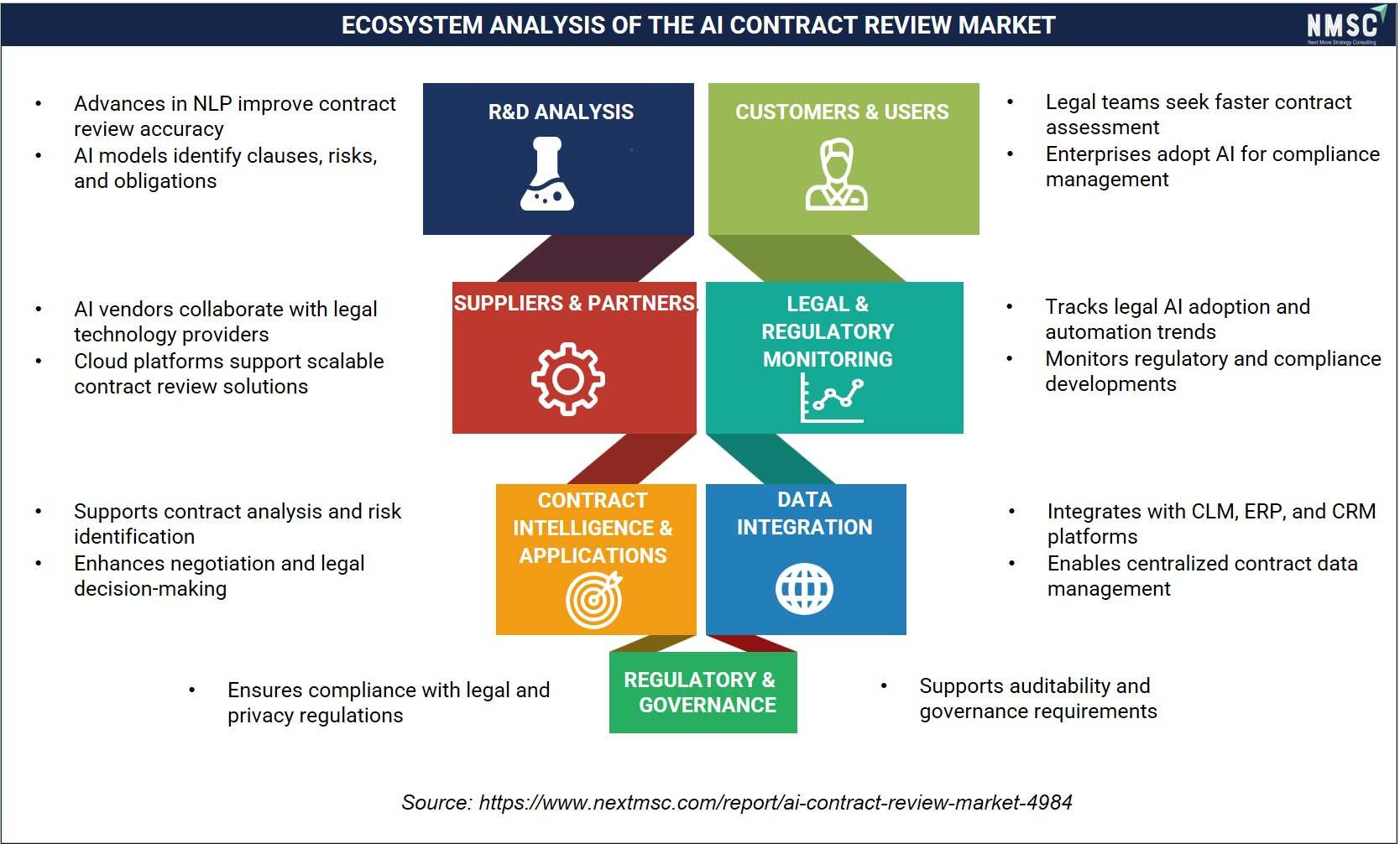
Based on our comprehensive assessment, we found that the AI Contract Review Market is supported by a collaborative ecosystem of AI technology developers, legal software vendors, enterprises, law firms, compliance specialists, and regulatory authorities. Advanced natural language processing, contract intelligence platforms, and data integration tools enhance document analysis and risk identification. Our analysis indicates that regulatory governance and continuous innovation drive market growth.
What Are the Key Market Drivers, Breakthroughs, and Investment Opportunities that Will Shape the AI Contract Review Market in the Next Decade?
|
Drivers / Trends / Restraints |
(+/-) % Impact on CAGR Forecast |
Geographic Relevance |
Impact Timeline |
|
Surging Enterprise Demand for Legal Cost Reduction |
+3.2% |
Global (led by North America, Europe) |
2025–2032 |
|
LLM and Generative AI Integration in Legal Platforms |
+2.8% |
North America, Europe, APAC |
2025–2030 |
|
Regulatory Compliance Complexity Driving Adoption |
+2.1% |
Europe, North America, MEA |
2026–2035 |
|
Expansion of M&A and Due Diligence Review Use Cases |
+1.8% |
Global |
2026–2035 |
|
Cloud-Native Deployment and SaaS Accessibility |
+1.6% |
Global |
2025–2030 |
|
Multilingual AI Capability Expansion |
+1.2% |
APAC, Europe, LATAM |
2027–2035 |
|
Data Privacy Concerns in Contract Handling |
-1.4% |
Europe, North America, APAC |
Ongoing |
|
Resistance from Legal Professionals to AI Adoption |
-0.9% |
All regions |
2025–2028 |
|
Integration Complexity with Legacy CLM Systems |
-0.7% |
North America, Europe |
2025–2028 |
|
Marketplace and Ecosystem Distribution Expansion |
+1.5% |
North America, Europe |
2026–2035 |
What Are the Growth Drivers of the AI Contract Review Market?
How Is Rising Enterprise Demand for Legal Cost Reduction Driving the AI Contract Review Market?
Corporate legal departments are under sustained pressure to reduce outside counsel expenditure while managing increasing contract volumes, making AI contract review a strategic cost reduction tool. Based on NMSC's research, we found that the American Bar Association reports that corporate legal budgets have faced consistent scrutiny as organizations demand more work performed in-house at lower per-unit cost. The U.S. Bureau of Labor Statistics indicates that legal services represent one of the highest-cost professional service categories, creating a strong financial incentive for enterprises to deploy AI contract review platforms that reduce manual review hours across high-volume contract categories including procurement, sales, and employment agreements.
How Is the Maturation of Large Language Models Fueling Growth in the AI Contract Review Market?
The rapid advancement of large language models trained specifically on legal corpora is enabling AI contract review platforms to achieve near-professional accuracy in clause extraction, risk flagging, and deviation detection. Our assessment indicates that government-funded research, including work supported by the U.S. National Science Foundation on natural language understanding in specialized domains, has contributed to foundational capabilities now commercialized by AI contract review vendors. The NIST AI Risk Management Framework's emphasis on reliable, explainable AI outputs is further driving enterprise confidence in deploying LLM-based contract review tools for regulated use cases within BFSI, healthcare, and government procurement sectors.
How Is Regulatory Compliance Complexity Creating Structural Demand in the AI Contract Review Market?
The expanding global regulatory compliance landscape is generating durable structural demand for AI Contract Review capabilities that embed jurisdiction-specific rules directly within contract analysis workflows. From our research, we found that the EU AI Act requires that high-risk AI applications used in legal contexts maintain documentation, human oversight mechanisms, and audit trail capabilities. The U.S. Federal Acquisition Regulation (FAR) mandates specific contract terms for federal contractors, creating demand for AI review platforms capable of systematically verifying compliance against regulatory clause libraries. These requirements are compelling both private sector and public sector organizations to invest in AI contract review as a compliance infrastructure component.
What Are the Growth Inhibitors of the AI Contract Review Market?
How Do Data Privacy and Confidentiality Concerns Constrain the AI Contract Review Market?
Enterprise contracts frequently contain trade secrets, commercially sensitive pricing terms, personally identifiable information, and attorney-client privileged content, creating significant data security barriers to cloud-based AI contract review adoption. Through our market assessment, we observed that the EU's GDPR and the U.S. attorney-client privilege framework impose strict constraints on how contract data may be processed, stored, and transmitted to third-party AI platforms. Industry organization guidelines from the International Bar Association on data protection and AI tool usage further complicate enterprise procurement decisions, extending sales cycles and compelling vendors to offer private cloud, on-premises, and data clean room deployment architectures to satisfy legal department security requirements.
How Does Legal Professional Resistance Limit AI Contract Review Market Penetration?
Adoption of AI contract review within law firms and corporate legal departments continues to face resistance from legal professionals who express concern about liability, professional responsibility compliance, and the accuracy of AI-generated risk assessments. Our analysis shows that the American Bar Association's guidance on AI use in legal practice emphasizes the duty of competence and supervision, requiring attorneys to understand and validate AI-generated outputs before relying on them in professional legal work. This supervisory requirement adds workflow steps that reduce perceived efficiency gains, particularly in smaller law firms with limited dedicated legal technology resources, slowing the full displacement of manual contract review processes.
What Are the Growth Opportunities in the AI Contract Review Market?
How Does the Expansion of M&A Activity Create a Major Growth Opportunity in the AI Contract Review Market?
Mergers and acquisitions generate exceptional demand for AI Contract Review capabilities through the due diligence review use case, where acquiring entities must analyze hundreds or thousands of target company contracts within compressed deal timelines. Based on our market evaluation, we noticed that the U.S. Securities and Exchange Commission's M&A disclosure requirements necessitate comprehensive review of material contracts as part of regulatory filings. The World Trade Organization's analysis of global cross-border M&A trends confirms sustained activity across technology, healthcare, and energy sectors, all of which generate large-scale contract review requirements that AI Contract Review platforms are uniquely positioned to fulfill at a fraction of traditional law firm due diligence costs.
How Is the Integration of AI Contract Review Within Enterprise Ecosystems Creating Opportunity?
The deepening integration of AI contract review capabilities within existing enterprise technology ecosystems, including ERP platforms, CRM systems, and procurement solutions, is creating a structural expansion opportunity as contract review becomes embedded in routine business workflows rather than isolated legal processes. Our findings suggest that Microsoft Azure's legal AI services, SAP Ariba's contract analytics modules, and Salesforce's contract intelligence features are embedding AI contract review capabilities within platforms used daily by millions of business users globally. This ecosystem integration dramatically expands the total addressable user base beyond traditional legal department buyers to include procurement, sales, finance, and compliance functions.
How Does the Emerging Market for Public Sector AI Contract Review Create Growth Potential?
Government and public sector organizations represent a significant untapped growth opportunity for the AI Contract Review Market, driven by the scale of government procurement activity and the regulatory mandate for transparent, auditable contract management. According to evaluation of U.S. General Services Administration data, the U.S. federal government manages hundreds of thousands of active contracts annually across defense, technology, and infrastructure procurement categories. The UK Government Commercial Function's Contract Management Standards and the European Commission's procurement framework both encourage digital contract management capabilities, creating structured pathways for AI contract review vendors to access public sector budgets through approved supplier frameworks and marketplace channels.
How Is the AI Contract Review Market Segmented in This Report, and What Are the Key Insights from the Segmentation Analysis?
By Contract Review Application
Which Contract Review Applications Are Generating the Strongest Market Demand?
|
Contract Review Application |
2025 (USD Bn) |
2035 (USD Bn) |
CAGR (%) |
|
Clause Analysis |
0.52 |
3.80 |
21.9% |
|
Risk Review |
0.48 |
3.58 |
22.4% |
|
Compliance Review |
0.41 |
3.22 |
22.8% |
|
Contract Comparison |
0.35 |
2.68 |
22.5% |
|
Contract Intelligence |
0.38 |
3.10 |
23.2% |
|
Due Diligence Review |
0.32 |
2.40 |
22.3% |
|
Generative Contract Review |
0.34 |
3.62 |
26.5% |
NMSC's analysis indicates that the AI Contract Review Market is segmented by application into Clause Analysis, Risk Review, Compliance Review, Contract Comparison, Contract Intelligence, Due Diligence Review, and Generative Contract Review. Clause Analysis remains the dominant application, encompassing clause extraction, clause classification, and clause benchmarking sub-functions that collectively form the foundational layer of AI-assisted contract review workflows. Risk Review, which includes risk identification, risk scoring, and deviation detection, is witnessing strong adoption as legal departments prioritize proactive risk quantification. Generative Contract Review is the fastest-growing application, advancing at a CAGR of 26.5%.
By Deployment Model
How Do Deployment Model Preferences Shape AI Contract Review Market Revenue Distribution?
|
Deployment Model |
2025 (USD Bn) |
2035 (USD Bn) |
CAGR (%) |
|
Cloud — Public Cloud |
0.98 |
6.90 |
21.4% |
|
Cloud — Private Cloud |
0.70 |
4.30 |
19.8% |
|
Hybrid Cloud |
0.56 |
4.80 |
23.8% |
|
On-Premises |
0.56 |
6.40 |
27.5% |
Based on our analysis of enterprise deployment preferences across legal technology environments, we observed that the AI Contract Review Market is segmented into Public Cloud, Private Cloud, Hybrid Cloud, and On-Premises deployment models. Public Cloud deployment commands the largest share due to its scalability, lower capital expenditure requirements, and rapid feature update cadence, particularly favored by technology companies, professional services firms, and SMB legal departments. Private Cloud is preferred by large regulated enterprises requiring enhanced data control and isolation. Hybrid Cloud is the fastest-growing model among adjacent while On-Premises deployments, as financial institutions and healthcare organizations seek cloud AI capabilities while maintaining local contract data residency. On-Premises deployment is recording the highest absolute CAGR, reflecting growing demand from government agencies and defense contractors with strict data sovereignty mandates.
By Enterprise Size
How Does Enterprise Size Influence Adoption Patterns in the AI Contract Review Market?
|
Enterprise Size |
2025 (USD Bn) |
2035 (USD Bn) |
CAGR (%) |
|
Small Enterprises |
0.56 |
3.40 |
19.8% |
|
Medium Enterprises |
0.84 |
5.80 |
21.2% |
|
Large Enterprises |
1.40 |
13.20 |
25.0% |
Through NMSC's assessment, we found that the AI Contract Review Market is segmented by enterprise size into Small Enterprises, Medium Enterprises, and Large Enterprises. Large Enterprises dominate the market due to their high annual contract volumes, complex multi-party agreements spanning multiple jurisdictions, availability of dedicated legal operations budgets, and organizational appetite for enterprise-wide AI deployments. Medium Enterprises are experiencing steady adoption growth as vendors offer configurable, mid-market pricing tiers that deliver measurable ROI without the integration complexity of full CLM platform implementations. Small Enterprises are expanding access to the market as affordable, plug-and-play AI contract review applications become available through cloud marketplaces with minimal onboarding requirements.
By Contract Type
Which Contract Types Are Generating the Most Revenue in the AI Contract Review Market?
|
Contract Type |
2025 (USD Bn) |
2035 (USD Bn) |
CAGR (%) |
|
Sales Contracts |
0.34 |
2.42 |
21.7% |
|
Procurement Contracts |
0.30 |
2.31 |
22.6% |
|
Supplier Agreements |
0.28 |
2.09 |
22.3% |
|
Non-Disclosure Agreements |
0.25 |
1.76 |
21.6% |
|
Employment Agreements |
0.22 |
1.65 |
22.3% |
|
Licensing Agreements |
0.26 |
1.98 |
22.5% |
|
Service Agreements |
0.28 |
2.09 |
22.3% |
|
Lease Agreements |
0.18 |
1.32 |
22.0% |
|
Financial Agreements |
0.24 |
1.87 |
22.8% |
|
M&A Agreements |
0.20 |
2.31 |
27.7% |
|
Other Contract Types |
0.25 |
2.60 |
26.4% |
Based on our market evaluation, we noticed that the AI Contract Review Market is segmented by contract type across Sales Contracts, Procurement Contracts, Supplier Agreements, Non-Disclosure Agreements, Employment Agreements, Licensing Agreements, Service Agreements, Lease Agreements, Financial Agreements, M&A Agreements, and Other Contract Types. Sales Contracts represent the dominant type by revenue volume due to their high transaction frequency within commercial organizations and the strong business incentive to accelerate deal cycle velocity through AI-assisted review. Procurement and Supplier Agreements generate significant volumes driven by global supply chain complexity. M&A Agreements is the fastest-growing contract type at a CAGR of 27.7%, reflecting the expanding use of AI contract review for due diligence portfolios in corporate transactions, where bulk analysis of hundreds of target company contracts within compressed timelines creates a compelling value proposition for AI Contract Review platforms.
By Pricing Model
How Do Pricing Models Reflect the Commercial Evolution of the AI Contract Review Market?
|
Pricing Model |
2025 (USD Bn) |
2035 (USD Bn) |
CAGR (%) |
|
Subscription Licensing |
1.12 |
7.80 |
21.4% |
|
Usage-Based Licensing |
0.56 |
5.60 |
25.9% |
|
Per-User Licensing |
0.70 |
4.50 |
20.4% |
|
Enterprise Licensing |
0.42 |
4.50 |
26.8% |
In our observation, the AI Contract Review Market is segmented by pricing model into Subscription Licensing, Usage-Based Licensing, Per-User Licensing, and Enterprise Licensing. Subscription Licensing dominates due to its alignment with enterprise legal department budget cycles, provision of continuous platform updates and model improvements, and predictable total cost of ownership. Per-User Licensing remains prevalent in law firm deployments where attorney headcount is the natural unit of commercial measure. Usage-Based Licensing is gaining adoption particularly among procurement departments with seasonal contract volume spikes. Enterprise Licensing is the fastest-growing model at 26.8% CAGR, as large organizations negotiate organization-wide agreements covering all business functions with unlimited user access and expanded API integration rights.
By Delivery Channel
How Are Delivery Channels Reshaping Go-to-Market Strategy in the AI Contract Review Market?
|
Delivery Channel |
2025 (USD Bn) |
2035 (USD Bn) |
CAGR (%) |
|
Direct Sales |
1.12 |
6.70 |
19.6% |
|
Partner Sales |
0.56 |
4.50 |
23.1% |
|
System Integrator Sales |
0.56 |
5.40 |
25.4% |
|
Marketplace Sales |
0.42 |
4.50 |
26.8% |
|
OEM Sales |
0.14 |
1.30 |
25.1% |
Our assessment indicates that the AI Contract Review Market is segmented by delivery channel into Direct Sales, Partner Sales, System Integrator Sales, Marketplace Sales, and OEM Sales. Direct Sales dominates due to the consultative, complex nature of AI contract review procurement within enterprise legal and procurement departments, where vendors invest in dedicated account management and proof-of-concept engagement processes. System Integrator Sales is expanding rapidly as Accenture, Deloitte, and boutique legal technology consultancies embed AI contract review platforms within broader legal operations transformation programs. Marketplace Sales is the fastest-growing channel at 26.8% CAGR, reflecting the growing availability of AI contract review applications on Microsoft AppSource, Salesforce AppExchange, and AWS Marketplace, enabling frictionless procurement aligned with existing enterprise cloud spend commitments.
By Industry Vertical
Which Industry Verticals Generate the Most Value in the AI Contract Review Market?
|
Industry Vertical |
2025 (USD Bn) |
2035 (USD Bn) |
CAGR (%) |
|
BFSI |
0.53 |
4.03 |
22.5% |
|
Healthcare and Life Sciences |
0.39 |
3.36 |
24.0% |
|
Technology and Telecommunications |
0.47 |
3.81 |
23.3% |
|
Manufacturing |
0.27 |
1.90 |
21.5% |
|
Retail and Consumer Goods |
0.20 |
1.46 |
22.0% |
|
Energy and Utilities |
0.20 |
1.68 |
23.7% |
|
Government and Public Sector |
0.16 |
1.34 |
23.7% |
|
Real Estate and Construction |
0.14 |
1.01 |
21.8% |
|
Transportation and Logistics |
0.13 |
1.01 |
22.8% |
|
Professional Services |
0.26 |
2.35 |
24.6% |
|
Other Industries |
0.05 |
0.45 |
24.6% |
Based on our analysis of industry-specific contract management requirements, we observed that the AI Contract Review Market is segmented across BFSI, Healthcare and Life Sciences, Technology and Telecommunications, Manufacturing, Retail and Consumer Goods, Energy and Utilities, Government and Public Sector, Real Estate and Construction, Transportation and Logistics, Professional Services, and Other Industries. BFSI is the dominant vertical generating USD 0.53 billion in 2025, driven by high volumes of lending agreements, derivatives contracts, vendor agreements, and regulatory compliance mandates from the SEC, FCA, and equivalent authorities. Technology and Telecommunications follows closely, benefiting from high software licensing and partnership agreement volumes. Healthcare and Life Sciences is recording above-average growth at 24.0% CAGR due to the complexity of clinical trial agreements, pharma licensing, and HIPAA-compliant vendor contracts. Professional Services is the fastest-growing vertical, reflecting adoption by consulting, accounting, and staffing firms managing extensive client service agreement portfolios.
By End User
Which End Users Are Driving Purchasing Decisions in the AI Contract Review Market?
|
End User |
2025 (USD Bn) |
2035 (USD Bn) |
CAGR (%) |
|
Corporate Legal Departments |
0.98 |
7.83 |
23.1% |
|
Law Firms |
0.84 |
6.63 |
22.9% |
|
Procurement Departments |
0.45 |
3.59 |
23.1% |
|
Sales Departments |
0.28 |
2.28 |
23.3% |
|
Compliance Departments |
0.20 |
1.63 |
23.3% |
|
Other Business Functions |
0.05 |
0.44 |
24.3% |
Through our market assessment, we observed that the AI Contract Review Market end user landscape is segmented into Corporate Legal Departments, Law Firms, Procurement Departments, Sales Departments, Compliance Departments, and Other Business Functions. Corporate Legal Departments represent the largest end user segment at USD 0.98 billion in 2025, encompassing both SMB legal teams and large enterprise legal departments, and benefit most from AI-assisted contract review by reducing outside counsel reliance and accelerating internal review processes. Law Firms, including small, mid-sized, and large firms, represent the second-largest segment, adopting AI contract review primarily for due diligence, third-party paper review, and client contract analysis services. Procurement and Sales Departments are growing end user categories as AI contract review tools are increasingly embedded within CLM and CRM workflows to enable business users to conduct first-pass contract assessments without routing every agreement through legal review queues.
Regional Outlook
Geographic Performance Snapshot
|
Region |
2025 (USD Bn) |
2035 (USD Bn) |
CAGR (%) |
Key Driver |
|
North America |
1.12 |
8.60 |
22.8% |
Hyperscaler integration, enterprise legal AI spend |
|
Europe |
0.70 |
5.20 |
22.1% |
GDPR, EU AI Act compliance, regulatory-driven adoption |
|
Asia Pacific |
0.56 |
5.20 |
25.0% |
Digital transformation, multilingual AI, M&A growth |
|
Middle East & Africa |
0.22 |
1.80 |
23.4% |
Vision 2030 initiatives, legal modernization programs |
|
Latin America |
0.20 |
1.60 |
23.1% |
Digital economy expansion, cross-border trade agreements |
North America AI Contract Review Market
North America is the global epicenter of the AI Contract Review Market, accounting for USD 1.12 billion in 2025 and forecast to reach USD 8.6 billion by 2035 at a CAGR of 22.8%. The region benefits from the highest density of AI contract review vendors, the world's most active M&A market, and large enterprise legal departments with established legal operations functions and technology budgets. Regulatory complexity driven by SEC disclosure requirements, state-level data privacy laws, and federal procurement mandates sustains demand across corporate legal, procurement, and compliance functions. Venture capital investment in legaltech across North America continues to fuel platform innovation and market expansion.
U.S. AI Contract Review Market
Based on our engagements with enterprise legal departments across the United States, we found that the U.S. is the world's single largest national market for AI Contract Review, representing approximately 85% of North American revenue in 2025. The U.S. benefits from the headquartering of most leading AI contract review vendors including Ironclad, Icertis, DocuSign, LinkSquares, and Spellbook, as well as the most active private equity and venture capital ecosystem funding legaltech innovation. The American Bar Association's guidance on AI adoption in legal practice, combined with SEC contract disclosure mandates for public companies, creates structured institutional demand for AI-assisted contract review capabilities across corporate legal, M&A, and regulatory compliance functions.
Canada AI Contract Review Market
Through our analysis, we found that Canada represents approximately 11% of North American AI Contract Review revenue. Canadian financial institutions, energy companies, and professional services firms are increasingly deploying AI contract review for complex supplier and regulatory compliance agreements. The Canadian federal government's Digital Ambition strategy and the Personal Information Protection and Electronic Documents Act (PIPEDA) create both demand and compliance structure for AI contract review adoption. Domestic legaltech activity is growing, with Toronto and Vancouver emerging as secondary innovation hubs for AI-enabled legal technology ventures serving the Canadian and U.S. markets.
Mexico AI Contract Review Market
From our assessment, Mexico is the fastest-growing market within North America in the AI Contract Review Market, advancing above 25% CAGR. Mexico's expanding manufacturing base, driven by nearshoring trends from Asia, generates high volumes of supplier agreements, procurement contracts, and employment agreements requiring systematic AI contract review. The Ley Federal de Protección de Datos Personales en Posesión de los Particulares creates compliance requirements influencing contract review platform selection. Growing adoption among Mexican conglomerates and multinational subsidiaries is driving demand for Spanish-language AI contract review capabilities with regulatory alignment to Mexican commercial law.
Europe AI Contract Review Market
Europe is the second-largest region in the AI Contract Review Market, contributing USD 0.70 billion in 2025 and forecast to reach USD 5.2 billion by 2035 at a CAGR of 22.1%. The EU AI Act's classification of certain AI legal applications as high-risk is compelling vendors to develop explainable, auditable AI contract review solutions compliant with European regulatory standards. GDPR's data processing constraints directly influence deployment model selection, with private cloud and on-premises options gaining traction among European enterprises. The EU's digital single market agenda and cross-border commercial expansion are generating demand for multilingual AI contract review capabilities across member states.
U.K. AI Contract Review Market
Based on our engagements with U.K. legal technology stakeholders, we found that the United Kingdom is Europe's largest individual country market for AI Contract Review, representing approximately 24% of European revenue in 2025. The U.K. benefits from a progressive regulatory environment through the Financial Conduct Authority's technology adoption framework, combined with post-Brexit regulatory flexibility that has attracted legaltech investment. The Law Society of England and Wales has published guidance on AI use in legal practice, enabling firms to adopt AI contract review with greater professional confidence. London's position as a global financial center sustains strong BFSI demand for AI-assisted contract review across derivatives, lending, and vendor agreements.
Germany AI Contract Review Market
According to evaluation of Germany's legal technology adoption landscape, Germany is the second-largest AI Contract Review market in Europe, driven by its position as the EU's largest economy and most complex industrial contracting environment. German automotive, chemical, and engineering manufacturers manage extensive supplier networks requiring systematic contract review. The German Federal Ministry of Justice's digital justice program and Germany's engagement in the EU AI Act implementation create a structured regulatory environment for AI contract review adoption. German enterprises prioritize data sovereignty, making private cloud and on-premises AI contract review deployments disproportionately represented compared to the European average.
France AI Contract Review Market
Through our analysis, we found that France is the third-largest AI Contract Review market in Europe, supported by its strong legal services sector and the French government's AI strategy, France 2030. The Commission Nationale de l'Informatique et des Libertés (CNIL) exercises active GDPR enforcement, compelling French enterprises to select AI contract review platforms with robust data protection architectures. French civil law contracting conventions differ from common law systems, creating demand for civil law-specific AI contract review models. Paris's growing legaltech ecosystem and the involvement of Legifrance's statutory frameworks in enterprise contract compliance are sustaining AI contract review adoption across corporate and government sectors.
Italy AI Contract Review Market
From our assessment, Italy's AI Contract Review Market is growing steadily, driven by the legal needs of Italy's extensive SME manufacturing sector and the complexity of Italian civil code contracting requirements. The Italian Data Protection Authority (Garante) enforces strict GDPR compliance standards influencing AI platform procurement decisions. Italy's participation in the EU AI Act and the National Recovery and Resilience Plan (PNRR) digital transition programs are creating public sector momentum for AI contract review adoption across government procurement and public works contract management functions.
Spain AI Contract Review Market
Based on our market evaluation, Spain's AI Contract Review Market is expanding through adoption within financial services, telecommunications, and construction sectors. The Spanish Data Protection Agency (AEPD) operates one of Europe's most active regulatory enforcement programs, driving enterprise demand for GDPR-compliant contract data handling within AI review platforms. Spain's increasing inbound foreign direct investment and cross-border trade within the EU single market are generating demand for multilingual AI contract review covering Spanish, Catalan, and English-language commercial agreements. The government's Spain Digital Agenda 2025 initiatives support digital transformation across legal functions.
Sweden AI Contract Review Market
Through our analysis, Sweden's AI Contract Review Market benefits from one of Europe's highest digital technology adoption rates and a mature legal technology awareness among corporate counsel. Swedish multinationals in manufacturing, financial services, and life sciences maintain complex international contract portfolios requiring systematic AI-assisted review. The Swedish Authority for Privacy Protection enforces GDPR standards that influence platform architecture choices. Sweden's innovation ecosystem supports domestic legaltech startups and has attracted investment from Nordic venture capital funds targeting AI legal technology applications.
Denmark AI Contract Review Market
According to evaluation of Denmark's legal technology environment, Denmark has one of the highest rates of digital government service adoption in Europe, creating a supportive public sector context for AI contract review adoption in government procurement. Denmark's financial services and pharmaceutical sectors are primary drivers of private sector AI contract review demand. The Danish Data Protection Agency maintains active enforcement of GDPR principles. Denmark's progressive approach to AI governance under the National AI Strategy supports responsible AI contract review adoption within both private enterprises and public institutions.
Finland AI Contract Review Market
From our assessment, Finland's AI Contract Review Market is driven by the country's strong technology sector, forest industry, and cleantech enterprises with complex international supplier and licensing agreements. The Finnish Data Protection Ombudsman's enforcement actions have heightened enterprise awareness of contract data handling obligations, influencing cloud versus on-premises deployment preferences. Finland's AI Strategy, published by the Ministry of Economic Affairs and Employment, positions the country as a responsible AI adoption leader in Northern Europe, creating favorable institutional conditions for AI contract review integration in corporate legal operations.
Netherlands AI Contract Review Market
Based on our engagements with legal technology stakeholders in the Netherlands, we found that the country's position as a major European trade hub and the headquarters location of numerous multinational corporations sustains strong AI Contract Review demand. Rotterdam's role as Europe's largest port creates extensive logistics and trade contract review requirements. The Dutch Data Protection Authority (Autoriteit Persoonsgegevens) actively enforces GDPR, and the Netherlands' sophisticated legal market, home to major international law firms, is among Europe's most receptive to AI contract review technology adoption for high-volume commercial contract workflows.
Rest of Europe AI Contract Review Market
Through our market assessment, we observed that the Rest of Europe cluster, including markets such as Poland, Switzerland, Belgium, Austria, and the Nordic countries, represents a growing segment of the AI Contract Review Market. Switzerland's financial sector and pharmaceutical industry generate significant demand for AI contract review in areas including banking agreements, licensing contracts, and clinical trial documentation. Poland's growing outsourcing sector and emerging legaltech ecosystem are creating early-stage but structurally promising AI contract review adoption. Collectively, Rest of Europe markets are advancing at CAGRs aligned with the broader European average, with growth potential concentrated in financial services, manufacturing, and technology sectors.
Asia Pacific AI Contract Review Market
Asia Pacific is the fastest-growing region in the AI Contract Review Market, advancing at a CAGR of 25.0% from 2026 to 2035, from USD 0.56 billion in 2025 to USD 5.2 billion by 2035. The region's growth is propelled by the rapid digital transformation of legal departments across China, India, Japan, and South Korea, the expansion of cross-border trade agreements generating new contract volumes, and increasing multinational enterprise presence driving demand for multilingual AI contract review. Government AI strategies across Australia, Singapore, and India are creating favorable policy environments for enterprise AI adoption in legal and compliance functions.
China AI Contract Review Market
Based on our engagements with enterprises operating in China, we found that the China AI Contract Review Market is expanding rapidly, supported by the country's large and growing commercial contracting environment. China's Cybersecurity Law, Data Security Law, and Personal Information Protection Law impose strict data localization and security requirements that influence AI contract review deployment architecture, with on-premises and domestic private cloud deployments preferred by regulated entities. State-owned enterprises and large private conglomerates are primary adopters of AI contract review for procurement and supplier agreement management. Domestic AI vendors are developing Chinese-language legal AI models, creating a competitive local ecosystem alongside international platforms.
India AI Contract Review Market
Through our analysis, we found that India is the fastest-growing national market in Asia Pacific for AI Contract Review, advancing at an estimated CAGR exceeding 27% from 2026 to 2035. The Digital India initiative, the Information Technology Act, and the Digital Personal Data Protection Act 2023 are creating a structured digital governance environment supporting AI contract review adoption. India's expanding technology and business process outsourcing sector generates vast volumes of service agreements, vendor contracts, and software licensing agreements requiring systematic review. The presence of domestic legaltech startups including SpotDraft provides India-specific AI contract review capabilities aligned with Indian contract law requirements.
Japan AI Contract Review Market
According to evaluation of Japan's legal technology landscape, Japan is one of Asia Pacific's largest AI Contract Review markets by revenue, driven by the country's extensive corporate sector with complex cross-border trade and licensing agreements. The Ministry of Economy, Trade and Industry (METI) has published AI governance guidelines that support responsible AI adoption in business applications including contract review. Japan's 2024 revision of the Unfair Competition Prevention Act and ongoing corporate governance reforms are generating demand for systematic contract compliance review. Japanese enterprises are adopting AI contract review with particular emphasis on Japanese-language capabilities and integration with domestic ERP and CLM platforms.
South Korea AI Contract Review Market
From our assessment, South Korea's AI Contract Review Market is growing steadily, supported by the country's highly digitalized corporate sector and its position as a global technology manufacturing hub. South Korea's Personal Information Protection Act (PIPA) and the National AI Strategy create both compliance requirements and adoption incentives for AI contract review tools. Chaebols and their extensive supplier networks represent primary enterprise buyers of AI contract review capabilities. South Korea's active fintech and technology sectors generate high volumes of licensing and service agreements, while the country's large law firms are among Asia Pacific's early adopters of AI-powered legal technology.
Taiwan AI Contract Review Market
Based on our market evaluation, Taiwan's AI Contract Review Market is driven by its globally significant semiconductor and electronics manufacturing sector, which maintains complex supplier, licensing, and IP agreements with global partners. Taiwan's Personal Data Protection Act and the Industrial Development Agency's digital transformation initiatives support AI adoption in legal and procurement functions. The high concentration of technology company headquarters in Taiwan, including major semiconductor manufacturers, creates institutional demand for AI Contract Review capabilities managing cross-border technology licensing and supply chain agreements at scale.
Indonesia AI Contract Review Market
Through our analysis, we observed that Indonesia's AI Contract Review Market is an early-stage but high-potential growth opportunity, driven by the country's position as Southeast Asia's largest economy with rapidly expanding digital commerce activity. Indonesia's Government Regulation No. 71 on Electronic Systems and Transactions and the Personal Data Protection Law create regulatory structures influencing AI platform adoption. Growing numbers of multinational enterprises establishing regional headquarters in Jakarta are generating demand for AI contract review across procurement and employment agreement categories. The country's digital economy targets support legaltech investment as part of broader digital transformation programs.
Vietnam AI Contract Review Market
According to evaluation of Vietnam's legal technology adoption environment, Vietnam represents an emerging market within the Asia Pacific AI Contract Review landscape, driven by the country's manufacturing sector growth fueled by supply chain diversification from China. Vietnam's Cybersecurity Law and the Law on Protection of Consumer Rights create compliance frameworks influencing contract management practices. International manufacturing firms establishing operations in Vietnam increasingly require AI contract review capabilities in Vietnamese and English to manage supplier agreements. The government's National Digital Transformation Program supports broader enterprise technology adoption including AI-powered contract management solutions.
Australia AI Contract Review Market
Based on our engagements with Australian legal technology stakeholders, we found that Australia is one of Asia Pacific's most mature AI Contract Review markets, benefiting from a sophisticated legal services sector, strong corporate governance standards, and a progressive digital economy policy environment. The Australian Privacy Act 1988 and Privacy Amendment provisions create regulatory demand for contract data handling transparency. The Australian government's AI Ethics Framework encourages responsible AI adoption across public and private sectors. Law firms in Sydney and Melbourne are among the region's earliest adopters of AI contract review technology, driving adoption across law firm, corporate legal, and government procurement end user segments.
Philippines AI Contract Review Market
From our assessment, the Philippines AI Contract Review Market is gaining momentum, supported by the country's extensive business process outsourcing sector and growing corporate sector with complex service agreements. The Data Privacy Act of 2012, administered by the National Privacy Commission, creates compliance obligations that influence AI contract review platform selection. Philippines-headquartered BPO companies managing client contracts on behalf of global enterprises represent a growing end user segment for AI contract review capabilities. Government efforts under the Philippine Digital Economy Roadmap support enterprise technology modernization programs including contract management digitalization.
Malaysia AI Contract Review Market
Through our market assessment, we observed that Malaysia's AI Contract Review Market benefits from the country's strategic position as a regional business hub and the Malaysian government's AI adoption agenda under the National AI Roadmap (MyAI). Malaysia's Personal Data Protection Act 2010 creates contract compliance considerations for data processing agreements. The financial services sector, petrochemical industry, and palm oil industry generate significant volumes of commercial contracts requiring systematic review. Malaysia's Digital Free Trade Zone and Multimedia Super Corridor initiatives attract multinational enterprises whose contract management requirements stimulate demand for AI contract review capabilities.
Rest of Asia Pacific AI Contract Review Market
According to evaluation of the broader Asia Pacific region, markets including Singapore, Thailand, New Zealand, and Pakistan collectively represent a growing cluster of AI Contract Review adoption. Singapore is particularly significant, serving as the regional headquarters for numerous multinationals and maintaining a progressive AI governance environment through the Infocomm Media Development Authority's AI governance framework. Singapore's PDPA and its position as a major arbitration and contract law jurisdiction create structured institutional demand for AI contract review capabilities. Thailand and New Zealand are emerging adoption markets with growth concentrated in technology, manufacturing, and financial services sectors.
Middle East & Africa AI Contract Review Market
The Middle East & Africa region accounts for USD 0.22 billion in 2025 and is forecast to reach USD 1.8 billion by 2035 at a CAGR of 23.4% in the AI Contract Review Market. Vision 2030 in Saudi Arabia, similar national diversification programs in the UAE and Egypt, and Africa's expanding digital economy are creating new demand for AI-assisted contract management. Large government-sponsored infrastructure projects, energy sector agreements, and financial services contracts are primary drivers of AI contract review adoption in the region. Legal system modernization programs across Gulf Cooperation Council (GCC) states are enabling digital transformation of contract management workflows.
Saudi Arabia AI Contract Review Market
Based on our engagements with enterprises in Saudi Arabia, we found that the country represents the largest AI Contract Review market in the MEA region, driven by Vision 2030's economic diversification agenda and the unprecedented scale of infrastructure, energy, and technology investment projects. The Saudi Data and AI Authority (SDAIA) has published responsible AI principles and personal data protection frameworks that directly influence AI contract review platform procurement. The National Data Management Office's regulations on data classification and storage create architecture requirements for AI contract review deployments. Saudi Aramco and its extensive supplier network represent a major potential buyer of enterprise-grade AI contract review capabilities.
UAE AI Contract Review Market
Through our analysis, we found that the UAE is the second-largest AI Contract Review market in MEA and one of the world's most progressive AI adoption environments. The UAE National AI Strategy 2031 and the AI Office established under the Ministry of State for Artificial Intelligence set national targets for AI integration across business and government functions. The Dubai International Financial Centre's (DIFC) digital law framework and the Abu Dhabi Global Market's fintech-forward regulatory environment create institutional demand for AI contract review in financial services. The UAE's role as a regional trade and investment hub generates high cross-border contract volumes requiring AI-assisted multilingual review capabilities.
Egypt AI Contract Review Market
From our assessment, Egypt's AI Contract Review Market is at an early but expanding stage, driven by the country's significant legal services sector, expanding fintech ecosystem, and government modernization programs under Egypt's Vision 2030 National Development Strategy. The Egyptian Data Protection Law and emerging AI governance frameworks are creating regulatory structures that will influence enterprise AI adoption. Egypt's growing number of multinational corporate subsidiaries and its active outsourcing sector generate demand for AI-assisted contract analysis, particularly for employment and service agreements in Arabic and English.
Israel AI Contract Review Market
Based on our market evaluation, we noticed that Israel is one of the MEA region's most technically advanced AI Contract Review markets, reflecting the country's deep AI research and development ecosystem and its high density of technology startups and multinational R&D centers. The Privacy Protection Authority's data governance regulations and Israel's Standards Institution's cybersecurity frameworks influence platform procurement. Israeli technology companies engaged in global licensing, partnership, and M&A transactions generate high-value demand for AI contract review capabilities. Israel's AI research institutions contribute to foundational NLP and legal AI technology that supports contract review innovation globally.
Turkey AI Contract Review Market
Through our analysis, we observed that Turkey's AI Contract Review Market is growing within the context of the country's large manufacturing and financial services sectors. The Turkish Personal Data Protection Law (KVKK) aligns with GDPR principles and influences AI contract review platform deployment decisions. Turkey's position as a gateway between European and Asian markets generates cross-border contract volumes. The Information and Communication Technologies Authority (BTK) supports digitalization of business processes, creating a supportive policy environment for AI contract review adoption within Turkish corporate legal and procurement departments.
Nigeria AI Contract Review Market
According to evaluation of Nigeria's legal technology landscape, Nigeria represents the largest AI Contract Review market opportunity in Sub-Saharan Africa, driven by the country's extensive oil and gas sector, growing fintech ecosystem, and the largest economy on the African continent. The Nigeria Data Protection Act 2023 creates compliance requirements that will influence AI contract review platform adoption. Nigerian banks, telecommunications companies, and energy sector enterprises manage extensive commercial contract portfolios. The Lagos-based legaltech ecosystem is emerging as a center for AI-enabled contract management innovation addressing African market requirements.
South Africa AI Contract Review Market
From our assessment, South Africa is the most mature AI Contract Review market in Sub-Saharan Africa, reflecting the country's developed legal system, large corporate sector, and established legal technology awareness. The Protection of Personal Information Act (POPIA) creates GDPR-comparable data protection obligations influencing AI contract review platform architecture. South African financial services firms, mining companies, and professional services organizations represent primary end users. The Johannesburg Bar Council and Law Society of South Africa are engaged in AI governance discussions, providing institutional context for responsible AI contract review adoption within the country's legal profession.
Rest of MEA AI Contract Review Market
Based on our engagements in the broader MEA region, we found that markets including Kuwait, Qatar, Bahrain, Oman, Kenya, and Ghana represent emerging adoption opportunities for AI Contract Review. GCC markets beyond Saudi Arabia and the UAE are benefiting from national AI strategies and digital government programs. Qatar's World Cup legacy investment program generated significant contract management requirements. Kenya's expanding fintech and agriculture technology sectors are creating new commercial contract management needs. The African Union's Digital Transformation Strategy for Africa provides a continental framework supporting AI adoption across legal and commercial functions.
Latin America AI Contract Review Market
Latin America accounts for USD 0.20 billion in 2025 in the AI Contract Review Market and is forecast to reach USD 1.6 billion by 2035, advancing at a CAGR of 23.1%. The region's growth is driven by digital transformation of legal departments, expansion of cross-border trade agreements, and increasing foreign direct investment generating new contract management requirements. Brazil, Argentina, Chile, and Colombia are the primary markets, each with distinct regulatory frameworks and commercial contracting environments. Spanish and Portuguese-language AI contract review capabilities are critical for regional market penetration.
Brazil AI Contract Review Market
Based on our engagements with Brazilian enterprises and legal technology stakeholders, we found that Brazil is the largest AI Contract Review market in Latin America, accounting for approximately 45% of regional revenue in 2025. Brazil's Lei Geral de Proteção de Dados (LGPD), modeled on GDPR, creates data protection compliance requirements directly influencing AI contract review platform selection. The country's extensive financial services sector, agricultural commodity trading operations, and growing technology industry generate high volumes of commercial contracts in Portuguese requiring AI-assisted review. Brazil's active M&A market and expanding startup ecosystem are driving legaltech adoption among both domestic enterprises and multinational operations.
Argentina AI Contract Review Market
Through our analysis, we observed that Argentina's AI Contract Review Market is evolving within the context of the country's significant legal services sector and active fintech ecosystem. Argentina's Personal Data Protection Law and Ministry of Justice digital transformation programs influence AI adoption. Argentine law firms and corporate legal departments are beginning to explore AI contract review tools for supplier agreement management and employment contract review. The country's complex economic environment creates particular demand for AI contract review in financial agreements, debt instruments, and cross-border trade contracts where accuracy and risk identification carry elevated commercial importance.
Chile AI Contract Review Market
According to evaluation of Chile's technology and legal landscape, Chile is one of the most digitally advanced AI Contract Review adoption environments in Latin America. The Personal Data Protection Bill and Chile's Digital Transformation Strategy 2022–2027 create a structured framework for AI adoption in commercial and legal functions. Chile's mining sector, financial services industry, and active capital markets generate complex contract portfolios. The country's progressive trade agreement network, including the Comprehensive and Progressive Agreement for Trans-Pacific Partnership (CPTPP), generates cross-jurisdictional contract review requirements particularly suited to AI contract review capabilities.
Colombia AI Contract Review Market
From our assessment, Colombia's AI Contract Review Market is expanding through adoption in financial services, energy, and technology sectors. Colombia's Statutory Law 1581 on Personal Data Protection and Decree 1074 of 2015 create compliance structures influencing AI platform procurement. Colombia's oil and gas sector manages extensive concession, supplier, and environmental compliance agreements requiring systematic review. The Colombian Ministry of Justice's digital justice programs and the National Policy for Digital Transformation are supporting broader AI adoption within legal and compliance functions, creating institutional demand for AI contract review capabilities aligned with Colombian commercial law.
Rest of Latin America AI Contract Review Market
Based on our market evaluation, we noticed that the Rest of Latin America cluster, including Peru, Mexico beyond North America classification, Ecuador, and Uruguay, represents growing AI Contract Review adoption opportunities. Peru's mining and financial services sectors generate significant commercial contract management needs. Uruguay's advanced digital government infrastructure and free trade zone activity make it an early adopter within the sub-region. The Pacific Alliance trade bloc, encompassing Mexico, Colombia, Peru, and Chile, is generating cross-border commercial contract volumes that create structural demand for multilingual AI contract review capabilities covering Spanish, Portuguese, and English agreements.
Pain Point Analysis of the AI Contract Review Market
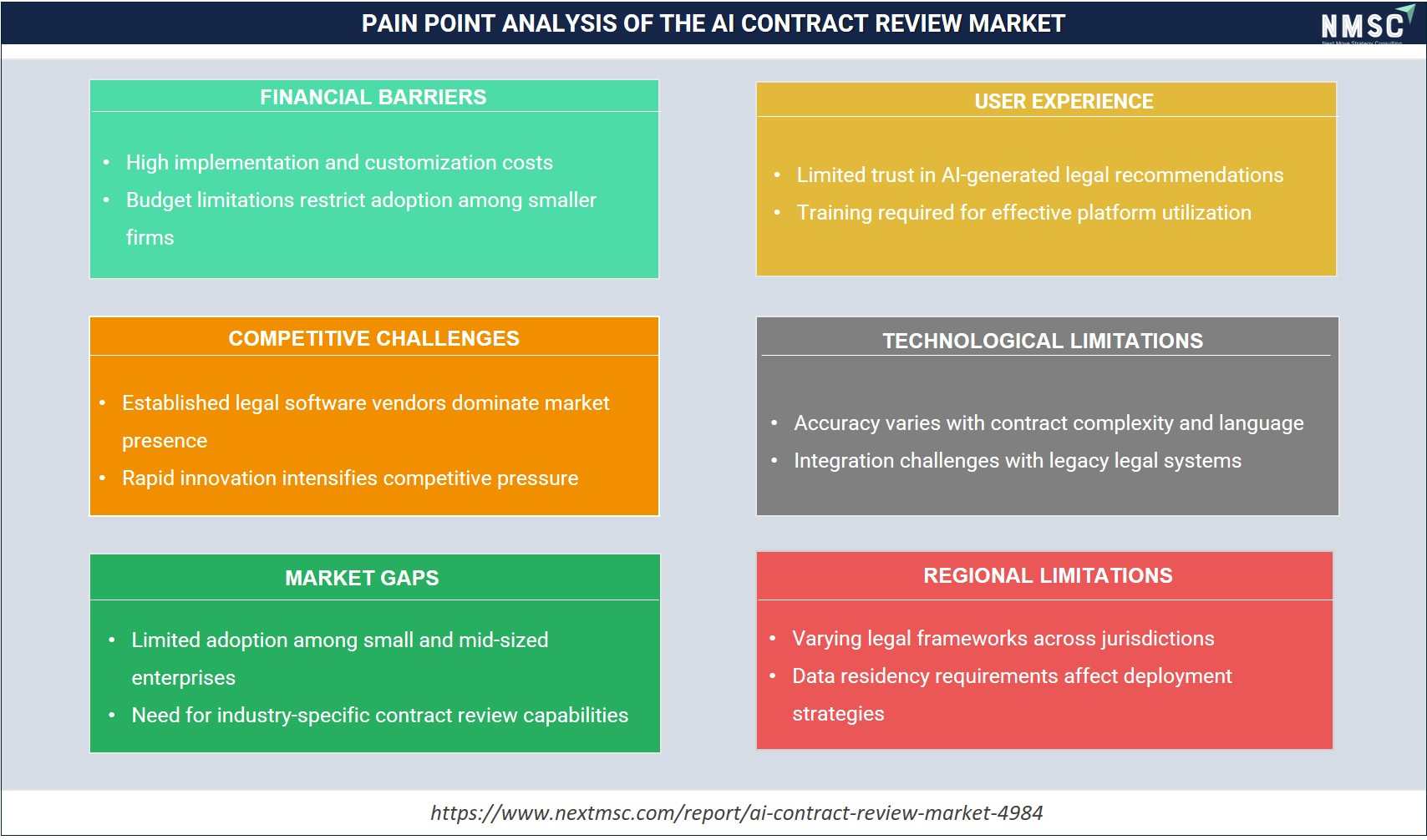
Based on our comprehensive assessment, we found that the AI Contract Review Market faces challenges related to implementation costs, user trust, and technology limitations. Small and mid-sized organizations often encounter budget constraints, while legal professionals require confidence in AI-generated recommendations. Our analysis indicates that contract complexity, integration with legacy systems, regulatory differences, and industry-specific requirements continue to influence adoption rates globally.
Competitive Landscape
Competitive Dynamics and M&A Landscape
|
Key Takeaways |
Details |
|
Market Structure |
The AI Contract Review industry is moderately fragmented, characterized by a mix of AI-native specialist vendors such as Ironclad, LegalOn Technologies, Robin AI, and SpotDraft competing with broader CLM platform providers including Icertis, DocuSign, Conga, and Agiloft. No single vendor holds dominant market share, though Icertis and DocuSign lead by enterprise contract volume managed. |
|
Innovation Focus |
Innovation across the AI Contract Review Market is concentrated in LLM-powered generative review capabilities, conversational contract interfaces, multilingual AI model development, and deep integration with enterprise ERP and CRM platforms. Vendors advancing explainable AI, audit trail capabilities, and compliance module libraries aligned with jurisdiction-specific regulatory frameworks are gaining competitive differentiation. |
|
M&A Activity |
M&A activity in the AI Contract Review Market is accelerating as CLM platform vendors acquire AI-native contract review capabilities to close technology gaps. Strategic acquisitions, private equity roll-up strategies, and technology licensing partnerships are reshaping the competitive map. Vendors with proprietary legal NLP training datasets and established enterprise contract repositories represent attractive acquisition targets. |
How Do Companies Compete in the AI Contract Review Market?
Competition in the AI Contract Review Market is multidimensional, spanning AI model accuracy, platform integrations, pricing model flexibility, deployment architecture options, and domain-specific compliance module breadth. Our assessment indicates that the market structure is moderately fragmented with intensifying consolidation pressure as enterprise buyers rationalize point solutions in favor of integrated AI contract review platforms embedded within CLM suites. Competitive strategies include platform ecosystems building, legal corpus proprietary data moats, and geographic expansion into multilingual markets. AI-native vendors compete on model performance benchmarks, while incumbent CLM providers leverage existing customer relationships and integration footprints.
Which Kind of Companies Dominate the AI Contract Review Market?
The AI Contract Review Market is dominated by two distinct company archetypes. AI-native legal technology specialists, including Ironclad, LegalOn Technologies, Robin AI, and SpotDraft, compete on model accuracy, user experience, and specialized legal domain expertise. Established CLM platform vendors including Icertis, DocuSign, Conga, Sirion, and Agiloft leverage broad enterprise deployments and integration ecosystems to embed AI contract review capabilities within comprehensive contract lifecycle management solutions. NMSC's analysis indicates that the competitive balance is shifting toward AI-native vendors as LLM performance improvements reduce the advantage of legacy rule-based review engines.
AI-Native Differentiation and Open Standards Drive Market Success in the AI Contract Review Market
Differentiation in the AI Contract Review Market increasingly rests on three strategic pillars: proprietary legal AI model performance, enterprise integration ecosystem depth, and compliance module breadth aligned with multi-jurisdictional regulatory requirements. Vendors building on open standards and pre-built connectors for Salesforce, SAP, Microsoft 365, and ServiceNow are capturing enterprise deals at higher velocity. Our findings suggest that platforms demonstrating measurable risk identification accuracy, model explainability, and attorney-validated review quality are earning enterprise-wide deployment mandates that displace multiple point solutions in legal, procurement, and compliance departments simultaneously.
Market Players to Opt for Merger and Acquisition Strategies to Expand Their Presence in the AI Contract Review Market
Merger and acquisition activity is reshaping the competitive landscape of the AI Contract Review Market. Established CLM vendors are acquiring AI-native contract review specialists to accelerate LLM integration and close capability gaps. Private equity investors are pursuing platform consolidation strategies targeting mid-market AI contract review vendors with established enterprise customer bases. The acquisition of legal AI capabilities by ERP vendors including SAP and Oracle signals that AI contract review is transitioning from specialty software to core enterprise platform functionality. Our analysis indicates that consolidation will intensify through 2028 as the market rationalizes from over 50 active vendors toward a smaller set of full-capability AI contract review platforms.
Who Are the Key Market Players in the AI Contract Review Market?
-
Icertis, Inc.
-
Ironclad, Inc.
-
DocuSign, Inc.
-
Conga Corporation
-
Sirion Pte. Ltd.
-
LegalOn Technologies, Inc.
-
Agiloft, Inc.
-
Luminance Technologies Ltd.
-
Leah Technologies Ltd.
-
SpotDraft, Inc.
-
Juro Online Limited
-
Counsel AI Corporation
-
Litera Corporation
-
Robin AI Ltd.
-
LinkSquares, Inc.
-
Spellbook Legal Inc.
-
LexCheck, Inc.
-
ThoughtRiver Limited
-
Ivo AI Ltd.
-
Legartis AG
What Are the Latest Developments in the AI Contract Review Industry?
|
Date |
Event |
Source URL |
|
March 2026 |
DocuSign launched the AI Contract Review Assistant within its Intelligent Agreement Management (IAM) platform. Powered by the "Iris" AI engine, the assistant allows users to query contracts using natural language, automatically generate redlines based on internal playbooks, and convert static PDFs to editable documents within a single interface. |
Expert Insights
 “Legal teams today are facing pressure to do more, while working faster with smaller teams. AI is helping lawyers focus on strategic work, drive value for their business, and model best practices for how the technology can be used by company leadership and other departments.”
— Jasmine Singh, General Counsel, Ironclad
Statement made during the release of Ironclad’s 2026 State of AI in Legal Report, which examined how legal professionals are leveraging AI to improve efficiency, accelerate contract-related workflows, and enhance strategic contributions within organizations.
Market Interpretation
The comment highlights the growing adoption of AI-powered contract review solutions as legal departments seek to manage increasing workloads with limited resources. AI technologies are enabling legal professionals to automate contract analysis, identify risks, extract key clauses, accelerate review cycles, and improve compliance management. By reducing the time spent on repetitive contract-related tasks, AI allows legal teams to focus on higher-value strategic activities and business decision-making. As organizations increasingly prioritize operational efficiency, risk mitigation, and faster contract turnaround times, demand for AI-driven contract review platforms and intelligent contract lifecycle management solutions is expected to expand significantly across industries.
What Are the Investment Opportunities in the AI Contract Review Market?
Capital Inflows and Venture Activity
The AI Contract Review Market is attracting significant venture capital and growth equity investment, reflecting investor confidence in the market's durable structural drivers. Our findings suggest that the National Venture Capital Association (NVCA) reports that legal AI and contract technology represent one of the most actively funded enterprise software subsegments in 2024 and 2025. AI-native contract review vendors including Ironclad, Robin AI, LegalOn Technologies, and SpotDraft have secured successive funding rounds. Institutional investors are particularly drawn to vendors demonstrating measurable enterprise ROI, strong net revenue retention, and the capacity to expand from legal department buyers into procurement, compliance, and sales department end users.
Infrastructure Investments
Infrastructure investment in AI contract review is concentrated in three areas: proprietary legal AI model training infrastructure, enterprise integration middleware, and contract data repository development. From our research, we found that Microsoft's investment in Azure Legal AI services and Amazon Web Services' expansion of AI legal tooling through AWS Marketplace directly enable AI contract review vendor growth by reducing underlying model training and deployment costs. The U.S. General Services Administration's FedRAMP certification pathway is attracting AI contract review vendor investment in government-grade security infrastructure, unlocking access to the large federal contracting market.
ESG and Sustainable Corporate Governance
Environmental, Social, and Governance (ESG) considerations are becoming a structural investment driver for the AI Contract Review Market. The SEC's climate risk disclosure rules require public companies to review supplier and vendor contracts for climate-related obligations and risk clauses, creating new AI contract review use cases in ESG contract analysis. European Commission sustainability reporting requirements under the Corporate Sustainability Reporting Directive (CSRD) are compelling enterprises to systematically extract and monitor ESG-related contract obligations. Our assessment indicates that AI contract review vendors developing ESG compliance modules aligned with CSRD, the Task Force on Climate-related Financial Disclosures (TCFD), and equivalent frameworks will capture premium positioning in enterprise procurement evaluations.
Digital Transformation Enablement
AI contract review platforms serve as critical digital transformation enablers for corporate legal departments undergoing modernization from paper-based and email-centric workflows to structured, data-driven contract management environments. NMSC's analysis indicates that the NIST Cybersecurity Framework and the EU's Digital Decade policy objectives both emphasize contract and procurement digitalization as foundational elements of enterprise resilience. Organizations implementing enterprise resource planning system upgrades, shared services center transformations, and legal operations function builds are systematically procuring AI contract review as part of multi-year technology investment programs, creating durable, multi-year revenue streams for established vendors.
Private Equity and Strategic M&A Activity
Private equity firms are actively deploying capital in the AI Contract Review Market through both platform company builds and bolt-on acquisition strategies. Vista Equity Partners, Thoma Bravo, and Francisco Partners have historically targeted enterprise legal technology companies with strong recurring revenue characteristics. Our analysis indicates that the current investment cycle is focusing on mid-market AI contract review vendors with enterprise customer bases of 50 to 500 deployments, providing platform companies for subsequent consolidation. Strategic acquirers including Salesforce, SAP, and Oracle are monitoring AI contract review vendors with strong CLM ecosystem integration as near-term M&A targets, reflecting the strategic value of contract intelligence within enterprise application suites.
Key Benefits for Stakeholders
For Enterprise Buyers
Enterprise buyers gain comprehensive, vendor-neutral intelligence on the AI Contract Review Market trends, including quantitative sizing across all contract review application types, deployment models, enterprise size segments, and industry verticals. This intelligence supports technology investment prioritization, vendor evaluation, and make-versus-buy analysis for AI contract review capabilities within legal operations, procurement, and compliance transformation programs. NMSC's competitive landscape analysis enables legal technology and procurement teams to benchmark vendor capabilities, pricing models, and integration architectures against enterprise requirements with analytical rigor.
For Investors and Financial Analysts
Investors and financial analysts access a structured, data-driven assessment of the AI Contract Review Market's growth trajectory, competitive dynamics, M&A pipeline, and segment-level revenue forecasts through 2035. The CAGR analysis by segment, region, and end user type enables precise portfolio construction and valuation modeling for legaltech investments. Detailed coverage of all 20 profiled vendors, combined with latest development tracking, provides an early-signal framework for identifying acquisition targets, emerging leaders, and at-risk incumbents within the global AI contract review landscape through the forecast period.
For AI Contract Review Vendors and Platform Providers
AI Contract Review vendors and platform providers gain actionable competitive intelligence on white-space opportunities, fastest-growing subsegments, and geographic expansion priorities within the AI Contract Review Market. Segmentation analysis by pricing model, delivery channel, and end user function enables vendors to refine go-to-market strategies and optimize channel mix between direct enterprise sales, system integrator partnerships, and cloud marketplace distribution. Regional outlook analysis provides compliance and deployment architecture guidance critical for vendors pursuing international market expansion in Europe, Asia Pacific, and MEA geographies with distinct regulatory requirements.
For Government and Regulatory Bodies
Government agencies and regulatory bodies gain structured analysis of how AI governance frameworks, including the EU AI Act, U.S. AI Executive Orders, and national data protection laws, are shaping the AI Contract Review Market's competitive dynamics and vendor product design priorities. Country-level insights provide policymakers with evidence-based perspectives on how regulatory clarity and digital transformation programs influence enterprise technology adoption rates. The public sector analysis directly informs policy development around AI adoption standards for government procurement contract management and legal department modernization programs.
AI Contract Review Market Key Segments
By Contract Review Application
-
Clause Analysis
-
Clause Extraction
-
Clause Classification
-
Clause Benchmarking
-
-
Risk Review
-
Risk Identification
-
Risk Scoring
-
Deviation Detection
-
-
Compliance Review
-
Regulatory Compliance Review
-
Policy Compliance Review
-
Playbook Compliance Review
-
-
Contract Comparison
-
Version Comparison
-
Third-Party Paper Review
-
Automated Redlining
-
-
Contract Intelligence
-
Obligation Extraction
-
Metadata Extraction
-
Contract Summarization
-
-
Due Diligence Review
-
M&A Review
-
Portfolio Review
-
Bulk Contract Analysis
-
-
Generative Contract Review
-
Conversational Review
-
Contract Question Answering
-
Review Recommendations
-
By Deployment Model
-
Cloud
-
Public Cloud
-
Private Cloud
-
Hybrid Cloud
-
On-Premises
By Enterprise Size
-
Small Enterprises
-
Medium Enterprises
-
Large Enterprises
By Contract Type
-
Sales Contracts
-
Procurement Contracts
-
Supplier Agreements
-
Non-Disclosure Agreements
-
Employment Agreements
-
Licensing Agreements
-
Service Agreements
-
Lease Agreements
-
Financial Agreements
-
M&A Agreements
-
Other Contract Types
By Pricing Model
-
Subscription Licensing
-
Usage-Based Licensing
-
Per-User Licensing
-
Enterprise Licensing
By Delivery Channel
-
Direct Sales
-
Partner Sales
-
System Integrator Sales
-
Marketplace Sales
-
OEM Sales
By Industry Vertical
-
BFSI
-
Healthcare and Life Sciences
-
Technology and Telecommunications
-
Manufacturing
-
Retail and Consumer Goods
-
Energy and Utilities
-
Government and Public Sector
-
Real Estate and Construction
-
Transportation and Logistics
-
Professional Services
-
Other Industries
By End User
-
Corporate Legal Departments
-
SMB Legal Teams
-
Large Enterprise Legal Teams
-
-
Law Firms
-
Small Law Firms
-
Mid-Sized Law Firms
-
Large Law Firms
-
-
Procurement Departments
-
Sales Departments
-
Compliance Departments
-
Other Business Functions
By Region
-
North America: U.S., Canada, and Mexico.
-
Europe: UK, Germany, France, Italy, Spain, Sweden, Denmark, Finland, the Netherlands, and the rest of Europe.
-
Asia Pacific: China, India, Japan, South Korea, Taiwan, Indonesia, Vietnam, Australia, Philippines, Malaysia and the rest of APAC.
-
Middle East & Africa (MEA): Saudi Arabia, UAE, Egypt, Israel, Turkey, Nigeria, South Africa, and the rest of MEA.
-
Latin America: Brazil, Argentina, Chile, Colombia, and the rest of LATAM.
Conclusion and Recommendations
Long-Term Outlook
The AI Contract Review Market is entering its most consequential decade, transitioning from a specialist legal technology application to a foundational enterprise intelligence infrastructure. The market is forecast to grow from USD 3.4 billion in 2026 to USD 22.4 billion by 2035, at a CAGR of 23.2%. Our analysis further indicates that this growth reflects both the broadening of the addressable end user base from legal departments to procurement, sales, and compliance functions and the increasing strategic importance of contract intelligence as a source of competitive advantage in managing supplier, customer, and regulatory relationships at scale.
Strategic Positioning Recommendations
AI contract review vendors should prioritize generative AI capability development, embedding conversational contract review and AI-generated recommendation functions that extend platform value beyond legal professionals to non-technical business users. Multilingual AI model investment is critical for vendors pursuing European, Asia Pacific, and Latin American geographic expansion. Enterprise integration depth, particularly with Salesforce, SAP Ariba, and Microsoft 365, remains the primary decision criterion for enterprise buyers evaluating competing platforms, making ecosystem partnership strategy a core competitive differentiator in the AI Contract Review Market through 2035.
Investment Attractiveness
The AI Contract Review Market represents a highly attractive investment environment, characterized by strong recurring revenue characteristics, expanding end user addressable market, and structural regulatory tailwinds sustaining durable multi-year demand. Our assessment identifies the highest-conviction investment themes as Generative Contract Review at 26.5% CAGR, Enterprise Licensing at 26.8% CAGR, M&A Agreement review at 27.7% CAGR, and Marketplace Sales channel at 26.8% CAGR. Private equity investors should monitor mid-market AI contract review vendors with established enterprise customer bases and proprietary legal corpus training data as primary consolidation targets.
Market Shifts and Key Risks
The most significant market shift underway is the migration from standalone AI contract review point solutions toward fully integrated AI contract review capabilities embedded within CLM, ERP, and CRM platforms. This shift is compressing margins for specialist vendors while expanding the market's total addressable customer base. Key risks for the AI Contract Review Market include regulatory escalation under the EU AI Act constraining AI legal application deployment, attorney liability frameworks slowing law firm adoption, data security incidents eroding enterprise confidence in cloud-based contract data processing, and open-source legal AI model development reducing vendor differentiation opportunities.
Growth Pathways
Organizations seeking to maximize value from the AI Contract Review Market should pursue a three-horizon strategy. In the near term from 2025 to 2027, enterprises should prioritize high-ROI use cases including sales contract review acceleration, NDA automation, and third-party paper review standardization to establish measurable business cases for broader investment. In the mid-term from 2027 to 2031, organizations should invest in enterprise-wide AI contract review standardization, CLM integration, and obligation tracking automation to create contract intelligence as a managed organizational capability. In the long term from 2031 to 2035, strategic positioning should focus on generative AI contract management, agentic contract workflows, and contract data monetization programs.
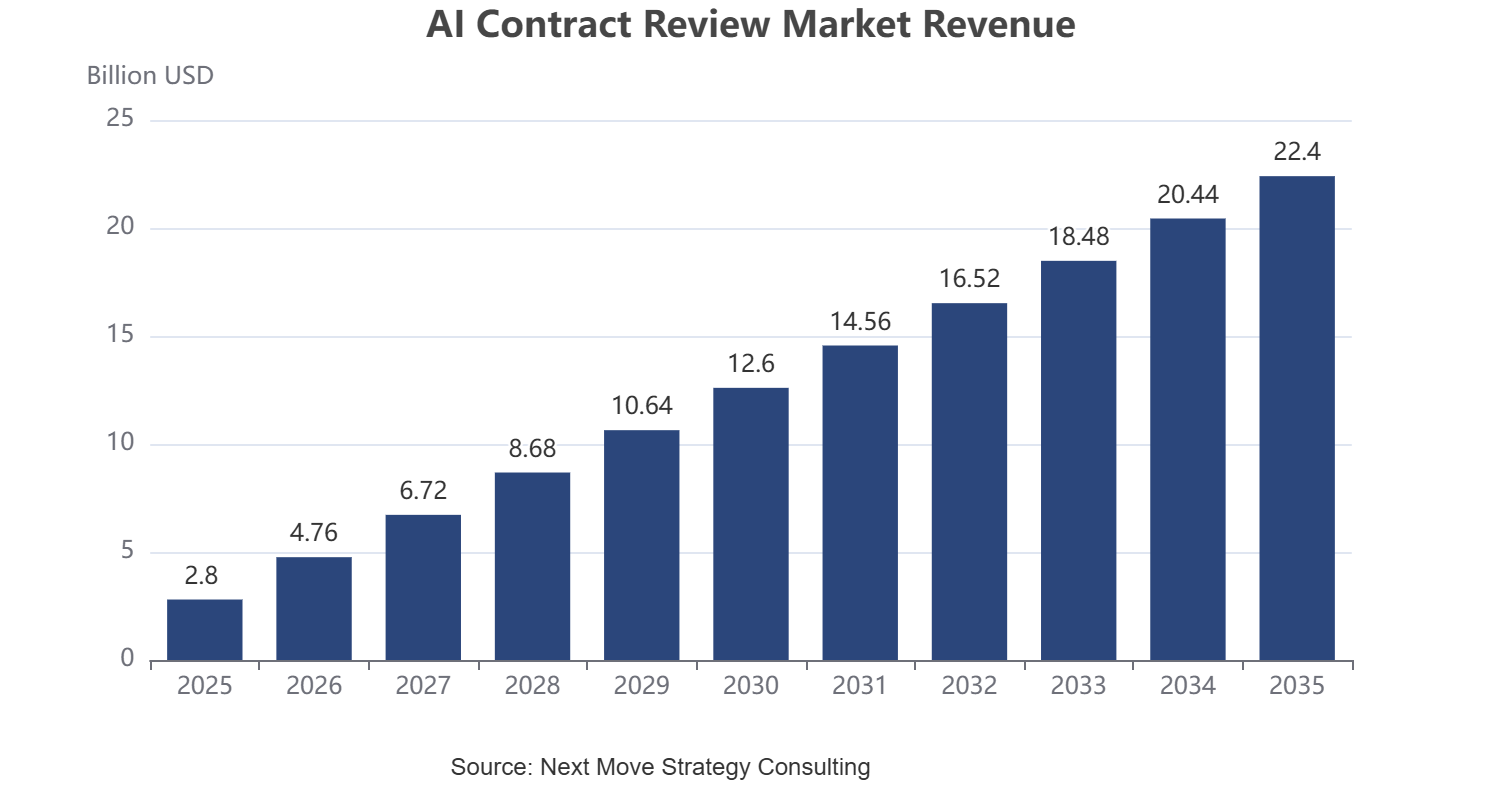
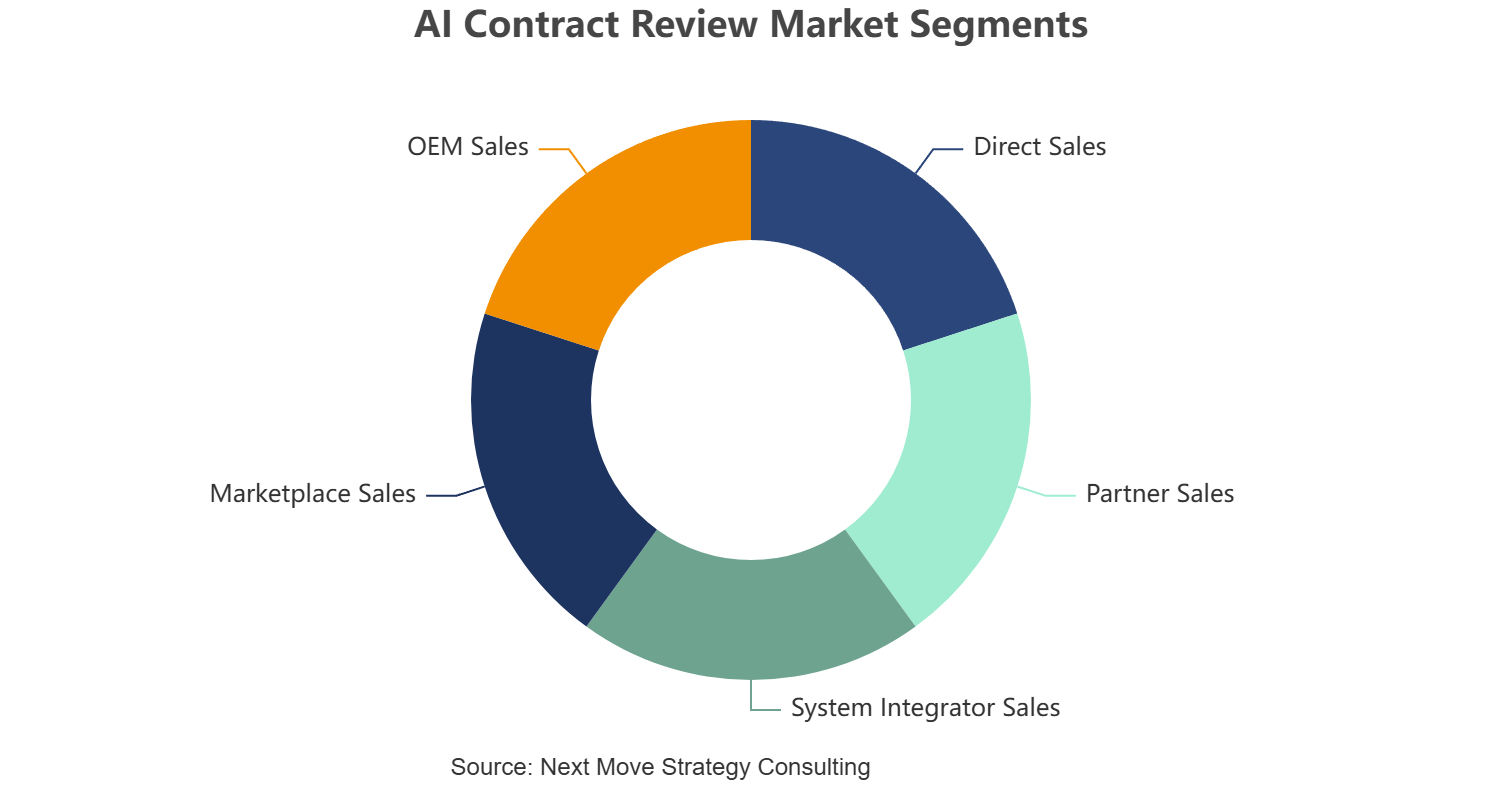
About the Author
 Saista Faiyaz
— Saista Faiyaz is Research Associate at Next Move Strategy Consulting, where she has covered consumer markets and healthcare technologies for 3 years. Her work includes primary interview review, secondary-source validation, market sizing, and structured analysis of company and industry data. She supports research by comparing evidence across sources, organizing findings into market narratives, and documenting assumptions used in analysis. Her scope includes cross-market benchmarking, and reports.
Saista Faiyaz
— Saista Faiyaz is Research Associate at Next Move Strategy Consulting, where she has covered consumer markets and healthcare technologies for 3 years. Her work includes primary interview review, secondary-source validation, market sizing, and structured analysis of company and industry data. She supports research by comparing evidence across sources, organizing findings into market narratives, and documenting assumptions used in analysis. Her scope includes cross-market benchmarking, and reports.
About the Reviewer
 Supradip Baul
— Supradip Baul is an accomplished business consultant and strategist with over a decade of rich experience in market intelligence, strategy, technology, and business transformation. His work has included rigorous qualitative and quantitative analysis across multiple industries, helping clients shape investment decisions and long-term roadmaps. Earlier in his career, he was associated with Gartner, where he contributed to industry-leading reports and market share analyses. He has worked with leading global companies and holds an MBA with a dual specialization in Marketing and Finance.
Supradip Baul
— Supradip Baul is an accomplished business consultant and strategist with over a decade of rich experience in market intelligence, strategy, technology, and business transformation. His work has included rigorous qualitative and quantitative analysis across multiple industries, helping clients shape investment decisions and long-term roadmaps. Earlier in his career, he was associated with Gartner, where he contributed to industry-leading reports and market share analyses. He has worked with leading global companies and holds an MBA with a dual specialization in Marketing and Finance.
At Next Move Strategy Consulting, we understand that insightful market research is the cornerstone of successful business decisions. That's why we employ a robust and multifaceted approach, combining various methodologies to deliver the most accurate and actionable data for our clients.

Research Landscape
We navigate the world of research with two primary approaches:
Qualitative Approach
Our qualitative research methodologies involve immersive techniques such as in-depth interviews, focus groups, and observational studies. By engaging directly with individuals and stakeholders, we uncover valuable insights that quantitative data alone may overlook.

Quantitative Research
In tandem with qualitative methodologies, NMSC leverages the power of Quantitative Research to provide a robust foundation of numerical insights. Through systematic data collection and analysis, we quantify patterns, preferences, and market trends, offering a comprehensive view of the business landscape.
Our quantitative research approach employs diverse tools, including surveys, experiments, and statistical modelling. These methodologies enable us to gather data from a large and representative sample, ensuring the statistical significance of our findings. By employing structured questionnaires and standardized data collection methods, we guarantee the reliability and validity of the information we present to our clients.
Quantitative research is particularly effective in measuring the prevalence of trends, assessing market size, and gauging the impact of various factors on consumer behavior. The numerical precision attained through this approach equips our clients with actionable insights, facilitating data-driven decision-making and strategy formulation.


Our Specialized Toolbox for Industry-Specific Market Research
We deploy a specialized arsenal of techniques tailored to meet your unique requirements. Here's a glimpse into our comprehensive toolbox:

Information Procurement
The stage entails acquiring market data or relevant information through various sources and methodologies.


Market Research Approach
We utilize both top-down and bottom-up approaches in market research analysis to achieve a comprehensive understanding of the market dynamics, leveraging the broad perspective of industry trends and macroeconomic factors alongside detailed insights from specific segments and individual companies.

Porters Five Forces Analysis
We conduct Porter's Five Forces analysis to evaluate the competitive landscape of an industry, providing us with insights into factors that affect profitability and strategic positioning.

SWOT Analysis

Forecasting
We utilize a forecasting model to predict future consumption by considering parameters like population, economics, regulations, market competition, drivers, constraints, technology, and pricing. We also employ statistical techniques such as multilinear regression, exponential smoothing, moving average, ARIMA, and Monte Carlo simulations for accurate predictions. In econometric forecasting, we analyzed short-term and long-term event impacts, attributing values based on regulatory frameworks, economic factors, and market events.





 Speak to Our Analyst