AI Demand Response Market Size, Share, Trends and Growth Analysis, By Offering (Software Platform, Managed Flexibility Service, and Edge Enablement), By Sales Channel (Direct Enterprise Sales, Utility Program and Procurement, OEM Embedded, Partner Reseller and Integrator, Retail Platform, and Other Channels), By End User (Utility and Grid Operator, Energy Retailer, Pure-Play Aggregator, and Other End Users), and Region — Global Industry Report and Forecast, 2026–2035
Industry: ICT & Media | Publishing Date: July 14, 2026 | Last Updated: September 30, 2026 | No of Pages: N/A | No. of Tables: N/A | No. of Figures: N/A | Format: PDF | Report Code: IC5133
What Is the AI Demand Response Market Size?
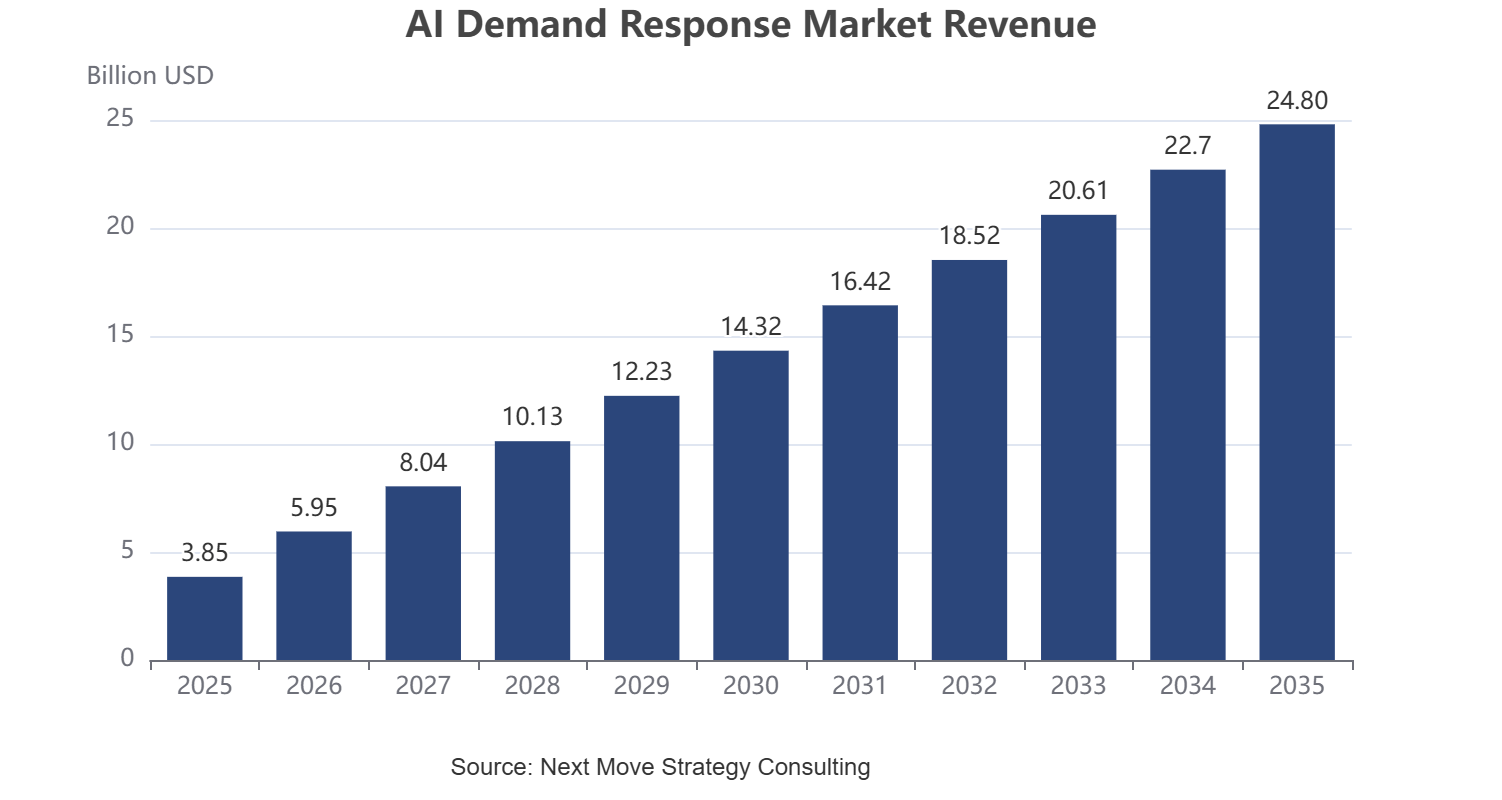
The global AI Demand Response Market size was valued at USD 3.85 Billion in 2025 and is estimated at USD 4.62 Billion in 2026, forecast to reach USD 24.80 Billion by 2035, expanding at a 20.5% CAGR between 2026 and 2035. North America leads with approximately 36% share, while under offering, Software Platform dominates with approximately 46% share.
We observed that growth is broad-based across every segmentation axis, with AI scheduling engines and virtual power plant aggregation driving the dominant structural shifts through 2035.
|
Key Takeaways |
|
By Offering: Software Platform held the largest share of approximately 46% (USD 1.77 Billion) in 2025; Edge Enablement is the fastest-growing sub-segment at 21.0% CAGR from 2026–2035. |
|
By Sales Channel: Direct Enterprise Sales held the largest share of approximately 34% (USD 1.31 Billion) in 2025; OEM Embedded is the fastest-growing sub-segment at 22.3% CAGR from 2026–2035. |
|
By End User: Utility and Grid Operator held the largest share of approximately 38% (USD 1.46 Billion) in 2025; Pure-Play Aggregator is the fastest-growing sub-segment at 22.1% CAGR from 2026–2035. |
|
Dominant Region: North America dominated with approximately 36% revenue share (USD 1.39 Billion) in 2025. |
|
Fastest-Growing Region: Asia-Pacific is expected to register the highest CAGR of 22.8% during 2026–2035. |
|
Dominant Country: U.S. led with approximately USD 998 Million in 2025. |
|
Fastest-Growing Country: India is the fastest-growing country at approximately 29.8% CAGR from 2026–2035. |
Between 2026 and 2035, the AI Demand Response Market is set to generate an absolute dollar opportunity of USD 20.18 Billion, positioning AI scheduling and virtual power plant aggregation platforms as a compelling area for capital allocation.
According to Next Move Strategy Consulting analysis, utilities embedding generative AI forecasting into legacy DERMS deployments are compressing procurement cycles, as grid operators increasingly favor vendors demonstrating measurable dispatch-accuracy gains over incumbent rule-based systems.
What does the AI Demand Response Market Encompass?
The AI Demand Response Market encompasses software platforms, managed flexibility services, and edge-enablement hardware that use artificial intelligence to forecast, orchestrate, and monetize flexible electricity load and distributed generation. Our assessment indicates that scope spans DERMS, virtual power plant, standalone DRMS, and forecasting and optimization software supplied to utilities, aggregators, and commercial and residential end users. The category has evolved from manually triggered curtailment programs into continuously optimized, AI-orchestrated flexibility marketplaces.
Regulatory frameworks such as the U.S. Federal Energy Regulatory Commission's Order 2222 and the European Commission's Clean Energy Package shape aggregator market access and cross-border flexibility trading rules. We observed that technology adoption is shifting toward generative and predictive AI scheduling engines that replace static load-curve forecasting. Next Move Strategy Consulting's analysis indicates that this structural shift, combined with rising distributed energy resource penetration, is redefining vendor selection criteria across the AI Demand Response Market.
|
Parameters |
Details |
|
Market Size in 2025 |
USD 3.85 Billion |
|
Market Size in 2026 |
USD 4.62 Billion |
|
Revenue Forecast in 2035 |
USD 24.80 Billion |
|
Growth Rate |
CAGR of 20.5% from 2026 to 2035 |
|
Analysis Period |
2025–2035 |
|
Base Year Considered |
2025 |
|
Forecast Period |
2026–2035 |
|
Market Size Estimation |
Revenue (USD Billion) |
|
Companies Profiled |
20 |
|
Countries Covered |
33 |
|
Market Share |
Available for 10 companies |
Key Emerging Trends
Based on research conducted by Next Move Strategy Consulting, we found that four structural trends are reshaping product development, sourcing, and stakeholder engagement across the AI Demand Response Market.
How Is Generative AI Transforming Demand Response Forecasting?
Generative and machine-learning forecasting engines are replacing static load-curve models across demand response management systems. We observed that utilities are deploying AI scheduling engines capable of ingesting weather, tariff, and device-level telemetry to predict flexible capacity in near real time. Schneider Electric's EcoStruxure Grid platform exemplifies this shift, embedding AI-based load forecasting to help grid operators dispatch flexibility with materially improved accuracy across distribution networks.
Why Are Virtual Power Plants Becoming Central to Grid Flexibility?
Virtual power plant platforms are consolidating distributed batteries, EVs, and behind-the-meter assets into dispatchable capacity pools. Our findings suggest that aggregators are prioritizing portfolio optimization and market-bidding software to monetize flexibility across wholesale and ancillary-services markets. AutoGrid's virtual power plant orchestration expansion illustrates how aggregation platforms are scaling to serve utility and commercial customers simultaneously.
How Is FERC Order 2222 Reshaping U.S. Demand Response Participation?
FERC Order 2222 implementation is opening wholesale market access to distributed energy resource aggregators across the U.S. Next Move Strategy Consulting's analysis indicates that this regulatory shift is accelerating adoption of aggregation and trading software among pure-play aggregators. Voltus's expanded enrollment platform reflects how market participants are scaling capacity contracts and ancillary-services bidding in response to this structural opening.
What Role Does Edge Enablement Play in AI Demand Response Adoption?
Edge controllers embedded in HVAC systems, battery storage, and EV charging equipment are becoming critical enablers of automated demand response participation. We found that building energy management systems increasingly incorporate DR logic directly at the site level, reducing latency between grid signals and load adjustment. This edge-enabled architecture is expanding participation among commercial and industrial owners previously excluded from manual DR programs.
Supply Chain Structure of the AI Demand Response Market
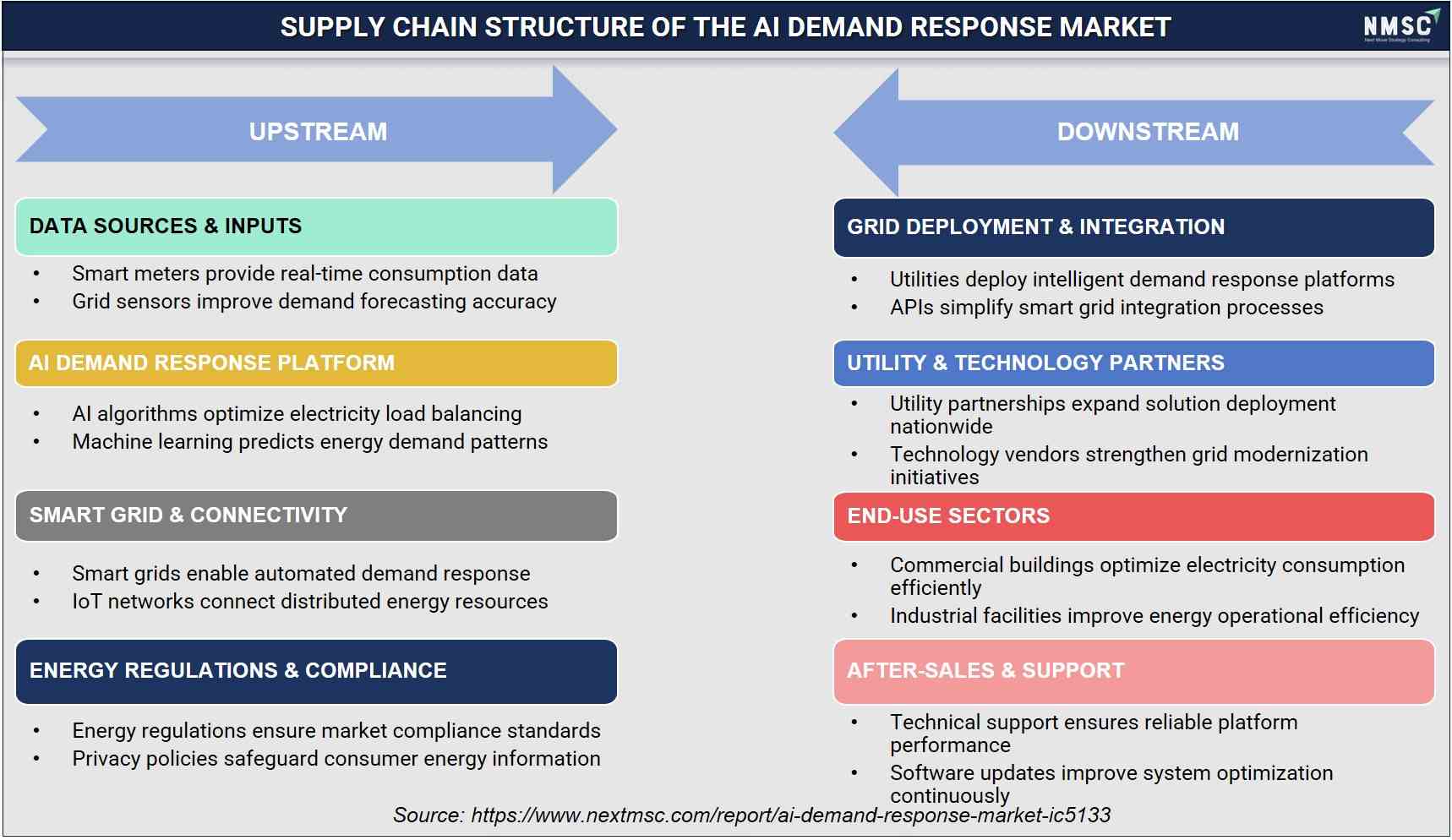
The supply chain of the AI Demand Response Market begins with smart meters, grid sensors, and IoT devices that generate real-time energy consumption data. AI platform developers apply machine learning algorithms to forecast demand and optimize electricity load balancing, supported by cloud infrastructure and smart grid connectivity. Deployment partners and utility technology vendors integrate these solutions into grid operations through APIs and enterprise platforms. Downstream activities include adoption across commercial and industrial sectors, complemented by technical support, software updates, and compliance with energy and data privacy regulations.
Growth Drivers and Restraints
|
Factors |
Type |
(+/−) % Impact on CAGR |
Geographic Relevance |
Impact Timeline |
|
Rising renewable-integration and grid-balancing needs |
Driver |
+2.4% |
Global |
2026-2035 |
|
FERC Order 2222 and utility DER market-access rules |
Driver |
+2.0% |
North America |
2026-2035 |
|
EU Clean Energy Package flexibility mandates |
Driver |
+1.7% |
Europe |
2026-2035 |
|
Falling AI inference and edge-compute costs |
Driver |
+1.5% |
Global |
2026-2032 |
|
Expansion of behind-the-meter battery and EV assets |
Driver |
+1.3% |
Global |
2026-2035 |
|
Utility digitalization and AMI rollout in Asia-Pacific |
Driver |
+1.2% |
Asia-Pacific |
2026-2035 |
|
Rising capital allocation toward aggregator platforms |
Driver |
+0.9% |
Global |
2026-2032 |
|
Interoperability gaps across legacy utility IT systems |
Restraint |
-1.1% |
Global |
2026-2035 |
|
Cybersecurity and data-privacy compliance costs |
Restraint |
-0.8% |
North America, Europe |
2026-2035 |
|
Slow regulatory harmonization across emerging markets |
Restraint |
-0.6% |
Middle East & Africa, Latin America |
2028-2035 |
What Is the Primary Growth Driver of the AI Demand Response Market?
Rising renewable-integration and grid-balancing needs represent the primary driver of the AI Demand Response Market. The U.S. Energy Information Administration continues to report growing variable renewable capacity additions that require dispatchable flexibility to maintain grid reliability. We observed that this structural shift, reinforced by utility digitalization programs, continues to anchor baseline demand for AI-orchestrated forecasting and dispatch software across developed and emerging grids alike.
How Is FERC Order 2222 Driving AI Demand Response Market Growth?
FERC Order 2222 implementation is accelerating AI Demand Response Market growth by opening U.S. wholesale markets to distributed energy resource aggregators. The Federal Energy Regulatory Commission's public filings confirm expanding aggregator participation rules across regional transmission organizations. Our assessment indicates that this regulatory opening, combined with comparable European flexibility mandates, is compressing adoption timelines for aggregation and trading software across North America and Europe.
What Is Restraining AI Demand Response Market Expansion?
Interoperability gaps across legacy utility IT systems restrain integration speed and margin stability across the AI Demand Response Market supply chain. The U.S. Department of Energy has documented recurring grid-modernization funding gaps that delay software integration projects at smaller utilities. We found that smaller regional utilities face particular exposure, as limited technical capacity reduces their ability to integrate AI scheduling engines compared with larger, digitally mature grid operators.
Segmentation Analysis
Segment Sizing: By Offering
|
Segment |
2025 (USD) |
2035 (USD) |
CAGR% (2026–2035) |
|
Software Platform |
USD 1.77 Billion |
USD 10.91 Billion |
19.9% |
|
Managed Flexibility Service |
USD 1.27 Billion |
USD 8.43 Billion |
20.8% |
|
Edge Enablement |
USD 808 Million |
USD 5.46 Billion |
21.0% |
|
Total |
USD 3.85 Billion |
USD 24.80 Billion |
20.5% |
Which Offering Segment Dominates the AI Demand Response Market?
Software Platform, encompassing DERMS, virtual power plant, standalone DRMS, and forecasting and optimization software, led the AI Demand Response Market with USD 1.77 Billion in 2025, supported by utilities' preference for centralized orchestration capability. We observed that Edge Enablement is the fastest-growing offering, expanding at a 21.0% CAGR from 2026 to 2035, as building energy management and site controller adoption accelerates among commercial and industrial owners.
Segment Sizing: By Sales Channel
|
Segment |
2025 (USD) |
2035 (USD) |
CAGR% (2026–2035) |
|
Direct Enterprise Sales |
USD 1.31 Billion |
USD 7.94 Billion |
19.7% |
|
Utility Program and Procurement |
USD 1.08 Billion |
USD 6.70 Billion |
20.0% |
|
OEM Embedded |
USD 462 Million |
USD 3.47 Billion |
22.3% |
|
Partner Reseller and Integrator |
USD 578 Million |
USD 3.72 Billion |
20.5% |
|
Retail Platform |
USD 308 Million |
USD 2.23 Billion |
21.9% |
|
Other Channels |
USD115 Million |
USD 744 Million |
20.5% |
|
Total |
USD 3.85 Billion |
USD 24.80 Billion |
20.5% |
Which Sales Channel Leads AI Demand Response Market Distribution?
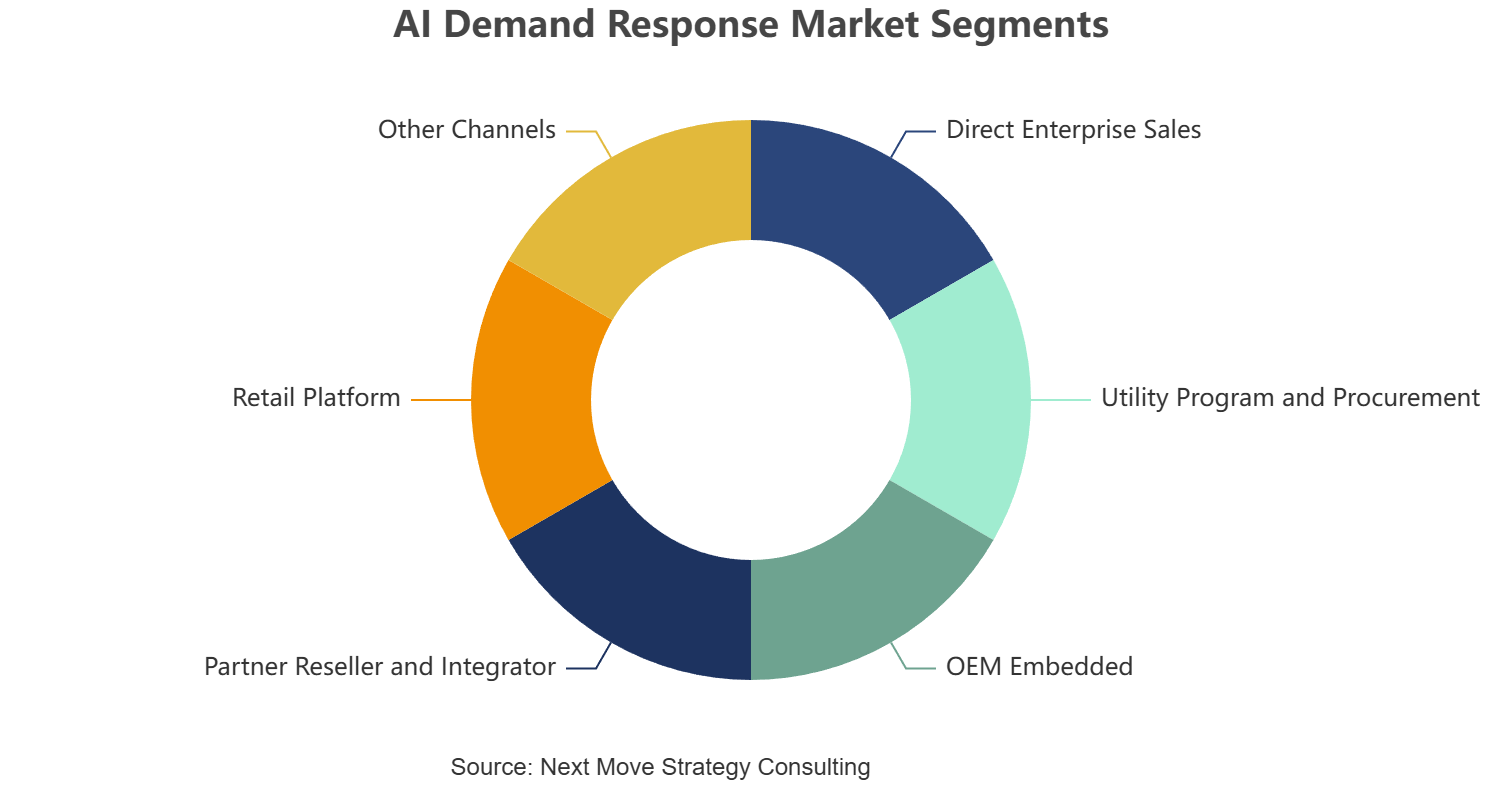
Direct Enterprise Sales remained the leading sales channel within the AI Demand Response Market, valued at USD 1.31 Billion in 2025 on sustained utility procurement relationships. Our findings suggest that OEM Embedded is the fastest-growing channel, registering a 22.3% CAGR from 2026 to 2035, as device manufacturers increasingly embed AI demand response logic directly into thermostats, batteries, and EV chargers at the point of manufacture.
Segment Sizing: By End User
|
Segment |
2025 (USD) |
2035 (USD) |
CAGR% (2026–2035) |
|
Utility and Grid Operator |
USD 1.46 Billion |
USD 8.68 Billion |
19.5% |
|
Energy Retailer |
USD 693 Million |
USD 4.22 Billion |
19.8% |
|
Pure-Play Aggregator |
USD 539 Million |
USD 3.97 Billion |
22.1% |
|
Commercial and Industrial Owner |
USD 655 Million |
USD 4.46 Billion |
21.2% |
|
Residential Platform and OEM |
USD 385 Million |
USD 2.73 Billion |
21.6% |
|
Other End Users |
USD 115 Million |
USD 744 Million |
20.5% |
|
Total |
USD 3.85 Billion |
USD 24.80 Billion |
20.5% |
Which End User Segment Dominates AI Demand Response Market Demand?
Utility and Grid Operator remained the dominant end user within the AI Demand Response Market, valued at USD 1.46 Billion in 2025 on sustained grid-modernization investment. Our analysis shows that Pure-Play Aggregator is the fastest-growing end user, registering a 22.1% CAGR from 2026 to 2035, as FERC Order 2222 and comparable frameworks expand wholesale market access for independent aggregation businesses.
Growth Opportunities
Our analysis shows that three forward-looking opportunities stand out for stakeholders positioning within the AI Demand Response Market over the 2026-2035 forecast period.
How Are AI Scheduling Engines Creating Opportunities for Utility Software Vendors?
AI scheduling engines capable of co-optimizing forecasting, dispatch, and settlement present a whitespace opportunity for software platform vendors serving utility and grid operator customers. Vendors that embed explainable AI scheduling logic into DERMS and forecasting suites stand to capture recurring subscription revenue as utilities modernize legacy demand response infrastructure across regulated markets.
Why Do Wholesale Capacity Contracts Represent a Growth Opportunity for Aggregators?
Wholesale capacity contracts and ancillary-services bidding create a recurring revenue opportunity for pure-play aggregators expanding under FERC Order 2222 and comparable international frameworks. Aggregators that scale aggregation and trading software can secure long-duration capacity commitments, benefiting from growing wholesale market access across North America and parts of Asia-Pacific.
How Does Retail Flexibility Brokerage Unlock Opportunities for Residential Platforms?
Retail flexibility brokerage focused on tariff optimization and self-consumption maximization creates an opportunity for residential platform and OEM providers serving smart thermostat and battery storage customers. Providers that package edge enablement hardware with retail brokerage software can differentiate among energy retailers seeking to retain residential customers through bundled flexibility offerings.
Regional Outlook
|
Region |
2025 (USD) |
2035 (USD) |
CAGR% (2026–2035) |
Key Driver |
|
North America |
USD 1.39 Billion |
USD 7.94 Billion |
19.1% |
Utility-led demand response modernization and FERC Order 2222 market-access rules |
|
Europe |
USD 1.04 Billion |
USD 6.45 Billion |
20.0% |
EU Clean Energy Package flexibility mandates and national capacity-market reforms |
|
Asia-Pacific |
USD 924 Million |
USD 7.19 Billion |
22.8% |
Rapid renewable integration and grid-balancing needs across China and India |
|
Middle East & Africa |
USD 270 Million |
USD 1.74 Billion |
20.5% |
Grid diversification programs and utility digitalization initiatives |
|
Latin America |
USD 231 Million |
USD 1.49 Billion |
20.5% |
Expanding distributed energy resource penetration and regulatory modernization |
|
Total |
USD 3.85 Billion |
USD 24.80 Billion |
20.5% |
— |
North America AI Demand Response Market Outlook
North America leads the AI Demand Response Market with an established utility digitalization base and mature wholesale market structure. We observed that FERC Order 2222 implementation sustains aggregator participation, while utilities increasingly specify AI scheduling engines to meet reliability standards. Technology adoption remains advanced, with virtual power plant platforms scaling rapidly across the region's deregulated electricity markets.
Europe AI Demand Response Market Outlook
Europe's AI Demand Response Market reflects a mature but regulation-intensive landscape shaped by the European Commission's Clean Energy Package and national capacity-market reforms. Our findings suggest that utilities across Germany, France, and the UK are accelerating adoption of DERMS and forecasting software to meet flexibility obligations. Technology adoption favors aggregation platforms, supported by regional grid operators investing in cross-border balancing infrastructure.
Asia-Pacific AI Demand Response Market Outlook
Asia-Pacific is the fastest-growing AI Demand Response Market region, propelled by rapid renewable-capacity additions in China and India and expanding utility digitalization. We found that regulatory frameworks remain less harmonized than in Europe, giving software vendors flexibility to scale forecasting platforms rapidly. Technology adoption is accelerating as regional utilities, including several China-based grid operators, expand AI-orchestrated dispatch capacity.
Middle East & Africa AI Demand Response Market Outlook
The Middle East & Africa AI Demand Response Market is expanding as Gulf Cooperation Council economies diversify grid infrastructure and pursue renewable-integration targets. Our analysis shows that Saudi Arabia and the UAE are attracting utility digitalization investment tied to national energy-transition programs. Regulatory influence remains moderate, while technology adoption is gradually shifting toward imported DERMS and forecasting platforms.
Latin America AI Demand Response Market Outlook
Latin America's AI Demand Response industry is supported by growing distributed energy resource penetration in Brazil and Argentina and expanding grid-modernization infrastructure. We observed that regulatory frameworks are less stringent than in North America or Europe, though multinational utilities operating locally are introducing AI-based forecasting specifications. Technology adoption remains centered on utility-led programs, with competitive intensity increasing as regional distributors partner with global software integrators.
U.S. AI Demand Response Market
Based on our engagements, the U.S. AI Demand Response industry was valued at approximately USD 998 Million in 2025 and is projected to reach USD 5.71 Billion by 2035, growing at a 19.1% CAGR. Demand structure reflects the region's utility digitalization pace and regulatory maturity, with adoption led by grid operators and aggregators integrating AI scheduling and forecasting software. Technology penetration continues to rise as competitive intensity increases among domestic and international software vendors serving this market.
Canada AI Demand Response Market
Through our analysis, the Canada AI Demand Response industry was valued at approximately USD 277 Million in 2025 and is projected to reach USD 1.59 Billion by 2035, growing at a 19.1% CAGR. Demand structure reflects the region's utility digitalization pace and regulatory maturity, with adoption led by grid operators and aggregators integrating AI scheduling and forecasting software. Technology penetration continues to rise as competitive intensity increases among domestic and international software vendors serving this market.
UK AI Demand Response Market
From our assessment, the UK AI Demand Response industry was valued at approximately USD 208 Million in 2025 and is projected to reach USD 1.29 Billion by 2035, growing at a 20.0% CAGR. Demand structure reflects the region's utility digitalization pace and regulatory maturity, with adoption led by grid operators and aggregators integrating AI scheduling and forecasting software. Technology penetration continues to rise as competitive intensity increases among domestic and international software vendors serving this market.
Germany AI Demand Response Market
According to evaluation, the Germany AI Demand Response industry was valued at approximately USD 198 Million in 2025 and is projected to reach USD 1.23 Billion by 2035, growing at a 20.0% CAGR. Demand structure reflects the region's utility digitalization pace and regulatory maturity, with adoption led by grid operators and aggregators integrating AI scheduling and forecasting software. Technology penetration continues to rise as competitive intensity increases among domestic and international software vendors serving this market.
France AI Demand Response Market
Based on our engagements, the France AI Demand Response industry was valued at approximately USD 146 Million in 2025 and is projected to reach USD 903 Million by 2035, growing at a 20.0% CAGR. Demand structure reflects the region's utility digitalization pace and regulatory maturity, with adoption led by grid operators and aggregators integrating AI scheduling and forecasting software. Technology penetration continues to rise as competitive intensity increases among domestic and international software vendors serving this market.
China AI Demand Response Market
Through our analysis, the China AI Demand Response industry was valued at approximately USD 314 Million in 2025 and is projected to reach USD 2.16 Billion by 2035, growing at a 21.2% CAGR. Demand structure reflects the region's utility digitalization pace and regulatory maturity, with adoption led by grid operators and aggregators integrating AI scheduling and forecasting software. Technology penetration continues to rise as competitive intensity increases among domestic and international software vendors serving this market.
India AI Demand Response Market
From our assessment, the India AI Demand Response industry was valued at approximately USD 111 Million in 2025 and is projected to reach USD 1.51 Billion by 2035, growing at a 29.8% CAGR. Demand structure reflects the region's utility digitalization pace and regulatory maturity, with adoption led by grid operators and aggregators integrating AI scheduling and forecasting software. Technology penetration continues to rise as competitive intensity increases among domestic and international software vendors serving this market.
Japan AI Demand Response Market
According to evaluation, the Japan AI Demand Response industry was valued at approximately USD 139 Million in 2025 and is projected to reach USD 863 Million by 2035, growing at a 20.1% CAGR. Demand structure reflects the region's utility digitalization pace and regulatory maturity, with adoption led by grid operators and aggregators integrating AI scheduling and forecasting software. Technology penetration continues to rise as competitive intensity increases among domestic and international software vendors serving this market.
South Korea AI Demand Response Market
Based on our engagements, the South Korea AI Demand Response industry was valued at approximately USD 102 Million in 2025 and is projected to reach USD 647 Million by 2035, growing at a 20.3% CAGR. Demand structure reflects the region's utility digitalization pace and regulatory maturity, with adoption led by grid operators and aggregators integrating AI scheduling and forecasting software. Technology penetration continues to rise as competitive intensity increases among domestic and international software vendors serving this market.
Australia AI Demand Response Market
Through our analysis, the Australia AI Demand Response industry was valued at approximately USD 65 Million in 2025 and is projected to reach USD 431 Million by 2035, growing at a 20.9% CAGR. Demand structure reflects the region's utility digitalization pace and regulatory maturity, with adoption led by grid operators and aggregators integrating AI scheduling and forecasting software. Technology penetration continues to rise as competitive intensity increases among domestic and international software vendors serving this market.
UAE AI Demand Response Market
From our assessment, the UAE AI Demand Response industry was valued at approximately USD 59 Million in 2025 and is projected to reach USD 382 Million by 2035, growing at a 20.5% CAGR. Demand structure reflects the region's utility digitalization pace and regulatory maturity, with adoption led by grid operators and aggregators integrating AI scheduling and forecasting software. Technology penetration continues to rise as competitive intensity increases among domestic and international software vendors serving this market.
Saudi Arabia AI Demand Response Market
According to evaluation, the Saudi Arabia AI Demand Response industry was valued at approximately USD 65 Million in 2025 and is projected to reach USD 417 Million by 2035, growing at a 20.5% CAGR. Demand structure reflects the region's utility digitalization pace and regulatory maturity, with adoption led by grid operators and aggregators integrating AI scheduling and forecasting software. Technology penetration continues to rise as competitive intensity increases among domestic and international software vendors serving this market.
South Africa AI Demand Response Market
Based on our engagements, the South Africa AI Demand Response Market was valued at approximately USD 24 Million in 2025 and is projected to reach USD 156 Million by 2035, growing at a 20.5% CAGR. Demand structure reflects the region's utility digitalization pace and regulatory maturity, with adoption led by grid operators and aggregators integrating AI scheduling and forecasting software. Technology penetration continues to rise as competitive intensity increases among domestic and international software vendors serving this market.
Brazil AI Demand Response Market
Through our analysis, the Brazil AI Demand Response Market was valued at approximately USD 102 Million in 2025 and is projected to reach USD 655 Million by 2035, growing at a 20.5% CAGR. Demand structure reflects the region's utility digitalization pace and regulatory maturity, with adoption led by grid operators and aggregators integrating AI scheduling and forecasting software. Technology penetration continues to rise as competitive intensity increases among domestic and international software vendors serving this market.
Argentina AI Demand Response Market
From our assessment, the Argentina AI Demand Response Market was valued at approximately USD 46 Million in 2025 and is projected to reach USD 298 Million by 2035, growing at a 20.5% CAGR. Demand structure reflects the region's utility digitalization pace and regulatory maturity, with adoption led by grid operators and aggregators integrating AI scheduling and forecasting software. Technology penetration continues to rise as competitive intensity increases among domestic and international software vendors serving this market.
SWOT Analysis of the AI Demand Response Market
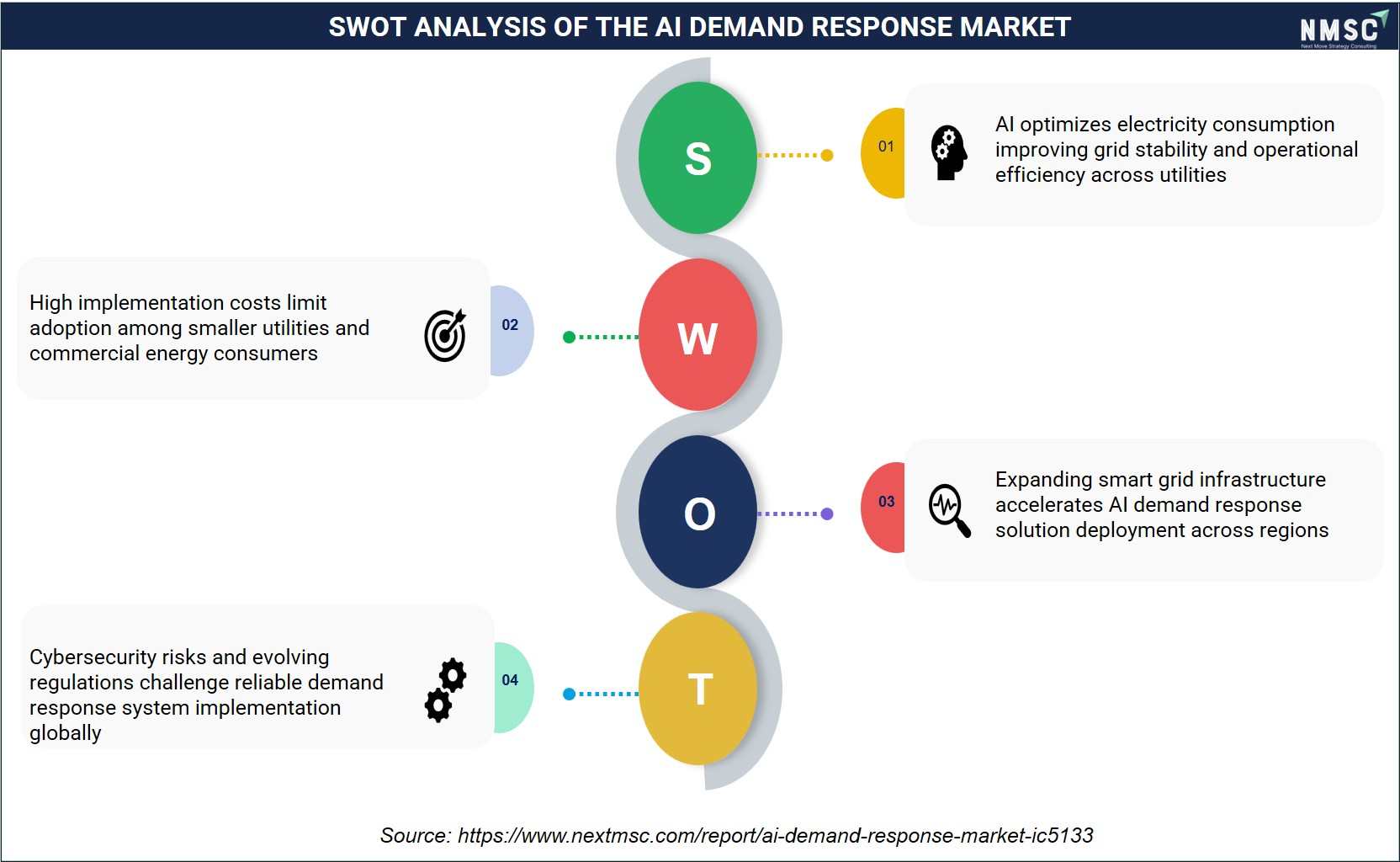
The SWOT analysis of the AI Demand Response Market highlights strong capabilities in optimizing electricity consumption, improving grid stability, and enhancing operational efficiency through AI-driven demand forecasting. However, high implementation costs limit adoption among smaller utilities and commercial users. Expanding smart grid infrastructure and digital energy management create significant growth opportunities for solution providers. At the same time, cybersecurity risks, evolving regulatory requirements, and increasing system complexity present ongoing challenges that require secure, compliant, and resilient demand response platforms.
Competitive Landscape
We observed that the competitive landscape of the AI Demand Response Market is moderately consolidated, with established grid-technology conglomerates competing alongside specialized aggregation and software-native entrants.
|
Dimension |
Description |
|
Market Structure |
Moderately consolidated, with the top 10 companies collectively accounting for a significant share of global market revenue while regional and niche providers compete across localized customer segments. |
|
Innovation Focus |
Artificial intelligence-enabled scheduling, forecasting accuracy enhancement, and platform interoperability remain the primary innovation priorities, improving grid flexibility, forecasting accuracy, virtual power plant orchestration, and DERMS interoperability. |
|
M&A Activity |
Selective acquisitions of aggregation platforms and software specialists by diversified technology conglomerates are strengthening digital capabilities, expanding service portfolios, and enhancing end-to-end demand response management, DERMS, aggregation, and grid flexibility capabilities. |
How Do Companies Compete in the AI Demand Response Market?
Companies compete primarily on forecasting accuracy, platform interoperability, and breadth of wholesale market access secured for aggregated capacity. We observed that established conglomerates such as Schneider Electric and Siemens leverage integrated grid-hardware relationships, while software-native entrants such as AutoGrid and Uplight differentiate through faster AI model iteration and flexible deployment across utility and commercial customer segments.
Which Competitive Archetypes Dominate the AI Demand Response Market?
Two archetypes dominate the AI Demand Response Market: diversified grid-technology conglomerates offering integrated DERMS and hardware, and specialized aggregators such as Voltus and CPower focused purely on wholesale capacity monetization. Our findings suggest that this bifurcation reflects differing customer priorities, with utilities favoring integrated conglomerates and commercial and industrial owners favoring specialized aggregation platforms offering faster enrollment cycles.
What Innovation and Differentiation Strategies Define This Market?
Innovation strategies center on embedding generative AI forecasting, expanding edge-device interoperability, and improving settlement transparency for aggregated capacity. Our analysis shows that companies including Next Kraftwerke and Enel are differentiating through cross-border balancing-market participation, while device-focused entrants such as EnergyHub emphasize residential smart-device integration to expand addressable flexibility pools.
What M&A Activity Is Shaping the Competitive Landscape?
M&A activity in the AI Demand Response Market has centered on diversified conglomerates acquiring specialized aggregation and software capabilities to accelerate market entry. We found that Uplight's integration of AutoGrid's virtual power plant orchestration technology exemplifies this pattern, allowing combined entities to offer end-to-end forecasting, aggregation, and settlement services across utility and commercial customer segments.
Key Market Players
Next Move Strategy Consulting's analysis identifies the following companies as the key validated players shaping competitive dynamics across the AI Demand Response Market.
-
Schneider Electric
-
GE Vernova
-
Honeywell
-
Johnson Controls
-
Emerson Electric
-
Hitachi Energy
-
EnergyHub
-
CPower
-
Voltus
-
Enel
-
Uplight
-
AutoGrid
-
Next Kraftwerke
-
AGL Energy
-
NRG Energy
-
ENGIE
-
Ameresco
-
C3 AI
Latest Developments
We observed the following recent developments among key players shaping the competitive trajectory of the AI Demand Response Market.
|
Date |
Event |
|
June 2026 |
CPower Energy secured a contract with the New Jersey Division of Property Management & Construction (DPMC) to serve as a demand response provider. The initiative leverages CPower's VPP platform to help state government facilities reduce discretionary electric loads (HVAC, lighting) and utilize on-site generation, demonstrating the state-level adoption of automated, grid-interactive energy flexibility. |
|
May 2026 |
AutoSiemens launched "Asset Performance Advanced," an AI-enabled service integrated into its Building X ecosystem. The service uses predictive and prescriptive intelligence to automate energy responses in buildings, allowing facilities to sense grid stress and autonomously adjust operations to improve energy performance and reliability. |
|
September 2025 |
Schneider Electric finalized a series of major agreements, including a USD1.9 billion supply capacity deal with Switch and a USD 2.3 billion package for U.S. data center operators. These deals specifically focus on deploying AI-native power and cooling infrastructure to manage the high-volatility loads characteristic of modern AI data centers, which are increasingly integrated into broader demand-side energy management strategies. |
Investment Opportunities
What Capital Inflows Are Supporting AI Demand Response Market Growth?
Capital inflows into AI Demand Response Market participants are concentrated in aggregation and forecasting software vendors demonstrating recurring subscription revenue. Our findings suggest that investors favor companies combining software platforms with wholesale market access, given the recurring nature of aggregation and trading revenue streams tied to expanding regulatory frameworks such as FERC Order 2222.
How Is Infrastructure Investment Shaping This Market?
Infrastructure investment is flowing toward advanced metering infrastructure and grid-edge sensing that enable AI-based forecasting accuracy. We observed that utilities in North America and Europe are prioritizing digitalization capital expenditure to support DERMS and forecasting software deployment, creating a durable investment thesis for hardware-software integration across the AI Demand Response Market.
What ESG Considerations Influence Investment in This Market?
Environmental, social, and governance considerations favor AI demand response platforms that displace fossil-fuel peaker plants with software-orchestrated flexibility. Our analysis shows that investors increasingly screen for measurable emissions-avoidance metrics when evaluating aggregation and forecasting software vendors, reinforcing the sector's alignment with broader grid-decarbonization and renewable-integration objectives disclosed by utility and grid-operator customers.
Key Benefits for Stakeholders
How Does This Report Benefit Utility and Grid Operator Leaders?
This report equips utility and grid operator leaders with segmented revenue forecasts, competitive benchmarking, and regulatory analysis needed to prioritize AI scheduling and DERMS procurement decisions. Our findings suggest that access to country-level sizing and CAGR data supports more informed capital-budgeting decisions across digitalization programs through 2035.
How Does This Report Benefit Investors and Financial Analysts?
Investors and financial analysts gain a consolidated view of market sizing, growth drivers, and competitive positioning across the AI Demand Response Market's software, service, and hardware layers. Our assessment indicates that the report's segmented CAGR data supports comparative valuation analysis across aggregation, forecasting, and edge-enablement sub-segments.
How Does This Report Benefit Technology Vendors and Product Teams?
Technology vendors and product teams benefit from detailed segmentation analysis identifying the fastest-growing offering, channel, and end-user categories for roadmap prioritization. We observed that this level of granularity helps product teams align AI scheduling and forecasting feature development with the segments demonstrating the strongest projected CAGR through 2035.
Key Market Segments
By Offering
-
Software Platform
-
DERMS
-
Grid Optimization
-
Constraint Management
-
-
Virtual Power Plant
-
Portfolio Optimization
-
Market Bidding
-
Dispatch Coordination
-
-
Standalone DRMS
-
Event Automation
-
Measurement and Verification
-
Customer Enrollment
-
-
Forecasting and Optimization
-
Load Forecasting
-
Price and Signal Forecasting
-
AI Scheduling Engine
-
-
-
Managed Flexibility Service
-
Program Administration
-
Incentive Management
-
Compliance Reporting
-
Full-Service Enrollment
-
-
Aggregation and Trading
-
Wholesale Capacity Contract
-
Ancillary Services Bidding
-
Balancing Energy Dispatch
-
-
Retail Flexibility Brokerage
-
Tariff Optimization
-
Peak Management
-
Self-Consumption Maximization
-
-
-
Edge Enablement
-
Building Energy Management
-
HVAC Control System
-
Lighting and Plug Load Control
-
BMS with DR Logic
-
-
Site and Microgrid Controller
-
Battery Storage Controller
-
EVSE Controller
-
Generator and Fuel Cell Controller
-
-
Device Management
-
Smart Thermostat Management
-
Smart Water Heater Control
-
Other Connected Load Device
-
-
By Sales Channel
-
Direct Enterprise Sales
-
Utility Program and Procurement
-
OEM Embedded
-
Partner Reseller and Integrator
-
Retail Platform
-
Other Channels
By End User
-
Utility and Grid Operator
-
Energy Retailer
-
Pure-Play Aggregator
-
Commercial and Industrial Owner
-
Residential Platform and OEM
-
Other End Users
By Region
-
North America: U.S., Canada, Mexico
-
Europe: UK, Germany, France, Italy, Spain, Sweden, Denmark, Finland, Netherlands, Rest of Europe
-
Asia-Pacific: China, India, Japan, South Korea, Taiwan, Indonesia, Vietnam, Australia, Philippines, Malaysia, Rest of APAC
-
Middle East & Africa: Saudi Arabia, UAE, Egypt, Israel, Turkey, Nigeria, South Africa, Rest of MEA
-
Latin America: Brazil, Argentina, Chile, Colombia, Rest of LATAM
Conclusion & Recommendations
What Is the Long-Term Outlook for the AI Demand Response Market?
The AI Demand Response Market is set to expand from USD 4.62 Billion in 2026 to USD 24.80 Billion by 2035, sustaining a 20.5% CAGR as grid operators, aggregators, and end users adopt AI-driven flexibility platforms. Our assessment indicates that sustained renewable integration and electrification of transport and heating will continue anchoring long-term demand for automated, software-orchestrated flexibility across mature and emerging markets alike.
What Strategic Positioning Should Vendors Pursue in This Market?
Vendors should prioritize interoperability across DERMS, virtual power plant, and edge-enablement layers to serve utility, aggregator, and commercial customers simultaneously. We observed that companies combining software platforms with managed flexibility services capture higher account retention. Strategic partnerships between software vendors and edge-device manufacturers are emerging as a differentiator across the competitive landscape.
How Attractive Is the AI Demand Response Market for Investors?
Between 2026 and 2035, the market is projected to generate an absolute dollar opportunity of USD 20.18 Billion, positioning AI-enabled flexibility platforms as an attractive capital allocation target. Our analysis shows that investor interest is concentrated in aggregation and forecasting software, given recurring subscription revenue models and expanding wholesale market access under evolving regulatory frameworks.
What Market Shifts and Key Risks Should Stakeholders Monitor?
Stakeholders should monitor interoperability gaps across legacy utility IT systems and cybersecurity compliance costs, which restrain near-term margin expansion. Based on research conducted by Next Move Strategy Consulting, we found that slower regulatory harmonization in the Middle East & Africa and Latin America could delay aggregator market entry, while faster-than-expected AI cost declines could accelerate adoption timelines globally.
What Are the Primary Growth Pathways Through 2035?
Primary growth pathways include expansion of virtual power plant aggregation, deeper edge-enablement penetration among residential and commercial assets, and scaling of managed flexibility services in underpenetrated regions. Our findings suggest that companies pursuing all three pathways simultaneously, rather than a single offering, are best positioned to capture share as the AI Demand Response Market matures through 2035.
About the Author
 Saista Faiyaz
— Saista Faiyaz is Research Associate at Next Move Strategy Consulting, where she has covered consumer markets and healthcare technologies for 3 years. Her work includes primary interview review, secondary-source validation, market sizing, and structured analysis of company and industry data. She supports research by comparing evidence across sources, organizing findings into market narratives, and documenting assumptions used in analysis. Her scope includes cross-market benchmarking, and reports.
Saista Faiyaz
— Saista Faiyaz is Research Associate at Next Move Strategy Consulting, where she has covered consumer markets and healthcare technologies for 3 years. Her work includes primary interview review, secondary-source validation, market sizing, and structured analysis of company and industry data. She supports research by comparing evidence across sources, organizing findings into market narratives, and documenting assumptions used in analysis. Her scope includes cross-market benchmarking, and reports.
About the Reviewer
 Supradip Baul
— Supradip Baul is an accomplished business consultant and strategist with over a decade of rich experience in market intelligence, strategy, technology, and business transformation. His work has included rigorous qualitative and quantitative analysis across multiple industries, helping clients shape investment decisions and long-term roadmaps. Earlier in his career, he was associated with Gartner, where he contributed to industry-leading reports and market share analyses. He has worked with leading global companies and holds an MBA with a dual specialization in Marketing and Finance.
Supradip Baul
— Supradip Baul is an accomplished business consultant and strategist with over a decade of rich experience in market intelligence, strategy, technology, and business transformation. His work has included rigorous qualitative and quantitative analysis across multiple industries, helping clients shape investment decisions and long-term roadmaps. Earlier in his career, he was associated with Gartner, where he contributed to industry-leading reports and market share analyses. He has worked with leading global companies and holds an MBA with a dual specialization in Marketing and Finance.
At Next Move Strategy Consulting, we understand that insightful market research is the cornerstone of successful business decisions. That's why we employ a robust and multifaceted approach, combining various methodologies to deliver the most accurate and actionable data for our clients.

Research Landscape
We navigate the world of research with two primary approaches:
Qualitative Approach
Our qualitative research methodologies involve immersive techniques such as in-depth interviews, focus groups, and observational studies. By engaging directly with individuals and stakeholders, we uncover valuable insights that quantitative data alone may overlook.

Quantitative Research
In tandem with qualitative methodologies, NMSC leverages the power of Quantitative Research to provide a robust foundation of numerical insights. Through systematic data collection and analysis, we quantify patterns, preferences, and market trends, offering a comprehensive view of the business landscape.
Our quantitative research approach employs diverse tools, including surveys, experiments, and statistical modelling. These methodologies enable us to gather data from a large and representative sample, ensuring the statistical significance of our findings. By employing structured questionnaires and standardized data collection methods, we guarantee the reliability and validity of the information we present to our clients.
Quantitative research is particularly effective in measuring the prevalence of trends, assessing market size, and gauging the impact of various factors on consumer behavior. The numerical precision attained through this approach equips our clients with actionable insights, facilitating data-driven decision-making and strategy formulation.


Our Specialized Toolbox for Industry-Specific Market Research
We deploy a specialized arsenal of techniques tailored to meet your unique requirements. Here's a glimpse into our comprehensive toolbox:

Information Procurement
The stage entails acquiring market data or relevant information through various sources and methodologies.


Market Research Approach
We utilize both top-down and bottom-up approaches in market research analysis to achieve a comprehensive understanding of the market dynamics, leveraging the broad perspective of industry trends and macroeconomic factors alongside detailed insights from specific segments and individual companies.

Porters Five Forces Analysis
We conduct Porter's Five Forces analysis to evaluate the competitive landscape of an industry, providing us with insights into factors that affect profitability and strategic positioning.

SWOT Analysis

Forecasting
We utilize a forecasting model to predict future consumption by considering parameters like population, economics, regulations, market competition, drivers, constraints, technology, and pricing. We also employ statistical techniques such as multilinear regression, exponential smoothing, moving average, ARIMA, and Monte Carlo simulations for accurate predictions. In econometric forecasting, we analyzed short-term and long-term event impacts, attributing values based on regulatory frameworks, economic factors, and market events.





 Speak to Our Analyst