AI Lead Scoring Market Size, Share, Trends and Growth Analysis, By Offering (Software (Sales Lead Scoring, Marketing Lead Scoring, and others), and Professional Services), By Commercialization Model (Suite-Embedded, and Standalone Platform), By Buyer Type (Marketing Operations, Sales Operations, and Others), By Sales Channel (Direct Sales, and Partner Channel), and By End-User Industry -- Global Industry Report and Forecast, 2026-2035
Industry: ICT & Media | Publishing Date: July 14, 2026 | Last Updated: September 30, 2026 | No of Pages: N/A | No. of Tables: N/A | No. of Figures: N/A | Format: PDF | Report Code: IC5138
What Is the AI Lead Scoring Market Size?
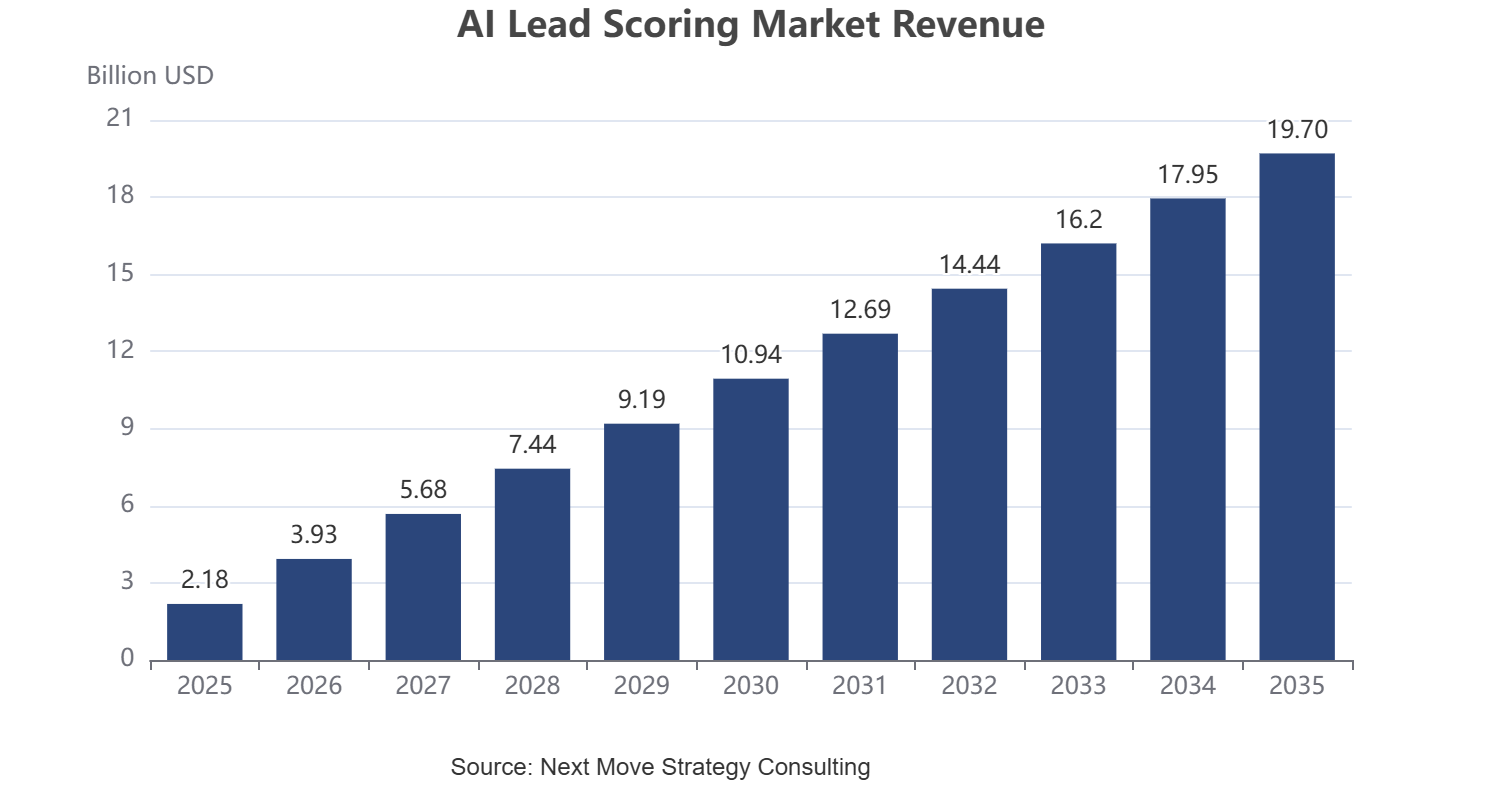
The global AI Lead Scoring Market size was valued at USD 2.18 Billion in 2025 and is estimated at USD 2.72 Billion in 2026, forecast to reach USD 19.70 Billion by 2035, expanding at a 24.6% CAGR between 2026 and 2035. North America leads with approximately 38% share, while under offering, Sales Lead Scoring dominates with approximately 30% share.
We observed that growth is broad-based across every segmentation axis, with predictive and product-led scoring architectures driving the dominant structural shifts through 2035.
|
Key Takeaways |
|
By Offering: Sales Lead Scoring held the largest share of approximately 30% (USD 654 Million) in 2025; Product-Led Lead Scoring is the fastest-growing sub-segment at 29.6% CAGR from 2026-2035. |
|
By Commercialization Model: Suite-Embedded held the largest share of approximately 57% (USD 1.24 Billion) in 2025; Standalone Platform is the fastest-growing sub-segment at 26.7% CAGR from 2026-2035. |
|
By Deployment Model: Public Cloud held the largest share of approximately 62% (USD 1.35 Billion) in 2025; Public Cloud is also the fastest-growing sub-segment at 26.3% CAGR from 2026-2035. |
|
By Organization Size: Enterprise held the largest share of approximately 46% (USD 1.00 Billion) in 2025; Small Business is the fastest-growing sub-segment at 26.6% CAGR from 2026-2035. |
|
By Buyer Type: Sales Operations held the largest share of approximately 29% (USD 632 Million) in 2025; Customer Success Operations is the fastest-growing sub-segment at 27.5% CAGR from 2026-2035. |
|
By Sales Channel: Direct Sales held the largest share of approximately 64% (USD 1.40 Billion) in 2025; Partner Channel is the fastest-growing sub-segment at 26.8% CAGR from 2026-2035. |
|
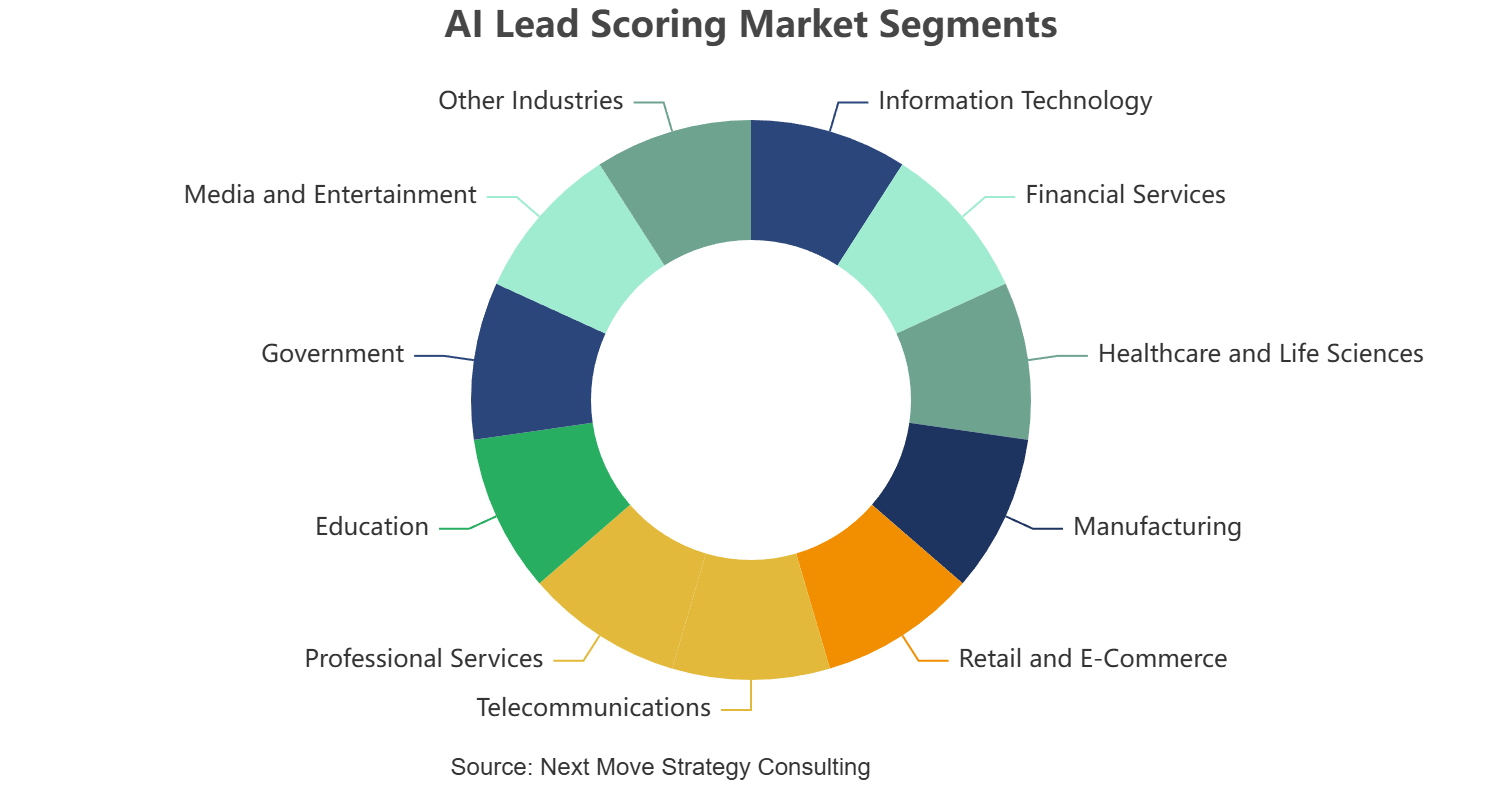
By End-User Industry: Information Technology held the largest share of approximately 19% (USD 414 Million) in 2025; Healthcare and Life Sciences is the fastest-growing sub-segment at 26.9% CAGR from 2026-2035. |
|
Dominant Region: North America dominated with approximately 38% revenue share (USD 828 Million) in 2025. |
|
Fastest-Growing Region: Asia-Pacific is expected to register the highest CAGR of 29.0% during 2026-2035. |
|
Dominant Country: U.S. led with approximately USD 596 Million in 2025. |
|
Fastest-Growing Country: India is the fastest-growing country at approximately 31.9% CAGR from 2026–2035. |
Between 2026 and 2035, the AI Lead Scoring Market is set to generate an absolute dollar opportunity of USD 16.98 Billion, positioning predictive and product-led scoring architectures as a compelling area for capital allocation.
According to Next Move Strategy Consulting analysis, sustained investment in revenue operations orchestration and buying-group scoring capability is reshaping procurement criteria for enterprise buyers, as model transparency and CRM-native embedding increasingly determine vendor shortlisting across sales and marketing organizations.
What does the AI Lead Scoring Market Encompass?
The AI Lead Scoring Market encompasses software and professional services that apply machine learning to rank sales leads, accounts, and buying groups by conversion likelihood, replacing static, rules-based qualification frameworks. Our assessment indicates that the scope spans predictive, behavioural, hybrid, account-based, product-led, and customer lifecycle scoring architectures embedded within customer relationship management, marketing automation, and revenue operations platforms. The category has evolved from a niche marketing-automation add-on into a core revenue-operations discipline, driven by rising data volumes, generative-AI-assisted modeling, and growing demand for real-time prioritization across sales and marketing functions worldwide.
Regulatory frameworks such as the European Union's General Data Protection Regulation and the California Consumer Privacy Act shape how vendors process behavioural and firmographic data used in scoring models, while sector-specific rules under U.S. Federal Trade Commission guidance influence permissible use of third-party intent data. We observed that technology adoption is shifting toward explainable, model-agnostic scoring engines that integrate first-party product usage signals alongside traditional firmographic and behavioural inputs. Next Move Strategy Consulting's analysis indicates that this structural shift, combined with agentic AI orchestration, is redefining how revenue teams prioritize pipeline across the AI Lead Scoring Market.
|
Parameters |
Details |
|
Market Size in 2025 |
USD 2.18 Billion |
|
Market Size in 2026 |
USD 2.72 Billion |
|
Revenue Forecast in 2035 |
USD 19.70 Billion |
|
Growth Rate |
CAGR of 24.6% from 2026 to 2035 |
|
Analysis Period |
2025–2035 |
|
Base Year Considered |
2025 |
|
Forecast Period |
2026–2035 |
|
Market Size Estimation |
Revenue (USD Billion) |
|
Companies Profiled |
20 |
|
Countries Covered |
38 |
|
Market Share |
Available for Top 10 Companies |
Key Emerging Trends
Based on research conducted by Next Move Strategy Consulting, we found that four structural trends are reshaping product development, buyer engagement, and vendor differentiation across the AI Lead Scoring Market.
How Is Agentic AI Transforming Lead Scoring Workflows?
Agentic AI is transforming lead scoring from a passive ranking function into an autonomous workflow layer that triggers outreach, routes accounts, and adjusts scores in real time. We observed that Salesforce's Agentforce platform, expanded through 2025 and 2026, embeds autonomous scoring agents that reprioritize pipeline without manual analyst intervention. Sales and revenue operations teams are adopting these agents to compress response times, while vendors retool architectures to support continuous, event-driven scoring rather than batch recalculation cycles.
Why Is Buying-Group Scoring Gaining Adoption Over Individual Lead Scoring?
Buying-group and account-level scoring is gaining share as B2B purchase decisions increasingly involve multiple stakeholders rather than a single lead. Our findings suggest that revenue operations teams are shifting budget toward account-based platforms capable of aggregating signals across buying committees. Vendors such as 6sense and Demandbase are expanding buying-group scoring modules, positioning this capability as a premium, higher-margin category within the broader AI Lead Scoring Market segmentation structure.
How Is Product-Led Growth Reshaping Lead Scoring Requirements?
Product-led growth motions are pushing vendors toward product-qualified and product-engagement scoring models that ingest in-app usage telemetry alongside traditional firmographic data. We observed that software companies increasingly require scoring engines capable of processing event-level product data at scale to flag expansion-ready accounts. This trend is elevating demand for engineering-friendly, API-first scoring platforms among product-led software and technology end users.
What Role Does Explainable AI Play in Lead Scoring Innovation?
Explainable and model-agnostic scoring engines are emerging as a response to sales-team distrust of opaque black-box scores. Our analysis shows that vendors are prioritizing transparent scoring rationale, such as factor-level attribution, to improve seller adoption and compliance auditability. HubSpot's Breeze AI scoring enhancements, expanded through 2025, exemplify this direction by surfacing the specific behavioural and firmographic signals driving each generated score for revenue teams.
Consumer Behavior Analysis of the AI Lead Scoring Industry

The consumer behavior analysis of the AI Lead Scoring Market illustrates a structured purchasing journey among enterprises seeking improved sales efficiency. Organizations first become aware of AI lead scoring through marketing automation platforms, webinars, and digital campaigns. During evaluation, decision-makers compare predictive accuracy, CRM integration, scalability, pricing, and analytics capabilities. Purchase decisions prioritize platforms delivering reliable lead qualification, seamless workflow integration, and measurable sales outcomes. Long-term customer loyalty depends on continuous model optimization, accurate lead predictions, strong vendor support, and consistent improvements in revenue generation and conversion performance.
Growth Drivers and Restraints
Growth Catalyst and Risk Assessment Matrix
|
Factors |
Type |
(+/-) % Impact on CAGR |
Geographic Relevance |
Impact Timeline |
|
Rising CRM-native AI adoption among sales teams |
Driver |
+3.4% |
Global |
2026–2035 |
|
Shift toward account-based and buying-group scoring |
Driver |
+2.8% |
North America, Europe |
2026–2035 |
|
Expansion of product-led growth software adoption |
Driver |
+2.2% |
North America, Asia-Pacific |
2026–2035 |
|
Growing enterprise revenue operations investment |
Driver |
+1.9% |
Global |
2026–2035 |
|
Rapid cloud and SaaS platform penetration in Asia-Pacific |
Driver |
+2.1% |
Asia-Pacific |
2026–2035 |
|
Increasing demand for explainable, auditable scoring models |
Driver |
+1.3% |
Global |
2026–2032 |
|
Data-privacy compliance costs under GDPR and CCPA |
Restraint |
-1.4% |
Europe, North America |
2026–2035 |
|
Data-quality and integration fragmentation across CRM stacks |
Restraint |
-1.1% |
Global |
2026–2035 |
|
Sales-team distrust of opaque scoring models |
Restraint |
-0.7% |
North America, Europe |
2026–2032 |
What Is the Primary Growth Driver of the AI Lead Scoring Market?
Rising adoption of CRM-native artificial intelligence among sales organizations is the primary driver of the AI Lead Scoring Market. The U.S. Federal Trade Commission's continued oversight of automated decision tools has not slowed enterprise adoption, as revenue teams increasingly embed scoring directly within existing CRM workflows. We observed that this behavioral shift, reinforced by growing sales-productivity pressure, continues to anchor baseline consumption of predictive and hybrid scoring modules across developed and emerging economies alike.
How Is Product-Led Growth Driving AI Lead Scoring Market Growth?
Expanding product-led growth business models are accelerating AI Lead Scoring Market growth toward product-qualified and engagement scoring formats. The U.S. Securities and Exchange Commission's public company disclosures show software companies increasingly citing product-usage-driven pipeline generation in investor communications. Our assessment indicates that this structural shift, combined with rising in-app telemetry volumes, is compressing adoption timelines for product-led scoring modules across software and technology end users.
What Is Restraining AI Lead Scoring Market Expansion?
Data-privacy compliance obligations under the European Union's General Data Protection Regulation and the California Consumer Privacy Act restrain scoring-model deployment speed across the AI Lead Scoring Market. The European Data Protection Board continues to issue guidance restricting automated profiling practices that affect individual data subjects. We found that smaller vendors face particular exposure, as limited compliance resources reduce their ability to support multi-jurisdictional data-processing requirements compared with larger, platform-scale competitors.
Segmentation Analysis
Segment Sizing: By Offering
|
Segment |
2025 (USD) |
2035 (USD) |
CAGR% (2026-2035) |
|
Sales Lead Scoring |
USD 654 Million |
USD 5.22 Billion |
22.9% |
|
Marketing Lead Scoring |
USD 349 Million |
USD 2.86 Billion |
23.3% |
|
Account-Based Lead Scoring |
USD 327 Million |
USD 3.05 Billion |
25.1% |
|
Product-Led Lead Scoring |
USD 283 Million |
USD 3.64 Billion |
29.6% |
|
Customer Lifecycle Lead Scoring |
USD 240 Million |
USD 2.66 Billion |
27.5% |
|
Professional Services |
USD 327 Million |
USD 2.27 Billion |
21.0% |
|
Total |
USD 2.18 Billion |
USD 19.70 Billion |
24.6% |
Which Offering Segment Dominates the AI Lead Scoring Market?
Sales Lead Scoring, encompassing predictive, behavioural, and hybrid scoring formats, led the AI Lead Scoring Market with USD 654 Million in 2025, supported by its direct integration within CRM sales workflows and near-universal applicability across industries. We observed that Product-Led Lead Scoring is the fastest-growing offering, expanding at a 29.6% CAGR from 2026 to 2035, as software companies increasingly specify product-qualified and engagement scoring modules to identify expansion-ready accounts.
Segment Sizing: By Deployment Model
|
Segment |
2025 (USD) |
2035 (USD) |
CAGR% (2026-2035) |
|
Public Cloud |
USD 1.35 Billion |
USD 13.79 Billion |
26.3% |
|
Private Cloud |
USD 523 Million |
USD 3.94 Billion |
22.1% |
|
On-Premises |
USD 305 Million |
USD 1.97 Billion |
20.0% |
|
Total |
USD 2.18 Billion |
USD 19.70 Billion |
24.6% |
Which Deployment Model Leads AI Lead Scoring Market Adoption?
Public Cloud remained the leading deployment model within the AI Lead Scoring Market, valued at USD 1.35 Billion in 2025 on sustained multi-tenant SaaS adoption among sales and marketing organizations. Our findings suggest that Public Cloud is also the fastest-growing deployment model, registering a 26.3% CAGR from 2026 to 2035, as vendors continue shifting release cycles toward cloud-native, continuously updated scoring engines.
Segment Sizing: By Organization Size
|
Segment |
2025 (USD) |
2035 (USD) |
CAGR% (2026-2035) |
|
Small Business |
USD 436 Million |
USD 4.53 Billion |
26.6% |
|
Mid-Market |
USD 741 Million |
USD 6.90 Billion |
25.0% |
|
Enterprise |
USD 1.00 Billion |
USD 8.27 Billion |
23.4% |
|
Total |
USD 2.18 Billion |
USD 19.70 Billion |
24.6% |
Which Organization Size Segment Leads AI Lead Scoring Market Demand?
Enterprise organizations remained the leading buyer segment within the AI Lead Scoring Market, valued at USD 1.00 Billion in 2025 on sustained investment in dedicated revenue operations functions. Based on research conducted by Next Move Strategy Consulting, we found that Small Business is the fastest-growing organization-size segment, registering a 26.6% CAGR from 2026 to 2035, reflecting rising affordability of packaged, low-configuration scoring modules embedded within entry-tier CRM suites.
Growth Opportunities
Our analysis shows that three forward-looking opportunities stand out for stakeholders positioning within the AI Lead Scoring Market over the 2026-2035 forecast period.
How Are Buying-Group Scoring Platforms Creating Opportunities for Enterprise Software Vendors?
Buying-group scoring platforms present a whitespace opportunity for enterprise software vendors seeking to align sales motions with complex, multi-stakeholder purchase committees. Suppliers that commercialize aggregated buying-group scoring stand to capture recurring platform revenue as enterprise revenue operations teams shift away from single-lead prioritization models.
Why Are Product Engagement Scoring Modules Emerging as a Growth Opportunity for PLG Software Companies?
Product-led growth software companies represent an underpenetrated opportunity for vendors offering engagement scoring modules built on in-app telemetry. Vendors that develop scalable, API-first product engagement scoring can secure long-term platform contracts with technology end users, benefiting from recurring expansion-revenue tied to usage-based pricing models.
How Are Explainable Scoring Engines Unlocking Opportunities for Regulated Industry Buyers?
Financial services and healthcare buyers subject to stricter data-governance obligations create an opportunity for vendors offering explainable, auditable scoring engines. Early movers that secure demonstrable model transparency can differentiate with compliance-sensitive buyers pursuing revenue-operations modernization across regulated end markets.
Regional Outlook
Geographic Performance Snapshot
|
Region |
2025 (USD) |
2035 (USD) |
CAGR% (2026-2035) |
Key Driver |
|
North America |
USD 828 Million |
USD 6.30 Billion |
22.3% |
Mature CRM ecosystem and enterprise revenue operations adoption |
|
Europe |
USD 523 Million |
USD 4.14 Billion |
22.8% |
GDPR-shaped explainable scoring adoption and SaaS penetration |
|
Asia-Pacific |
USD 480 Million |
USD 5.91 Billion |
29.0% |
Expanding SaaS and CRM adoption across China and India |
|
Middle East & Africa |
USD 196 Million |
USD 1.97 Billion |
26.1% |
Digital transformation programs and cloud CRM adoption |
|
Latin America |
USD 153 Million |
USD 1.38 Billion |
24.6% |
Growing SaaS adoption among mid-market enterprises |
|
Total |
USD 2.18 Billion |
USD 19.70 Billion |
24.6% |
-- |
North America AI Lead Scoring Market Outlook
North America leads the AI Lead Scoring industry with an established enterprise CRM ecosystem and mature revenue operations discipline. We observed that Federal Trade Commission scrutiny of automated decision tools has encouraged vendors to prioritize explainable scoring rationale, while enterprises increasingly consolidate scoring within unified revenue operations platforms. Technology adoption remains advanced, with agentic AI scoring workflows gaining rapid traction across the region's software and financial services sectors.
Europe AI Lead Scoring Market Outlook
Europe's AI Lead Scoring industry reflects a mature but compliance-intensive landscape shaped by the General Data Protection Regulation and evolving European Union artificial intelligence governance rules. Our findings suggest that enterprises across Germany, France, and the UK are accelerating adoption of explainable scoring engines to satisfy data-protection audit requirements. Technology adoption favors privacy-preserving architectures, supported by regional vendors investing in on-premises and private-cloud deployment options.
Asia-Pacific AI Lead Scoring Market Outlook
Asia-Pacific is the fastest-growing AI Lead Scoring industry region, propelled by expanding SaaS and CRM adoption across China and India and rising enterprise digitalization spending. We found that regulatory frameworks remain less harmonized than in Europe, giving vendors flexibility to scale standard scoring deployments rapidly. Technology adoption is accelerating as regional software vendors expand cloud-native scoring capacity to serve growing domestic enterprise demand.
Middle East & Africa AI Lead Scoring Market Outlook
The Middle East & Africa AI Lead Scoring industry is expanding as Gulf Cooperation Council economies accelerate digital transformation and cloud CRM adoption programs. Our analysis shows that Saudi Arabia and the UAE are attracting enterprise software investment tied to national digitalization strategies. Regulatory influence remains moderate, while technology adoption is gradually shifting toward cloud-native scoring platforms as regional enterprises align with global revenue operations practices.
Latin America AI Lead Scoring Market Outlook
Latin America's AI Lead Scoring industry is supported by growing SaaS adoption among mid-market enterprises in Brazil and Argentina and expanding cloud infrastructure availability. We observed that regulatory frameworks are less stringent than in North America or Europe, though multinational enterprises operating locally are introducing standardized scoring specifications. Technology adoption remains centered on suite-embedded scoring, with competitive intensity increasing as global CRM vendors expand regional distribution.
U.S. AI Lead Scoring Market
Based on our engagements, the U.S. AI Lead Scoring industry was valued at approximately USD 596 Million in 2025 and is projected to reach USD 4.41 Billion by 2035, growing at a 21.9% CAGR. Demand is anchored by mature enterprise CRM adoption, deep revenue operations staffing, and Federal Trade Commission oversight of automated decision-making tools. Technology penetration favors agentic and explainable scoring platforms, and competitive intensity remains high among established CRM vendors serving national enterprise accounts.
Canada AI Lead Scoring Market
Through our analysis, Canada's AI Lead Scoring industry reached roughly USD 133 Million in 2025 and is forecast to hit USD 1.07 Billion by 2035 at a 23.1% CAGR. Demand structure mirrors U.S. enterprise CRM consumption patterns, while the Office of the Privacy Commissioner of Canada's guidance shapes data-processing specifications for scoring models. Technology penetration is rising as national enterprises request explainable scoring formats, with competitive intensity moderate given reliance on cross-border platform vendors.
UK AI Lead Scoring Market
From our assessment, the UK market stood at about USD 115 Million in 2025, advancing toward USD 869 Million by 2035 at a 22.1% CAGR. Demand is driven by established financial services and technology enterprises navigating UK GDPR data-protection obligations. Regulatory influence is significant, technology penetration favors explainable scoring adoption, and competitive intensity remains steady among domestic and global vendors serving UK enterprise accounts.
Germany AI Lead Scoring Market
According to evaluation, Germany's market was valued near USD 105 Million in 2025 and is set to reach USD 786 Million by 2035, expanding at a 22.1% CAGR. Demand structure benefits from a strong domestic manufacturing and industrial enterprise base adopting revenue operations software. Germany's data-protection enforcement under the Federal Commissioner for Data Protection drives regulatory influence, while technology penetration favors private-cloud and on-premises scoring deployments among leading enterprises.
France AI Lead Scoring Market
Based on our engagements, France's market reached approximately USD 73 Million in 2025, projected to climb to USD 579 Million by 2035 at a 22.8% CAGR. Demand is supported by France's expanding enterprise software and financial services sector, which shapes standalone platform adoption. Regulatory influence from the Commission Nationale de l'Informatique et des Libertes is notable, and competitive intensity remains high given the concentration of enterprise software vendors serving French accounts.
China AI Lead Scoring Market
Through our analysis, China's AI Lead Scoring industry stood at roughly USD 158 Million in 2025 and is forecast to reach USD 1.77 Billion by 2035, registering a 27.6% CAGR. Demand is fueled by expanding domestic SaaS and enterprise software adoption and a growing base of regional CRM vendors. Regulatory influence is increasing gradually under China's Personal Information Protection Law, technology penetration is accelerating through cloud-native platform upgrades, and competitive intensity remains elevated among numerous domestic suppliers.
India AI Lead Scoring Market
From our assessment, India's AI Lead Scoring industry was valued at about USD 86 Million in 2025, projected to reach USD 1.30 Billion by 2035 at a 31.9% CAGR, the fastest among covered countries. Demand structure benefits from India's expanding IT services and software export sector, which increasingly embeds scoring within outbound sales operations. Regulatory influence remains moderate under the Digital Personal Data Protection Act, technology penetration is rising rapidly, and competitive intensity is increasing among global and domestic vendors.
Japan AI Lead Scoring Market
According to evaluation, Japan's AI Lead Scoring industry was valued at approximately USD 77 Million in 2025, projected to reach USD 768 Million by 2035 at a 26.0% CAGR. Demand structure is supported by steady enterprise CRM modernization across manufacturing and financial services sectors. Regulatory influence under the Act on the Protection of Personal Information is moderate, technology penetration favors suite-embedded scoring, and competitive intensity remains centered on established global platform vendors.
South Korea AI Lead Scoring Market
Based on our engagements, South Korea's AI Lead Scoring industry reached roughly USD 43 Million in 2025 and is forecast to hit USD 532 Million by 2035 at a 29.0% CAGR. Demand structure benefits from a technologically advanced enterprise sector rapidly adopting cloud CRM platforms. Regulatory influence under the Personal Information Protection Act is notable, technology penetration is accelerating, and competitive intensity remains moderate among domestic and global vendors.
Australia AI Lead Scoring Market
Through our analysis, Australia's AI Lead Scoring industry stood at about USD 29 Million in 2025, projected to reach USD 296 Million by 2035 at a 26.4% CAGR. Demand structure is supported by a mature financial services and professional services sector adopting revenue operations software. Regulatory influence under the Privacy Act is moderate, technology penetration favors public-cloud deployment, and competitive intensity remains steady among global CRM vendors serving Australian enterprises.
UAE AI Lead Scoring Market
From our assessment, the UAE's AI Lead Scoring industry was valued at about USD 43 Million in 2025, projected to reach USD 414 Million by 2035 at a 25.4% CAGR. Demand structure is supported by rapid enterprise digitalization tied to national economic diversification programs. Regulatory influence under UAE data-protection law is emerging, technology penetration favors cloud-native platforms, and competitive intensity is increasing as global vendors expand regional presence.
Saudi Arabia AI Lead Scoring Market
According to evaluation, Saudi Arabia's industry was valued near USD 47 Million in 2025 and is set to reach USD 453 Million by 2035, expanding at a 25.5% CAGR. Demand structure benefits from Vision 2030-linked enterprise software investment across financial services and telecommunications sectors. Regulatory influence under the Saudi Data and Artificial Intelligence Authority framework is increasing, and technology penetration favors public-cloud scoring adoption among leading enterprises.
South Africa AI Lead Scoring Market
Based on our engagements, South Africa's AI Lead Scoring industry reached roughly USD 16 Million in 2025 and is forecast to hit USD 158 Million by 2035 at a 26.1% CAGR. Demand structure is supported by growing enterprise software adoption among financial services and telecommunications firms. Regulatory influence under the Protection of Personal Information Act is notable, technology penetration is modest but rising, and competitive intensity remains centered on global CRM vendors.
Brazil AI Lead Scoring Market
Through our analysis, Brazil's AI Lead Scoring industry stood at about USD 64 Million in 2025 and is forecast to reach USD 552 Million by 2035 at a 23.9% CAGR. Demand structure is supported by expanding enterprise SaaS adoption across financial services and retail sectors. Regulatory influence under the Lei Geral de Protecao de Dados is significant, technology penetration favors public-cloud platforms, and competitive intensity is increasing among global and regional vendors.
Argentina AI Lead Scoring Market
From our assessment, Argentina's AI Lead Scoring industry was valued near USD 31 Million in 2025, projected to reach USD 276 Million by 2035 at a 24.6% CAGR. Demand structure is supported by steady enterprise software consumption despite macroeconomic volatility. Regulatory influence remains limited, technology penetration is modest, and competitive intensity is centered on a small number of regional distributors serving domestic enterprises.
Pain Point Analysis of the AI Lead Scoring Industry

The pain point analysis of the AI Lead Scoring industry highlights several operational and technical challenges affecting solution performance and adoption. Poor data quality, duplicate records, and incomplete customer information reduce scoring accuracy, while biased or static AI models fail to adapt to changing buyer behavior. Legacy CRM systems and data silos complicate seamless integration, and growing databases create scalability concerns. Additionally, data privacy regulations, consent management requirements, and low user trust in AI recommendations continue to limit widespread enterprise adoption.
Competitive Landscape
We observed that the AI Lead Scoring industry features a moderately consolidated competitive landscape, with global CRM and revenue-operations platforms competing alongside specialized scoring vendors on data breadth, model transparency, and integration depth.
|
Dimension |
Description |
|
Market Structure |
Moderately consolidated; the top companies profiled in this report collectively account for a majority of global AI Lead Scoring industry revenue, while numerous specialized point-solution vendors serve niche buyer-type demand. |
|
Innovation Focus |
Agentic scoring workflows, buying-group and account-level aggregation, and explainable model architectures dominate current innovation pipelines across leading suppliers. |
|
M&A Activity |
Selective consolidation through platform acquisitions, exemplified by Salesforce's continued integration of predictive intelligence capability into its Sales Cloud and Agentforce portfolio. |
How Do Companies Compete in the AI Lead Scoring Industry?
Companies compete primarily on data breadth, model transparency, and CRM integration depth across the AI Lead Scoring Market. Global players such as Salesforce and Microsoft leverage broad first-party data ecosystems to serve multinational enterprises, while specialized vendors such as 6sense and Demandbase compete on account-based intent-data depth for revenue operations and sales operations buyers.
Which Competitive Archetypes Dominate the AI Lead Scoring Industry?
Two archetypes dominate the AI Lead Scoring Market: diversified CRM and marketing-cloud platforms offering suite-embedded scoring, and specialized standalone vendors focused on account-based or product-led scoring depth. Oracle and SAP exemplify the diversified archetype through integrated enterprise-suite scoring, while 6sense and Leadspace exemplify the specialized standalone archetype serving revenue operations buyers.
How Are Companies Differentiating Through Innovation in AI Lead Scoring?
Innovation and differentiation strategy increasingly center on agentic workflow automation and explainable scoring rationale. Salesforce's Agentforce and HubSpot's Breeze AI both embed autonomous scoring agents that surface factor-level explanations for generated scores. Our analysis shows that vendors unable to demonstrate credible model transparency risk exclusion from enterprise procurement shortlists in regulated industries.
What M&A and Expansion Activity Is Shaping the AI Lead Scoring Industry?
Mergers, acquisitions, and platform expansion continue to consolidate scoring capabilities within the AI Lead Scoring Market. Salesforce's prior acquisition of Leadspace's data assets broadened its predictive scoring capability, while ZoomInfo's continued integration of intent-data providers illustrates how diversified vendors pursue capability expansion and cross-sell leverage across sales operations and marketing operations end markets.
Key Market Players
Our assessment indicates that the following 20 companies represent the validated competitive set actively shaping product innovation, platform expansion, and go-to-market strategy within the global AI Lead Scoring industry.
-
Salesforce, Inc.
-
Microsoft Corporation
-
Adobe Inc.
-
HubSpot, Inc.
-
ZoomInfo Technologies Inc.
-
6sense Insights, Inc.
-
Demandbase, Inc.
-
Zoho Corporation Pvt. Ltd.
-
Freshworks Inc.
-
Apollo.io, Inc.
-
ActiveCampaign, LLC
-
Pipedrive OU
-
LeadSquared Inc.
-
Creatio Ltd.
-
Leadspace, Inc.
-
Klaviyo, Inc.
-
Keap, Inc.
-
Dealfront Group GmbH
Latest Developments
We found that recent product launches within the AI Lead Scoring industry are concentrated on agentic scoring workflows and generative-AI-assisted qualification, reflecting the industry's broader shift toward autonomous revenue operations.
|
Date |
Event |
|
January 2026 |
Salesforce announced the Spring '26 Release, expanding Agentforce capabilities with new AI-driven sales automation, predictive intelligence, and workflow enhancements. The update enables sales teams to automate lead prioritization, generate contextual insights, and improve lead engagement through agentic AI capabilities. |
|
October 2025 |
Salesforce launched Agentforce 360, an enterprise AI platform that extends AI-driven sales capabilities by integrating customer data, automation, and intelligent agents. The platform strengthens AI-powered lead qualification and sales orchestration, supporting more efficient lead scoring and customer engagement workflows. |
|
August 2025 |
HubSpot announced the transition from legacy scoring properties to its new Lead Scoring tool, replacing existing scoring properties with enhanced scoring tools beginning August 31, 2025. The update modernizes lead qualification workflows and introduces more advanced lead scoring capabilities. |
Investment Opportunities
What Capital Inflows Are Shaping the AI Lead Scoring Industry?
Venture and growth-equity capital continues flowing into revenue-operations and go-to-market intelligence software, with 6sense and Apollo.io among the vendors that have raised substantial growth funding rounds in recent years. Our analysis shows that investors favor platforms combining proprietary intent data with agentic workflow automation, viewing these capabilities as durable differentiators within the broader AI Lead Scoring Market.
How Is Infrastructure Investment Supporting AI Lead Scoring Market Growth?
Cloud infrastructure investment by hyperscale providers underpins the compute capacity required for real-time, event-driven scoring at enterprise scale. We observed that vendors increasingly rely on managed machine-learning infrastructure to support continuous model retraining, reducing time-to-deployment for new scoring architectures across the AI Lead Scoring Market's public-cloud segment.
What ESG Considerations Apply to AI Lead Scoring Market Investment?
Environmental, Social, and Governance considerations for the AI Lead Scoring Market center on responsible data governance and algorithmic fairness in automated scoring decisions. Our findings suggest that investors increasingly evaluate vendors' data-privacy compliance posture and model-explainability practices as governance indicators, given regulatory scrutiny of automated profiling under frameworks such as the General Data Protection Regulation.
Key Benefits for Stakeholders
How Does This Report Benefit Enterprise Revenue Leaders?
Enterprise revenue and sales operations leaders gain a structured view of segmentation, regional demand, and competitive positioning to inform platform-selection and budget-allocation decisions. Our analysis and forecasts help leaders benchmark vendor capability against buying-group scoring, product-led scoring, and explainability requirements relevant to their organization's revenue operations maturity.
How Does This Report Benefit Investors and Financial Analysts?
Investors and financial analysts gain quantified market-sizing, segment-level growth-rate data, and competitive-landscape context to evaluate investment attractiveness within the AI Lead Scoring Market. Our strategic insights support diligence on vendor differentiation, capital-inflow patterns, and regional growth trajectories relevant to portfolio-allocation decisions.
How Does This Report Benefit Technology Vendors and Product Teams?
Technology vendors and product teams gain a granular segmentation framework spanning offering, deployment model, organization size, and buyer type to guide roadmap prioritization. Our analysis of emerging trends and growth opportunities helps product teams identify whitespace areas, such as buying-group and product-engagement scoring, worth prioritizing within development pipelines.
Key Market Segments
By Offering
-
Software
-
Sales Lead Scoring
-
Predictive Lead Scoring
-
Behavioural Lead Scoring
-
Hybrid Lead Scoring
-
-
Marketing Lead Scoring
-
Account-Based Lead Scoring
-
Account Scoring
-
Buying Group Scoring
-
-
Product-Led Lead Scoring
-
Product Qualified Lead Scoring
-
Product Engagement Scoring
-
-
Customer Lifecycle Lead Scoring
-
Expansion Opportunity Scoring
-
Retention Opportunity Scoring
-
-
-
Professional Services
-
Implementation Services
-
Integration Services
-
Model Development Services
-
Managed Optimisation Services
-
Training and Support Services
-
By Commercialization Model
-
Suite-Embedded
-
Standalone Platform
By Deployment Model
-
Public Cloud
-
Private Cloud
-
On-Premises
By Organization Size
-
Small Business
-
Mid-Market
-
Enterprise
By Buyer Type
-
Marketing Operations
-
Sales Operations
-
Revenue Operations
-
Customer Success Operations
-
Information Technology
By Sales Channel
-
Direct Sales
-
Partner Channel
By End-User Industry
-
Information Technology
-
Financial Services
-
Healthcare and Life Sciences
-
Manufacturing
-
Retail and E-Commerce
-
Telecommunications
-
Professional Services
-
Education
-
Government
-
Media and Entertainment
-
Other Industries
By Region
-
North America: U.S., Canada, Mexico.
-
Europe: UK, Germany, France, Italy, Spain, Sweden, Denmark, Finland, Netherlands, Rest of Europe.
-
Asia-Pacific: China, India, Japan, South Korea, Taiwan, Indonesia, Vietnam, Australia, Philippines, Malaysia, Rest of APAC.
-
Middle East & Africa: Saudi Arabia, UAE, Egypt, Israel, Turkey, Nigeria, South Africa, Rest of MEA.
-
Latin America: Brazil, Argentina, Chile, Colombia, Rest of LATAM.
Conclusion and Recommendations
What Is the Long-Term Outlook for the AI Lead Scoring Market?
The long-term outlook for the AI Lead Scoring Market remains positive, with global revenue projected to grow nearly ninefold from USD 2.18 billion in 2025 to USD 19.70 billion by 2035 at a 24.6% CAGR. We observed that sustained CRM-native AI adoption, buying-group scoring expansion, and product-led growth software adoption will continue underpinning demand across sales, marketing, and revenue operations functions through the forecast period.
What Strategic Positioning Should AI Lead Scoring Vendors Pursue?
Vendors should prioritize agentic workflow automation and explainable scoring architectures while pursuing deep CRM and revenue-operations platform integration to secure long-term enterprise contracts. Our assessment indicates that vendors investing early in buying-group aggregation and product-engagement scoring capability will be best positioned to capture premium pricing within the AI Lead Scoring Market.
How Attractive Is the AI Lead Scoring Market for New Investment?
The AI Lead Scoring Market presents an attractive investment case, supported by a USD 16.98 billion absolute dollar opportunity between 2026 and 2035 and above-average growth in Asia-Pacific and product-led scoring categories. We found that investment attractiveness is highest for vendors combining proprietary data assets with scaled agentic automation capability, positioning them to serve both cost-sensitive and premium enterprise segments simultaneously.
What Market Shifts and Key Risks Should Stakeholders Monitor?
Stakeholders should monitor tightening data-privacy regulation, integration fragmentation across CRM stacks, and competitive pressure from generalist CRM platforms bundling scoring as a free feature. Our analysis shows that vendors unable to adapt to explainability and compliance requirements risk losing enterprise budget to competitors with certified, auditable scoring platforms, particularly within Europe's increasingly regulated data environment.
What Are the Key Growth Pathways for the AI Lead Scoring Market?
Key growth pathways include expanding buying-group and account-level scoring portfolios, scaling product-engagement scoring for product-led growth software companies, and deepening penetration into regulated financial services and healthcare accounts. Next Move Strategy Consulting's analysis indicates that vendors pursuing these pathways while maintaining integration simplicity for mid-market buyers will be best positioned to capture the AI Lead Scoring Market's projected growth through 2035.
About the Author
 Saista Faiyaz
— Saista Faiyaz is Research Associate at Next Move Strategy Consulting, where she has covered consumer markets and healthcare technologies for 3 years. Her work includes primary interview review, secondary-source validation, market sizing, and structured analysis of company and industry data. She supports research by comparing evidence across sources, organizing findings into market narratives, and documenting assumptions used in analysis. Her scope includes cross-market benchmarking, and reports.
Saista Faiyaz
— Saista Faiyaz is Research Associate at Next Move Strategy Consulting, where she has covered consumer markets and healthcare technologies for 3 years. Her work includes primary interview review, secondary-source validation, market sizing, and structured analysis of company and industry data. She supports research by comparing evidence across sources, organizing findings into market narratives, and documenting assumptions used in analysis. Her scope includes cross-market benchmarking, and reports.
About the Reviewer
 Supradip Baul
— Supradip Baul is an accomplished business consultant and strategist with over a decade of rich experience in market intelligence, strategy, technology, and business transformation. His work has included rigorous qualitative and quantitative analysis across multiple industries, helping clients shape investment decisions and long-term roadmaps. Earlier in his career, he was associated with Gartner, where he contributed to industry-leading reports and market share analyses. He has worked with leading global companies and holds an MBA with a dual specialization in Marketing and Finance.
Supradip Baul
— Supradip Baul is an accomplished business consultant and strategist with over a decade of rich experience in market intelligence, strategy, technology, and business transformation. His work has included rigorous qualitative and quantitative analysis across multiple industries, helping clients shape investment decisions and long-term roadmaps. Earlier in his career, he was associated with Gartner, where he contributed to industry-leading reports and market share analyses. He has worked with leading global companies and holds an MBA with a dual specialization in Marketing and Finance.
At Next Move Strategy Consulting, we understand that insightful market research is the cornerstone of successful business decisions. That's why we employ a robust and multifaceted approach, combining various methodologies to deliver the most accurate and actionable data for our clients.

Research Landscape
We navigate the world of research with two primary approaches:
Qualitative Approach
Our qualitative research methodologies involve immersive techniques such as in-depth interviews, focus groups, and observational studies. By engaging directly with individuals and stakeholders, we uncover valuable insights that quantitative data alone may overlook.

Quantitative Research
In tandem with qualitative methodologies, NMSC leverages the power of Quantitative Research to provide a robust foundation of numerical insights. Through systematic data collection and analysis, we quantify patterns, preferences, and market trends, offering a comprehensive view of the business landscape.
Our quantitative research approach employs diverse tools, including surveys, experiments, and statistical modelling. These methodologies enable us to gather data from a large and representative sample, ensuring the statistical significance of our findings. By employing structured questionnaires and standardized data collection methods, we guarantee the reliability and validity of the information we present to our clients.
Quantitative research is particularly effective in measuring the prevalence of trends, assessing market size, and gauging the impact of various factors on consumer behavior. The numerical precision attained through this approach equips our clients with actionable insights, facilitating data-driven decision-making and strategy formulation.


Our Specialized Toolbox for Industry-Specific Market Research
We deploy a specialized arsenal of techniques tailored to meet your unique requirements. Here's a glimpse into our comprehensive toolbox:

Information Procurement
The stage entails acquiring market data or relevant information through various sources and methodologies.


Market Research Approach
We utilize both top-down and bottom-up approaches in market research analysis to achieve a comprehensive understanding of the market dynamics, leveraging the broad perspective of industry trends and macroeconomic factors alongside detailed insights from specific segments and individual companies.

Porters Five Forces Analysis
We conduct Porter's Five Forces analysis to evaluate the competitive landscape of an industry, providing us with insights into factors that affect profitability and strategic positioning.

SWOT Analysis

Forecasting
We utilize a forecasting model to predict future consumption by considering parameters like population, economics, regulations, market competition, drivers, constraints, technology, and pricing. We also employ statistical techniques such as multilinear regression, exponential smoothing, moving average, ARIMA, and Monte Carlo simulations for accurate predictions. In econometric forecasting, we analyzed short-term and long-term event impacts, attributing values based on regulatory frameworks, economic factors, and market events.





 Speak to Our Analyst