AI Event Planning Market Size, Share, Growth & Forecast by Offering (Event Software: Planning & Sourcing, Registration & Ticketing, Engagement & Networking, Others; Services: Implementation, Consulting, Managed Operations, Training & Support), Revenue Stream (Subscription License, Usage Fees, Transaction Fees,), Deployment Model (Multi-Tenant SaaS, Private), Event Type (Corporate Events, Trade Shows & Exhibitions, Associations & Nonprofit Events) — Global Analysis 2025–2035
Industry: ICT & Media | Publishing Date: July 13, 2026 | Last Updated: September 30, 2026 | No of Pages: N/A | No. of Tables: N/A | No. of Figures: N/A | Format: PDF | Report Code: IC5116
What Is the AI Event Planning Market Size?
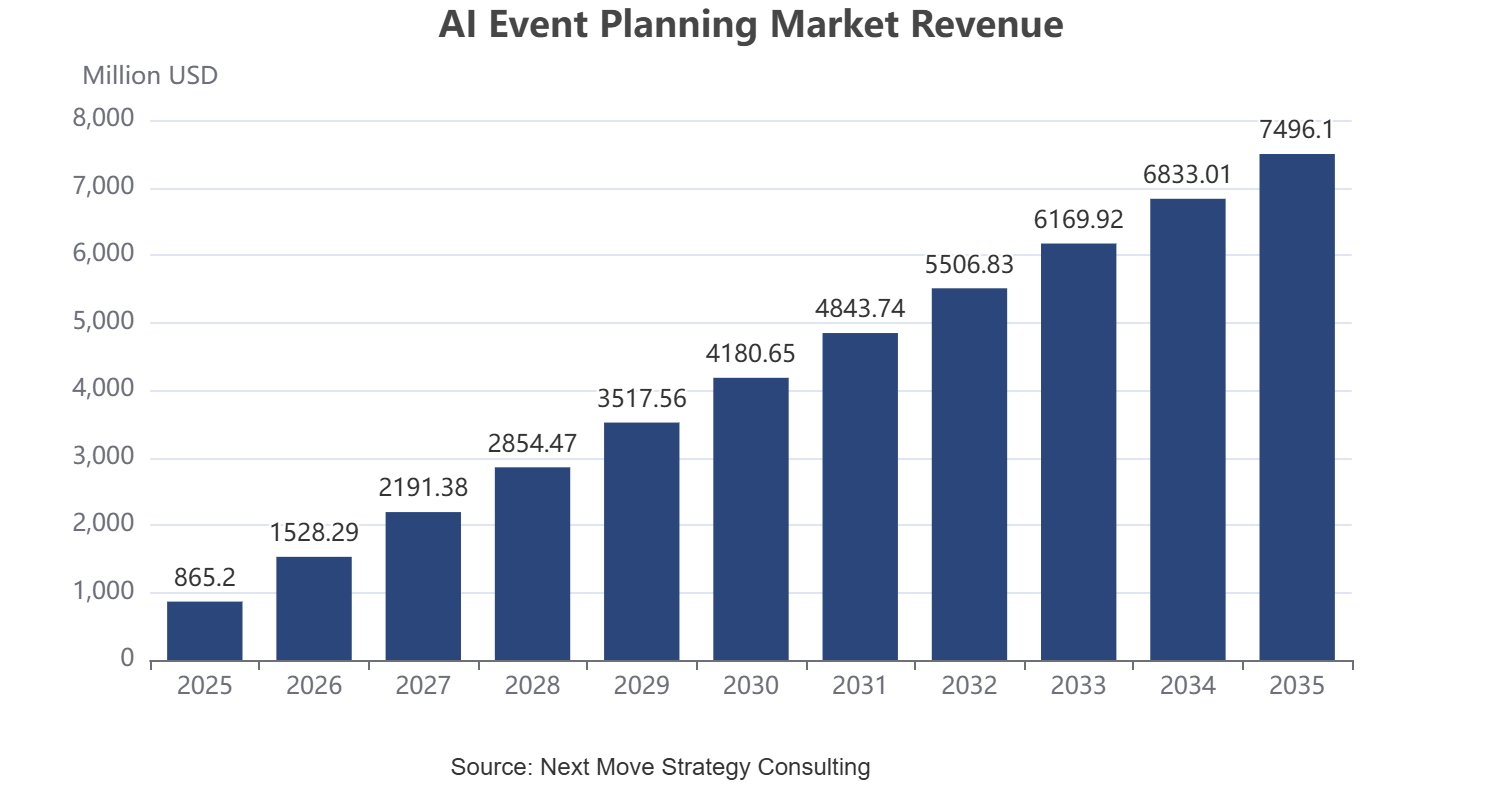
The global AI Event Planning Market encompasses artificial-intelligence-powered software platforms and professional services that automate, optimize, and personalize the full lifecycle of event management, from venue sourcing and budget planning through attendee registration, engagement, and post-event analytics. The market was valued at USD 865.2 Million in 2025 and is expected to reach USD 1,073.7 Million in 2026. Expanding enterprise adoption of AI-driven automation, surging demand for hybrid event formats, and the proliferation of subscription-based SaaS platforms are projected to propel the market to USD 7,496.1 Million by 2035, at a CAGR of 24.1% from 2026 to 2035. Key growth drivers include rapid deployment of AI matchmaking and personalization engines, rising demand for real-time event analytics, growing self-service adoption among mid-market organizers, and expanding AI events platform rollout across healthcare, financial services, and government sectors globally.
|
Parameters |
Details |
|
Market Size in 2025 |
USD 865.2 Million |
|
Market Size in 2026 |
USD 1,073.7 Million |
|
Revenue Forecast in 2035 |
USD 7,496.1 Million |
|
Growth Rate |
CAGR of 24.1% from 2026 to 2035 |
|
Analysis Period |
2025–2035 |
|
Base Year Considered |
2025 |
|
Forecast Period |
2026–2035 |
|
Market Size Estimation |
Revenue (USD Million) |
|
Companies Profiled |
20 |
|
Countries Covered |
38 |
|
Market Share |
Available for Top 10 Companies |
AI Event Planning Market Overview
What Is the AI Event Planning Market and What Does Its Scope Include?
The AI Event Planning Industry encompasses cloud-based software platforms and professional services applying artificial intelligence, machine learning, and natural language processing to automate and personalize the complete event lifecycle. Scope spans corporate conferences, trade shows and exhibitions, association gatherings, consumer festivals, internal employee events, and government ceremonies. Platform capabilities include AI-powered venue selection, RFP automation, budget optimization, intelligent registration and ticketing, attendee engagement through matchmaking and chatbot concierge, marketing automation with audience segmentation and lead scoring, and sponsor monetization tools deployed across multi-tenant SaaS, private cloud, and on-premises architectures.
How Has the AI Event Planning Market Evolved from Manual Planning to Intelligent Automation?
The AI Event Planning Market has progressed through three structural phases. The first generation comprised standalone digital registration and basic online ticketing, displacing manual spreadsheet processes. The second phase introduced integrated event management suites combining registration, email marketing, and basic reporting, exemplified by Cvent and Eventbrite's early deployments. Through our market assessment, we observed that the current phase is defined by AI-native platforms that predict attendee preferences, automate content recommendations, generate personalized agendas, and enable real-time ROI attribution across hybrid event formats, transforming event planners from logistics coordinators into strategic experience architects.
What Regulatory and Compliance Forces Are Shaping the AI Event Planning Market?
Regulatory frameworks governing data privacy, consent management, and digital accessibility are significantly shaping product architecture and procurement decisions within the AI Event Planning Market. The European Union's General Data Protection Regulation and the California Consumer Privacy Act impose strict requirements on attendee data collection and third-party sharing, compelling vendors to embed consent management, data residency controls, and purpose-limitation safeguards within registration and analytics modules. The Americans with Disabilities Act and the European Accessibility Act are driving demand for accessible registration interfaces, live captioning integration, and sign-language interpretation features within platforms serving corporate and government buyers.
How Is Technology Adoption Accelerating Growth Across the AI Event Planning Market?
Technology adoption within the AI Event Planning Market is accelerating as generative AI capabilities transition from experimental add-ons to production-grade tools embedded in commercial platforms. Our assessment indicates that AI-powered matchmaking engines now deliver statistically measurable improvements in networking satisfaction scores, directly influencing renewal decisions among enterprise event organizers. Cloud-native multi-tenant SaaS architectures are enabling mid-market organizers to access enterprise-grade AI capabilities previously limited to large organizations. Integration of real-time event analytics with CRM and marketing automation platforms through standardized API ecosystems is expanding the addressable buyer base to marketing operations teams that historically managed event technology independently.
|
Key Takeaways |
|
Event Software dominates at USD 595.0 Million in 2025, projected to reach USD 5,100.0 Million by 2035. Services is the fastest-growing offering at a CAGR of 24.6% from 2026 to 2035, driven by Managed Operations and Implementation demand from enterprise buyers transitioning from legacy point solutions to integrated AI event lifecycle platforms. |
|
Subscription License leads at USD 320.0 Million in 2025 and is the fastest-growing revenue stream at a CAGR of 24.5% from 2026 to 2035, reflecting enterprise adoption of annual platform licenses and the structural shift toward recurring SaaS cost models among corporate and association event organizers. |
|
Multi-Tenant SaaS dominates at USD 600.0 Million in 2025 and USD 5,250.0 Million by 2035, and is the fastest-growing deployment model at a CAGR of 24.5% from 2026 to 2035, propelled by cloud-native accessibility, elastic scalability, and vendor-managed infrastructure reducing total cost of ownership. |
|
Corporate Events leads at USD 268.0 Million in 2025. Consumer & Community Events is the fastest-growing event type at a CAGR of 24.3% from 2026 to 2035, advancing from USD 109.0 Million in 2025 to USD 950.0 Million by 2035, driven by community-brand experiences and AI-enhanced ticketing adoption. |
|
Direct Sales leads at USD 380.0 Million in 2025 and is the fastest-growing channel at a CAGR of 24.4% from 2026 to 2035, as enterprise-focused vendors prioritize dedicated sales motions for multi-year platform contracts with corporate, healthcare, and financial services event organizers. |
|
Technology And Media is the dominant end user industry at USD 260.0 Million in 2025 and the fastest-growing vertical at a CAGR of 24.5%, expanding to USD 2,295.0 Million by 2035, driven by high event frequency, digital-first attendee expectations, and advanced AI feature adoption among technology companies globally. |
|
North America held the largest regional share at USD 325.0 Million in 2025, forecast to reach USD 2,820.0 Million by 2035 at a CAGR of 24.3%, anchored by leading AI events planning vendors, the highest enterprise technology budgets, and the world's most active corporate conference ecosystem. |
|
Asia-Pacific is the fastest-growing major region at a CAGR of 24.7%, advancing from USD 195.0 Million in 2025 to USD 1,720.0 Million by 2035, driven by digital transformation of corporate event management across India, China, and Southeast Asia and expanding cloud infrastructure. |
|
The United States is the single largest country market, contributing approximately 76% of North American AI Event Planning Market revenue in 2025, supported by the world's highest concentration of technology, financial services, and healthcare conference organizers. |
|
India is the fastest-growing national market at a CAGR of 24.8% from 2026 to 2035, driven by rapidly expanding corporate event budgets, strong domestic SaaS ecosystem growth, and technology-sector event proliferation across Bangalore, Hyderabad, Mumbai, and Delhi NCR. |
Key Emerging Trends in the AI Event Planning Industry
How Is Generative AI Transforming Attendee Engagement and Event Personalization in the AI Event Planning Market?
Generative AI is fundamentally redefining attendee engagement within the AI Event Planning Market by enabling real-time, individualized content and schedule recommendations at scale, previously unachievable through manual curation. From our research, we found that platforms including Bizzabo and Cvent have embedded large language model capabilities into their attendee-facing mobile apps, enabling conversational session discovery, dynamic agenda building, and AI-generated event summaries. Enterprise event organizers report measurably higher session attendance completion rates when generative AI recommends personalized tracks aligned with attendee professional profiles. This trend is catalyzing investment in first-party data infrastructure and AI model training pipelines across the leading platform vendors.
What Role Is Real-Time Event Analytics Playing in Reshaping ROI Measurement Across the AI Event Planning Market?
Real-time analytics dashboards that aggregate registration conversion, session attendance, sponsor booth engagement, and app interaction data into unified event intelligence platforms are becoming competitive table-stakes within the AI Event Planning Market. Our findings suggest that corporate event buyers increasingly require demonstrable event ROI data linked to pipeline influence and marketing attribution models before committing to multi-year platform contracts. Platforms such as ON24, RainFocus, and Cvent have invested significantly in analytics capabilities that connect event engagement metrics directly to CRM systems, including Salesforce and Microsoft Dynamics, enabling CMOs to quantify event contribution to revenue generation and justify enterprise event budget allocations.
How Is Hybrid Event Technology Bridging Physical and Digital Participation in the AI Event Planning Market?
Hybrid event formats combining simultaneous in-person and virtual participation have created a structurally new technology requirement within the AI Event Planning Market for platforms capable of delivering equivalent engagement quality across both modalities. Based on our market evaluation, we noticed that vendors including vFairs, Swapcard, and ON24 have developed dedicated hybrid broadcast infrastructure supporting simultaneous live streaming, virtual networking rooms, and digital sponsor activations alongside physical event operations. The International Association of Exhibitions and Events has documented sustained organizer investment in hybrid-capable technology stacks, reflecting the recognition that hybrid formats expand audience reach while reducing geographic and cost barriers to attendance for global participants.
What Are the Key Market Drivers, Breakthroughs, and Investment Opportunities that will Shape the AI Event Planning Industry in the Next Decade?
|
Driver / Trend / Restraint |
(+/−) % Impact on CAGR Forecast |
Geographic Relevance |
Impact Timeline |
|
Enterprise Digital Transformation Accelerating Adoption of AI Event Management Platforms |
+2.8% |
Global (led by North America and Europe) |
2025–2032 |
|
Rising Adoption of Hybrid and Virtual Event Formats |
+2.4% |
Global |
2025–2030 |
|
Increasing Data Privacy Regulations and Attendee Consent Compliance Requirements |
−1.4% |
Europe, North America |
Ongoing |
|
Expansion of Cloud SaaS Infrastructure Across Emerging Markets |
+1.6% |
Asia-Pacific, Middle East & Africa, Latin America |
2026–2035 |
What Are the Growth Drivers of the AI Event Planning Market?
How Is the Acceleration of Enterprise Digital Transformation Driving AI Event Planning Industry Demand?
Enterprise digital transformation programs across technology, financial services, and healthcare sectors are compelling event management teams to replace manual spreadsheets and legacy on-premises planning tools with AI-powered cloud platforms that integrate natively with enterprise CRM, marketing automation, and procurement systems. Based on NMSC's research, we found that the U.S. General Services Administration's Federal Acquisition Regulation updates governing cloud software procurement have expanded federal agency adoption of cloud-hosted event management platforms, creating a durable government buyer segment for certified SaaS vendors. Globally, enterprises report that AI events platform adoption reduces event planning cycle times and enables smaller teams to manage higher event volumes, creating compelling operational productivity justifications for platform investment.
How Is the Rise of Hybrid and Virtual Event Formats Fueling Growth in the AI Event Planning Market?
The structural normalization of hybrid and virtual event formats following the post-pandemic period has permanently expanded the technology footprint required per event, directly increasing average per-event technology spend and platform contract values within the AI Event Planning Market. Our assessment indicates that organizations maintaining hybrid event programs require integrated platforms capable of managing registration, access control, live streaming, virtual networking, and on-demand content delivery within a single operational interface. The Professional Convention Management Association has documented sustained industry investment in hybrid event technology capabilities as a core competency, reflecting the recognition that hybrid formats have become a permanent fixture of enterprise event strategies rather than a temporary accommodation.
What Are the Growth Inhibitors of the AI Event Planning Market?
How Do Data Privacy Regulations and Attendee Consent Requirements Constrain the Market?
The complexity of complying with overlapping data privacy regulations across the 38 countries covered in this report creates significant product development and compliance overhead for AI events platform vendors, particularly those targeting multinational enterprise clients requiring simultaneous GDPR, CCPA, and PIPEDA compliance within unified attendee data architectures. Our analysis shows that implementing consent management workflows, data subject access request automation, and cross-border data transfer safeguards across registration, matchmaking, and analytics modules requires substantial engineering investment that smaller vendors struggle to fund, effectively creating a compliance-driven consolidation pressure that favors established platforms with dedicated legal and engineering compliance resources.
What Are the Growth Opportunities in the AI Event Planning Market?
How Does the Expansion of Emerging Markets Create New Growth Opportunities for AI Events Planning Vendors?
Rapid enterprise digital infrastructure expansion across Asia-Pacific, the Middle East, and Latin America is creating structurally new addressable markets for AI events planning platforms as organizations in these regions transition from manual event planning to cloud-native management tools. Through NMSC's assessment, we found that India's expanding corporate event sector, supported by the country's booming technology industry and growing MICE (Meetings, Incentives, Conferences, and Exhibitions) infrastructure, represents a high-growth opportunity for internationally expanding AI events platform vendors offering localized deployment, regional language support, and compliance with India's Digital Personal Data Protection Act. Government digitization programs across MEA and ASEAN nations are also creating structured demand for AI events platform adoption within public sector agencies.
How Is the AI Event Planning Industry Segmented and What Are the Key Insights from the Segmentation Analysis?
How Does the Offering Dimension Define the Competitive Boundaries of the AI Event Planning Market?
|
Segment |
2025 (USD Mn) |
2035 (USD Mn) |
CAGR% (2026–2035) |
|
Event Software |
595.0 |
5,100.0 |
23.9% |
|
Services |
270.2 |
2,396.1 |
24.6% |
The AI Event Planning Market is structurally divided between Event Software and Services, with Event Software encompassing Planning & Sourcing (Venue Selection, RFP Automation, Budgeting, Agenda Planning, Resource Planning), Registration & Ticketing (Registration Forms, Payments, Check-In, Badging), Engagement & Networking (Matchmaking, Recommendations, Chatbots, Concierge), Marketing & Monetization (Audience Segmentation, Campaign Automation, Lead Scoring, Sponsor Sales), and Others. Event Software dominates at USD 595.0 Million in 2025, driven by the breadth of modules delivered within integrated SaaS platforms that enterprise organizers deploy across the complete event lifecycle. Services, encompassing Implementation, Consulting, Managed Operations, and Training & Support, are the fastest-growing axis at a CAGR of 24.6%, as increasing platform complexity and enterprise customization requirements drive demand for vendor-delivered professional services alongside software licenses.
Which Revenue Stream Architectures Are Reshaping Commercial Models in the AI Event Planning Market?
|
Segment |
2025 (USD Mn) |
2035 (USD Mn) |
CAGR% (2026–2035) |
|
Subscription License |
320.0 |
2,800.0 |
24.5% |
|
Usage Fees |
195.0 |
1,690.0 |
24.1% |
|
Transaction Fees |
155.0 |
1,340.0 |
24.0% |
|
Service Fees |
145.0 |
1,250.0 |
24.2% |
|
Hardware-Bundled License |
50.2 |
416.1 |
23.4% |
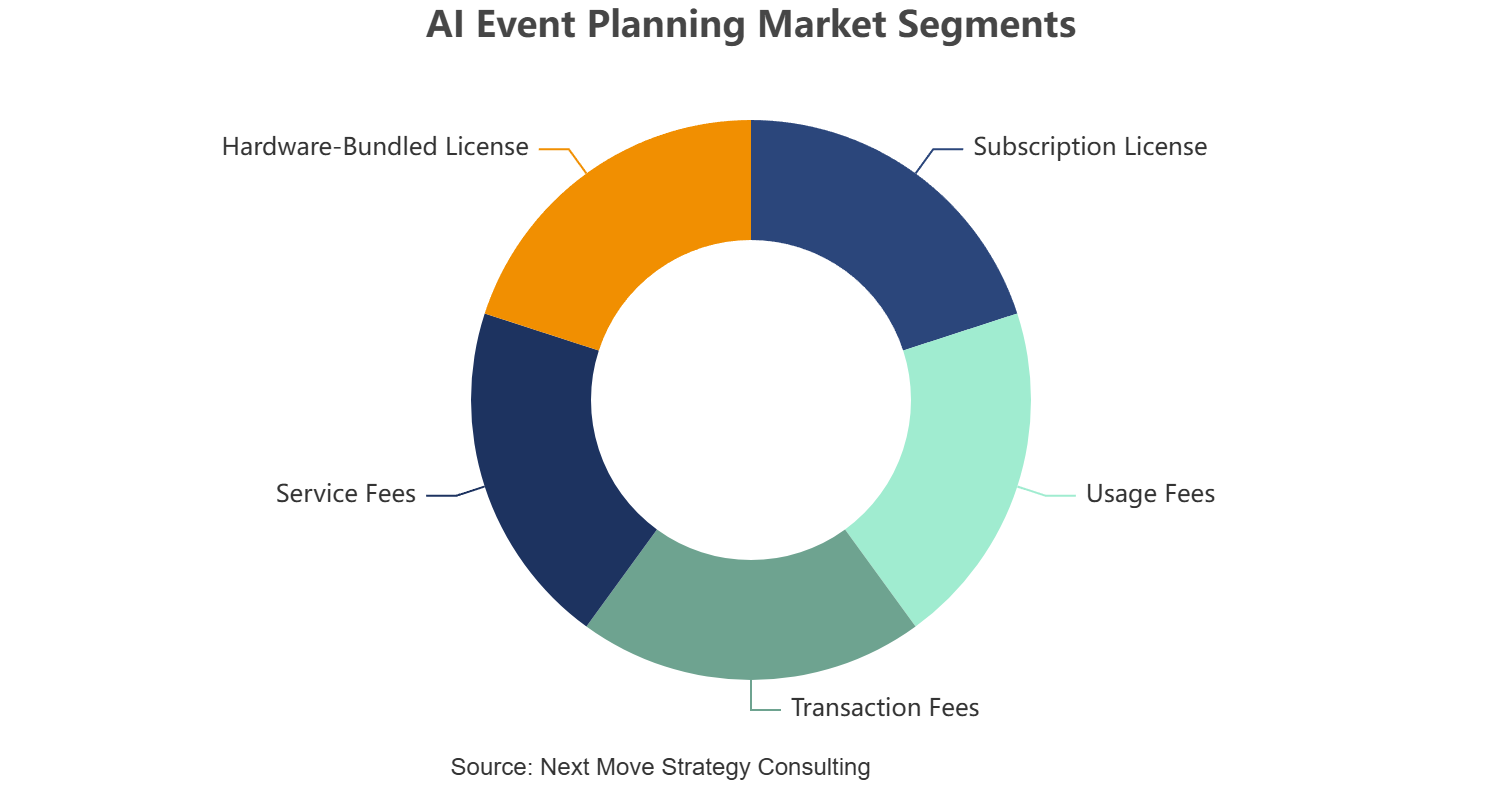
The AI Event Planning Market generates revenue across five distinct commercial streams. Subscription License leads at USD 320.0 Million in 2025, driven by enterprise annual platform agreements that provide predictable recurring revenue for vendors and stable budget allocation for buyers. Usage Fees at USD 195.0 Million reflect consumption-based pricing aligned with event volume and attendee counts, which appeals to mid-market organizers with variable event calendars. Transaction Fees at USD 155.0 Million are generated through ticketing and payment processing, disproportionately concentrated in consumer and trade show event types. Hardware-Bundled Licenses, though the smallest at USD 50.2 Million, support check-in device and badging hardware ecosystems. Subscription License is the fastest-growing stream at a CAGR of 24.5%, reflecting enterprise buyers' preference for all-inclusive annual platform access.
Which Industries Are Generating the Most Value Within the AI Event Planning Market?
|
Segment |
2025 (USD Mn) |
2035 (USD Mn) |
CAGR% (2026–2035) |
|
Technology And Media |
260.0 |
2,295.0 |
24.5% |
|
Healthcare And Life Sciences |
145.0 |
1,255.0 |
24.1% |
|
Financial And Professional Services |
155.0 |
1,345.0 |
24.1% |
|
Education |
100.0 |
860.0 |
24.0% |
|
Hospitality |
95.0 |
815.0 |
24.0% |
|
Government |
60.0 |
512.0 |
24.0% |
|
Other Industries |
50.2 |
414.1 |
23.4% |
The AI Event Planning Market is distributed across seven end-user industry verticals. Technology And Media dominates at USD 260.0 Million in 2025 and is the fastest-growing vertical at a CAGR of 24.5%, expanding to USD 2,295.0 Million by 2035, driven by technology companies' high annual event frequency, digital-first attendee populations, and early adoption of AI personalization and analytics features. Financial and Professional Services at USD 155.0 Million reflects compliance-driven investment in secure, auditable event platforms meeting financial services regulatory requirements. Healthcare and Life Sciences at USD 145.0 Million is sustained by pharmaceutical medical education events, hospital system conferences, and life sciences industry summits requiring HCP engagement compliance tracking. Education at USD 100.0 Million captures campus event management and academic conference platforms. Government at USD 60.0 Million is expanding through public sector digital modernization mandates.
Porter's Five Forces Analysis of the AI Event Planning Industry
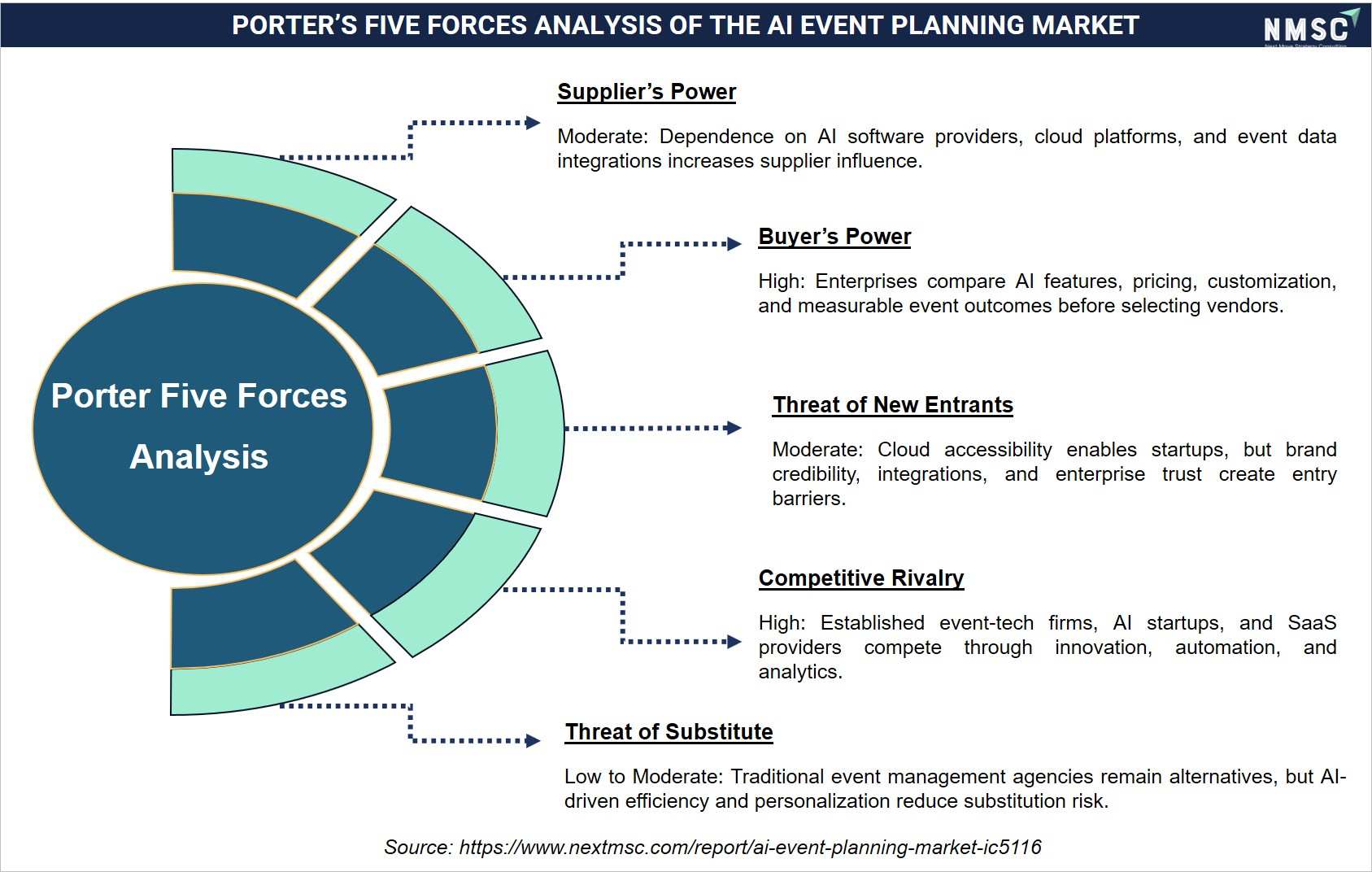
The Porter's Five Forces analysis below maps the key competitive forces, such as the threat of new entrants, bargaining power of suppliers, bargaining power of buyers, threat of substitutes, and industry rivalry, shaping the market. From our analysis, we observed that the bargaining power of buyers is significantly high, driven by the availability of multiple options and low switching costs, which compels existing players to continuously differentiate their offerings and enhance customer value to maintain their competitive edge.
Regional Outlook
Geographic Performance Snapshot
|
Region |
2025 (USD Mn) |
2035 (USD Mn) |
CAGR% (2026–2035) |
Key Driver |
|
North America |
325.0 |
2,820.0 |
24.3% |
Leading vendor HQ, enterprise tech budgets, corporate event density |
|
Europe |
215.0 |
1,860.0 |
24.1% |
GDPR-compliant platform demand, hybrid event investment, association events |
|
Asia-Pacific |
195.0 |
1,720.0 |
24.7% |
Digital transformation, corporate event growth, SaaS infrastructure expansion |
|
Middle East & Africa |
70.0 |
596.0 |
23.9% |
Vision 2030 digitization, MICE investment, government event modernization |
|
Latin America |
60.2 |
500.1 |
23.6% |
Corporate event digitization, fintech sector events, SaaS cloud adoption |
North America AI Event Planning Market
North America is the dominant region in the global AI Event Planning Market, contributing USD 325.0 Million in 2025 and is forecast to reach USD 2,820.0 Million by 2035 at a CAGR of 24.3%. The region benefits from the global headquarters of leading vendors, including Cvent, ON24, RainFocus, Bizzabo, Whova, and Eventbrite, alongside the world's highest density of corporate conference organizers. Enterprise technology budgets in financial services, technology, and healthcare sectors drive consistent platform procurement. The U.S. General Services Administration's cloud procurement frameworks and the American Disability Act accessibility standards create compliance-driven demand for certified event platform vendors across corporate and government buyer segments.
U.S. AI Event Planning Market
Based on our engagements with enterprise buyers, the United States represents approximately 76% of the North American AI Event Planning Market revenue in 2025, valued at USD 248.0 Million, and is forecast to reach USD 2,162.0 Million by 2035 at a CAGR of 24.3%. The U.S. benefits from the world's highest concentration of corporate event organizers, technology conference ecosystems, and healthcare and life sciences meeting professionals requiring AI-enhanced planning platforms. The FTC's data privacy guidelines and the Health Insurance Portability and Accountability Act compliance requirements for healthcare event data drive structured demand for governed event platforms among hospital systems and pharmaceutical companies. Leading technology companies' annual developer and user conference programs represent a high-value recurring buyer segment.
Canada AI Event Planning Market
Through our analysis, Canada represents approximately 15% of the North American AI Event Planning Market revenue in 2025, valued at USD 50.0 Million, projected to reach USD 430.0 Million by 2035 at a CAGR of 24.0%. Canada's significant financial services sector and growing technology industry across Toronto, Vancouver, and Montreal drive enterprise event platform adoption. The Government of Canada's Digital Ambition strategy is expanding public sector cloud event management investment. Canada's Personal Information Protection and Electronic Documents Act compliance requirements influence deployment architecture selection, favouring Canadian cloud regions offered by major SaaS vendors with confirmed data residency certifications for regulated industry buyers.
Europe AI Event Planning Market
Europe is the second-largest region in the AI Event Planning Market, contributing USD 215.0 Million in 2025 and is forecast to reach USD 1,860.0 Million by 2035 at a CAGR of 24.1%. The region's regulatory environment, shaped by the GDPR, the EU AI Act, and the European Accessibility Act, drives structured investment in compliant, governed event management platforms. Europe's dense association and professional society event ecosystem creates a large structural buyer base for AI-enhanced conference management platforms. Hybrid event investment remains strong across European corporate buyers who managed international participant bases during pandemic restrictions and have retained hybrid formats as a permanent structural element of their event programs.
UK AI Event Planning Market
According to our evaluation, the United Kingdom is Europe's largest individual AI Event Planning Market, valued at USD 48.0 Million in 2025 and projected to reach USD 418.0 Million by 2035 at a CAGR of 24.3%. London's financial center, professional services cluster, and technology ecosystem make the UK a high-density corporate event market. The UK Information Commissioner's Office enforces UK GDPR, compelling event platform vendors to maintain post-Brexit data adequacy certifications. ExCeL London, the NEC Birmingham, and the Scottish Event Campus represent major trade show venues driving exhibition technology demand. UK-based pharmaceutical and life sciences firms operating global medical education events represent a growing compliance-driven buyer segment for specialized event management platforms.
Germany AI Event Planning Market
Based on our engagements, Germany is Europe's second-largest AI Event Planning Market at USD 37.0 Million in 2025, projected to reach USD 320.0 Million by 2035 at a CAGR of 24.2%. Germany hosts the world's largest trade fairs, including Hannover Messe, IAA, and Bauma, operated by Deutsche Messe and Messe München, which represent high-value enterprise buyers of advanced exhibition management and matchmaking technology. The Federal Commissioner for Data Protection (BfDI) enforces stringent GDPR compliance, driving demand for data governance features within event platforms. Germany's manufacturing and automotive sector corporate event programs, and the country's strong association and industry federation event calendar, create a structurally broad enterprise buyer base.
France AI Event Planning Market
Through our analysis, France represents Europe's third-largest AI Event Planning Market at USD 30.0 Million in 2025, projected to reach USD 260.0 Million by 2035 at a CAGR of 24.2%. Paris's position as a global luxury, fashion, and automotive trade show destination, combined with France's strong corporate event culture, creates sustained platform demand. The CNIL enforces GDPR compliance stringently, shaping event platform data architecture selection among French enterprise buyers. The France 2030 investment plan directs public sector digital transformation spending, including digital event management for government agencies and state-owned enterprises. BNP Paribas, TotalEnergies, and L'Oreal represent large French enterprise event platform buyers.
Asia-Pacific AI Event Planning Market
Asia-Pacific is the fastest-growing major region in the AI Event Planning Market, advancing from USD 195.0 Million in 2025 to USD 1,720.0 Million by 2035 at a CAGR of 24.7%. Growth is driven by the digital transformation of corporate event management across India, China, Japan, and Southeast Asia, expanding cloud infrastructure that enables SaaS event platform adoption, and rapidly growing corporate event budgets among Asia-Pacific technology, manufacturing, and financial services companies. Regulatory frameworks, including India's Digital Personal Data Protection Act, China's Personal Information Protection Law, Japan's Act on Protection of Personal Information, and South Korea's Personal Information Protection Act, are shaping enterprise event platform data governance architecture across the region.
China AI Event Planning Market
Through our analysis, China is the largest individual AI Event Planning Market in Asia-Pacific, valued at USD 42.0 Million in 2025 and projected to reach USD 374.0 Million by 2035 at a CAGR of 24.6%. China's massive corporate event calendar, spanning technology company launches, manufacturing industry exhibitions, and government-sponsored trade fairs, drives structured demand for AI events platform capabilities. Domestic platform providers compete with international vendors, adapting to China's Personal Information Protection Law and data localization requirements enforced by the Cyberspace Administration of China. China's National Exhibition Center in Shanghai and the China International Import Expo represent large-scale event management deployments driving sophisticated platform requirements.
India AI Event Planning Market
From our assessment, India is the fastest-growing AI Event Planning Market in Asia-Pacific at a CAGR of 24.8%, advancing from USD 32.0 Million in 2025 to USD 292.0 Million by 2035. India's booming technology sector is driving large-scale developer conferences, the financial services industry growth is supporting investor and client events, and pharmaceutical sector medical education programs are creating diversified demand. The Ministry of Electronics and Information Technology's Digital India initiative and the Digital Personal Data Protection Act 2023 shape enterprise data governance. Infosys, Wipro, Tata Consultancy Services, and pharmaceutical companies represent significant Indian enterprise event platform buyers across Bangalore, Hyderabad, Pune, and Mumbai.
Japan AI Event Planning Market
According to our evaluation, Japan represents the second-largest AI Event Planning Market in Asia-Pacific at USD 28.0 Million in 2025, projected to reach USD 242.0 Million by 2035 at a CAGR of 24.2%. Japan's Society 5.0 vision and Digital Agency cloud strategy are driving enterprise digital event management adoption. Toyota, Sony, Panasonic, and Japan's major financial institutions, including Mitsubishi UFJ Financial Group, are significant corporate event platform buyers. The Personal Information Protection Commission enforces Japan's Act on Protection of Personal Information, governing event attendee data handling. Japan's large pharmaceutical industry and medical device sector create specialized demand for HCP engagement-compliant congress management platforms.
South Korea AI Event Planning Market
Based on our engagements, South Korea contributes USD 20.0 Million in 2025, projected to reach USD 174.0 Million by 2035 at a CAGR of 24.3%. South Korea's advanced digital infrastructure, global technology manufacturers including Samsung and LG, and expanding startup ecosystem in Seoul's Gangnam district drive demand for structured AI events platforms. The Personal Information Protection Commission enforces the Personal Information Protection Act. South Korea's K-Cloud initiative and government AI strategy are directing public sector investment toward cloud-native event management. Korea's semiconductor and display industry trade show calendar, anchored by events like Samsung Developer Conference, represents high-value corporate event platform buyers.
Middle East and Africa AI Event Planning Market
The Middle East and Africa region represents a growing segment of the AI Event Planning Market, advancing from USD 70.0 Million in 2025 to USD 596.0 Million by 2035 at a CAGR of 23.9%. National digital transformation programs in Saudi Arabia and the UAE, anchored by Vision 2030 and the UAE AI Strategy 2031, respectively, are the primary growth engines. South Africa's established financial services hub and Nigeria's growing corporate event sector provide Sub-Saharan Africa's primary revenue base. National data residency requirements across the GCC region are compelling platform vendors to establish in-country cloud regions supporting compliant event management deployments for regulated enterprise buyers.
Saudi Arabia AI Event Planning Market
Based on our engagements, Saudi Arabia is the largest AI Event Planning Market within MEA, valued at USD 14.0 Million in 2025 and projected to reach USD 120.0 Million by 2035 at a CAGR of 24.2%. Vision 2030's economic diversification agenda is driving large-scale government and corporate event investment, including NEOM smart city conferences, LEAP technology conference, and Future Investment Initiative forums. The Saudi Authority for Data and Artificial Intelligence has published the National Data Management Framework establishing public sector data governance requirements. All major cloud providers have established Saudi Arabia cloud regions, enabling compliant SaaS event platform deployment. ARAMCO, SABIC, and the Public Investment Fund represent high-value enterprise event buyers.
UAE AI Event Planning Market
Through our analysis, the UAE is the second-largest AI Event Planning Market in MEA at USD 12.0 Million in 2025, projected to reach USD 104.0 Million by 2035 at a CAGR of 24.3%. Dubai and Abu Dhabi's ambitions as global MICE destinations, exemplified by GITEX Global, Abu Dhabi Finance Week, and the Dubai World Trade Centre's extensive event calendar, drive demand for sophisticated event management platforms. The UAE AI Strategy 2031 and UAE Data Law provide enterprise governance frameworks. DIFC and ADGM financial free zones maintain global-standard data protection regimes. Emirates NBD, First Abu Dhabi Bank, Etisalat, and Abu Dhabi National Oil Company represent major UAE enterprise event platform buyers.
South Africa AI Event Planning Market
From our assessment, South Africa contributes USD 8.0 Million in 2025, projected to reach USD 66.0 Million by 2035 at a CAGR of 23.9% in the AI Event Planning Market. South Africa's Johannesburg financial capital, Cape Town technology hub, and Sandton Convention Centre represent the primary enterprise event technology demand centers. The Protection of Personal Information Act compliance requirements shape event data architecture. Standard Bank, FirstRand, and Nedbank are sophisticated corporate event platform buyers for investor days, product launches, and employee engagement events. South Africa's growing startup ecosystem and expanding pan-African corporate operations of South African multinationals create demand for AI events platforms with international deployment capability.
Latin America AI Event Planning Market
Latin America is an emerging segment of the global AI Event Planning Market, advancing from USD 60.2 Million in 2025 to USD 500.1 Million by 2035 at a CAGR of 23.6%. Brazil's corporate event sector, Argentina's growing tech event ecosystem, and regional trade show expansion are the primary demand drivers. Brazil's Lei Geral de Protecao de Dados, modeled on GDPR, is compelling enterprise event data governance investment across the region. Cloud infrastructure expansion by major providers in Sao Paulo and Santiago is enabling cloud-native AI events SaaS platform adoption among enterprise buyers transitioning from manual spreadsheets and legacy on-premises event management systems.
Brazil AI Event Planning Market
Based on our engagements, Brazil is the largest AI Event Planning Market in Latin America, valued at USD 22.0 Million in 2025 and projected to reach USD 184.0 Million by 2035 at a CAGR of 23.9%. Brazil's large technology, financial services, and agribusiness sectors drive significant corporate event budgets. The Autoridade Nacional de Protecao de Dados enforces the LGPD data protection law governing event attendee data. Sao Paulo's Expo Center Norte and Transamerica Expo Center represent large exhibition management buyers. Itau Unibanco, Bradesco, Nubank, and the Brazil-based operations of global technology companies are significant enterprise event platform buyers driving adoption of AI-powered planning and engagement tools.
Argentina AI Event Planning Market
Through our analysis, Argentina contributes USD 12.0 Million in 2025, projected to reach USD 100.0 Million by 2035 at a CAGR of 23.9% in the AI Event Planning Market. Argentina's Buenos Aires technology hub, growing fintech sector, and startup ecosystem anchored by companies including MercadoLibre create structured corporate event demand. The Agencia de Acceso a la Informacion Publica enforces Argentina's data protection framework. Despite macroeconomic volatility, Argentina's technology sector maintains strong growth, with software exports creating enterprise demand for cloud-native AI event management platforms accessed through global cloud provider regions. Argentina's extensive professional association network supports recurring conference management platform demand.
Competitive Landscape
|
Key Takeaways |
Details |
|
Market Structure |
The AI Event Planning Market is moderately fragmented, with Cvent and ON24 holding dominant positions in enterprise full-lifecycle planning and virtual event segments respectively, while Bizzabo, RainFocus, Swapcard, and Eventbrite lead in targeted mid-market, trade show, and self-service segments. The market supports numerous specialized vendors across engagement, matchmaking, and managed operations categories. |
|
Innovation Focus |
Vendors are prioritizing generative AI for attendee personalization and agenda automation, AI-powered matchmaking and networking facilitation, real-time event ROI attribution linked to CRM opportunity records, and hybrid event infrastructure enabling simultaneous in-person and virtual participant management within unified platform architectures. |
|
M&A Activity |
The AI Event Planning Market has seen strategic consolidation activity driven by private equity investment in leading platforms, enterprise software vendors acquiring event technology capabilities, and marketing technology companies integrating event management into broader customer experience suites. Consolidation is accelerating among mid-tier vendors seeking scale. |
How Do Companies Compete in the AI Event Planning Market?
The AI Event Planning Market is characterized by multi-dimensional competition across AI capability depth, platform breadth, integration ecosystem completeness, and enterprise support quality. Cvent competes on enterprise full-lifecycle platform comprehensiveness and global venue sourcing network breadth. ON24 differentiates through virtual event engagement analytics and marketing attribution depth. Bizzabo and Swapcard compete on attendee experience innovation and AI matchmaking quality. Our assessment indicates that market structure is evolving from point-solution competition toward platform ecosystem competition, where vendors differentiate through the completeness of their AI-enabled event lifecycle suite, the breadth of CRM and marketing automation integrations, and the depth of post-event analytics that connect event investment to revenue pipeline outcomes.
Which Company Archetypes Dominate the AI Event Planning Market?
The AI Event Planning Market is dominated by two structural archetypes: enterprise full-lifecycle platform vendors delivering integrated AI-powered solutions across all event management phases, and specialized point-solution vendors optimized for specific use cases including virtual events, attendee matchmaking, or trade show exhibitor management. Cvent, RainFocus, and Stova represent the enterprise full-lifecycle archetype, leveraging comprehensive platform breadth and deep enterprise integrations to win multi-year contracts. ON24, vFairs, and Whova represent specialized vendors competing on depth of capability within specific event formats or functional niches. Eventbrite and Eventzilla occupy the self-service marketplace archetype, serving the broad SMB and consumer event organizer segment through frictionless onboarding and transaction-fee revenue models.
AI-Native Personalization and Ecosystem Integration Drive Competitive Success in the AI Event Planning Market
NMSC's analysis indicates that AI-native personalization capabilities have become the primary competitive frontier in the AI Event Planning Market, with vendors racing to embed recommendation engines, conversational AI chatbots, predictive session attendance modeling, and generative content tools within attendee-facing mobile and web applications. Ecosystem integration depth, specifically native two-way data synchronization with Salesforce, HubSpot, Microsoft Dynamics, and marketing automation platforms including Marketo and Pardot, is increasingly a prerequisite for enterprise procurement qualification. Vendors that successfully combine deep AI personalization with robust CRM ecosystem connectivity are capturing disproportionate enterprise market share, as CMOs prioritize event platforms that deliver attributable pipeline influence data alongside attendee engagement metrics.
Market Players to Adopt Merger and Acquisition Strategies to Expand Their Presence in the AI Event Planning Market
Merger and acquisition activity is expected to intensify within the AI Event Planning Market through 2035, driven by private equity firms consolidating mid-tier platforms into broader event technology portfolio companies, enterprise software vendors integrating event management capabilities into customer experience suites, and marketing technology platforms acquiring event analytics and engagement tools. Specialized vendors with strong developer communities, established integrations with leading CRM platforms, and proprietary AI matchmaking or personalization capabilities represent attractive acquisition targets. Based on our analysis, the consolidation of the AI Event Planning Market's currently fragmented vendor landscape is expected to reduce the number of independent mid-tier vendors from approximately forty to fewer than twenty by 2030.
Key Market Players in the AI Event Planning Market
-
Cvent
-
Eventbrite
-
ON24
-
ACTIVE Network
-
Bizzabo
-
Swapcard
-
RainFocus
-
vFairs
-
Whova
-
Stova
-
EventMobi
-
Accelevents
-
Glue Up
-
Swoogo
-
PheedLoop
-
Gevme
-
Canapii
-
Eventzilla
-
Cadmium
-
Brella
What are the Latest Developments in the AI Event Planning Market?
|
Date |
Event |
|
June 2025 |
Cvent introduced CventIQ, an AI-powered intelligence layer integrated across its event and hospitality platform. The release adds AI-generated content, venue proposal assistance, session sentiment analysis, personalized attendee experiences, and workflow automation for event planners. |
Expert Insights
 “We’re doing the heavy lifting with AI so our customers don’t have to. We believe planners, marketers and hoteliers should be able to leverage AI so that they focus on what matters most: creating impactful moments.”
- Reggie Aggarwal, Cvent CEO and Founder
Statement made during Cvent CONNECT Europe, as part of Cvent's announcement highlighting three AI-driven trends shaping the future of meetings and events.
Market Interpretation
The statement underscores the expanding role of AI in automating event planning workflows, enabling planners, marketers, and hospitality providers to reduce administrative complexity while focusing on strategic event execution and attendee engagement. As organizations increasingly adopt AI to streamline scheduling, content creation, attendee management, and event personalization, demand for AI-powered event planning platforms is expected to accelerate across corporate meetings, conferences, exhibitions, and hospitality events.
Consumer Behavior Analysis of the AI Event Planning Market
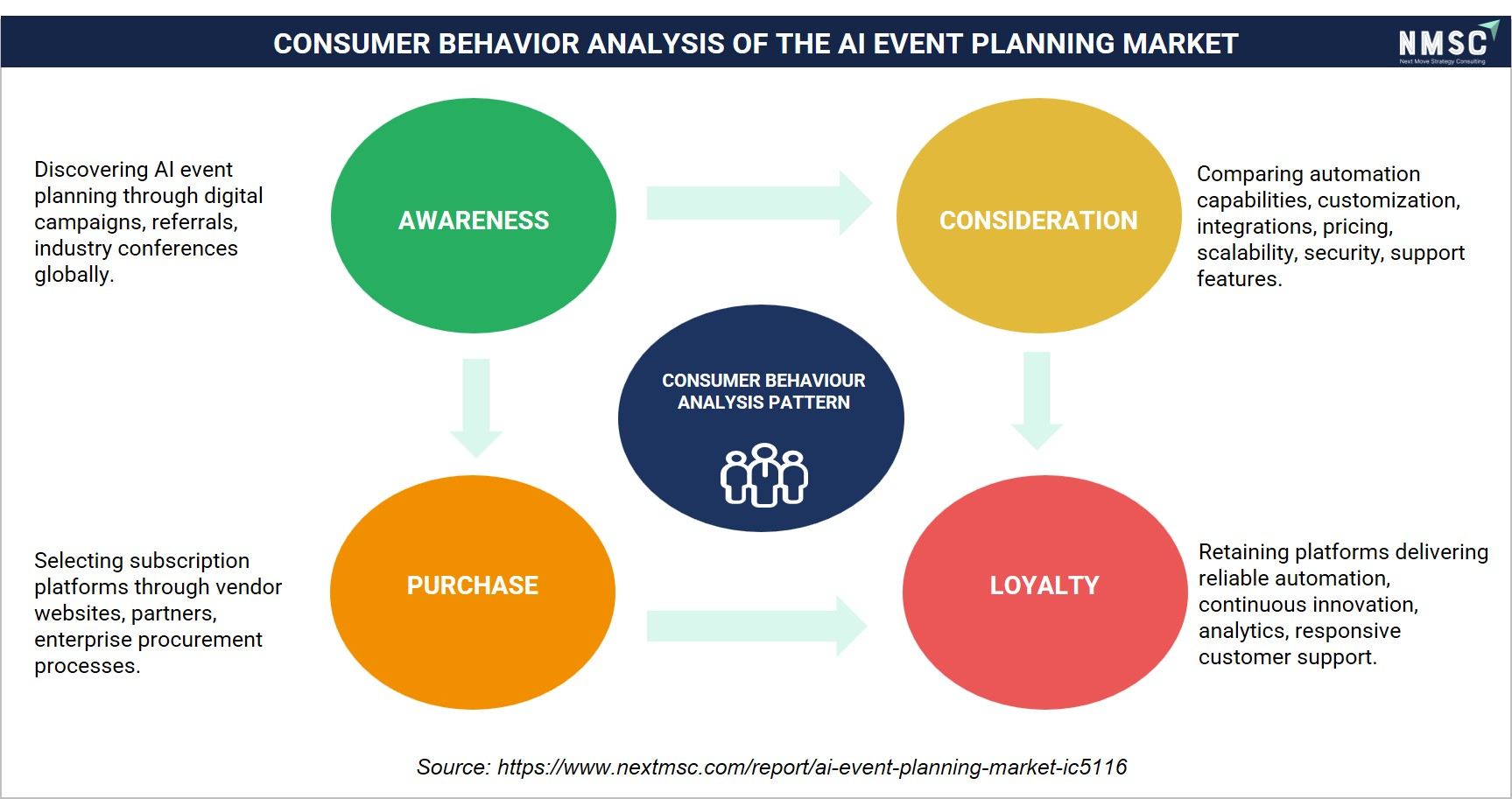
The consumer behavior analysis below maps the key stages, such as awareness, consideration, purchase, and loyalty, shaping the AI event planning market. From our analysis, we observed that consideration is the most critical phase, as customers prioritize customization, integrations, and scalability over pricing alone, compelling providers to invest in transparent feature comparisons and flexible demos to convert evaluators into long-term subscribers.
What Are the Investment Opportunities in the Investment Opportunities in the AI Event Planning Market?
The AI Event Planning Market is attracting strong investment driven by rising demand for AI-native event management platforms, intelligent engagement solutions, and cloud-based enterprise event software that delivers measurable marketing attribution and operational efficiency. Capital inflows from venture capital and private equity, supported by expanding hyperscale cloud infrastructure and AI computing investments, are accelerating platform innovation, deployment, and global market expansion. At the same time, ESG priorities are influencing enterprise procurement, with AI-enabled hybrid and virtual event platforms helping organizations reduce travel-related emissions, measure event carbon footprints, and support sustainability reporting. These trends, combined with enterprise digital transformation initiatives and increasing consolidation through strategic mergers and acquisitions, are creating attractive long-term investment opportunities across the AI Event Planning Market.
Key Benefits for Stakeholders
The AI Event Planning Market report delivers actionable insights for enterprise technology leaders, investors, financial analysts, and technology vendors by providing comprehensive market sizing, growth forecasts, competitive benchmarking, and platform adoption trends through 2035. It supports strategic technology investment, vendor selection, product roadmap development, and investment evaluation by analyzing deployment models, event types, end-user industries, high-growth market segments, and regional adoption patterns. Country-level intelligence, competitive landscape analysis, regulatory and technology adoption insights, and market segmentation across key dimensions further enable informed decision-making, geographic expansion planning, resource allocation, risk assessment, and sustainable business growth across the evolving AI events planning ecosystem.
Key Market Segments
By Offering
-
Event Software
-
Planning & Sourcing
-
Venue Selection
-
RFP Automation
-
Budgeting
-
Agenda Planning
-
Resource Planning
-
-
Registration & Ticketing
-
Registration Forms
-
Payments
-
Check In
-
Badging
-
-
Engagement & Networking
-
Matchmaking
-
Recommendations
-
Chatbots
-
Concierge
-
-
Marketing & Monetization
-
Audience Segmentation
-
Campaign Automation
-
Lead Scoring
-
Sponsor Sales
-
-
Others
-
-
Services
-
Implementation
-
Consulting
-
Managed Operations
-
Training & Support
-
By Revenue Stream
-
Subscription License
-
Usage Fees
-
Transaction Fees
-
Service Fees
-
Hardware-Bundled License
By Deployment Model
-
Multi-Tenant SaaS
-
Private Cloud
-
On-Premises
By Event Type
-
Corporate Events
-
Trade Shows & Exhibitions
-
Associations & Nonprofit Events
-
Consumer & Community Events
-
Internal Events
-
Government Events
By Sales Channel
-
Direct Sales
-
Self-Service
-
Partner-Led Sales
-
Embedded Marketplace
By End User Industry
-
Technology And Media
-
Healthcare And Life Sciences
-
Financial And Professional Services
-
Education
-
Hospitality
-
Government
-
Other Industries
By Region
-
North America: U.S., Canada, and Mexico
-
Europe: UK, Germany, France, Italy, Spain, Sweden, Denmark, Finland, Netherlands, and Rest of Europe
-
Asia-Pacific: China, India, Japan, South Korea, Taiwan, Indonesia, Vietnam, Australia, Philippines, Malaysia, and Rest of APAC
-
Middle East & Africa: Saudi Arabia, UAE, Egypt, Israel, Turkey, Nigeria, South Africa, and Rest of MEA
-
Latin America: Brazil, Argentina, Chile, Colombia, and Rest of LATAM
Conclusion & Recommendations
The AI Event Planning Market is expected to experience sustained growth through 2035, supported by enterprise digital transformation, increasing adoption of hybrid and virtual event formats, rising demand for AI-driven personalization and event ROI analytics, and continuous advancements in generative AI technologies. Vendors should focus on enhancing AI-powered attendee engagement, strengthening CRM ecosystem integrations, expanding industry-specific solutions, and supporting regional compliance and localization to maintain competitive advantage. Organizations can maximize long-term value by adopting phased AI event technology strategies that progress from unified event management and analytics to predictive personalization, real-time optimization, and integrated customer engagement ecosystems, enabling scalable, data-driven event operations and measurable business outcomes.
About the Author
 Mayurima Roy
— Mayurima Roy is Research Analyst at Next Move Strategy Consulting, where she has spent 4 years working across the firm's full industry coverage rather than a single fixed vertical. Her work centers on structured research, ongoing trend tracking, competitive assessment, and insight-led content development, translating complex market data into clear, decision-ready narratives that support informed client decision-making across diverse global industries, market sectors, and world regions every day.
Mayurima Roy
— Mayurima Roy is Research Analyst at Next Move Strategy Consulting, where she has spent 4 years working across the firm's full industry coverage rather than a single fixed vertical. Her work centers on structured research, ongoing trend tracking, competitive assessment, and insight-led content development, translating complex market data into clear, decision-ready narratives that support informed client decision-making across diverse global industries, market sectors, and world regions every day.
About the Reviewer
 Supradip Baul
— Supradip Baul is an accomplished business consultant and strategist with over a decade of rich experience in market intelligence, strategy, technology, and business transformation. His work has included rigorous qualitative and quantitative analysis across multiple industries, helping clients shape investment decisions and long-term roadmaps. Earlier in his career, he was associated with Gartner, where he contributed to industry-leading reports and market share analyses. He has worked with leading global companies and holds an MBA with a dual specialization in Marketing and Finance.
Supradip Baul
— Supradip Baul is an accomplished business consultant and strategist with over a decade of rich experience in market intelligence, strategy, technology, and business transformation. His work has included rigorous qualitative and quantitative analysis across multiple industries, helping clients shape investment decisions and long-term roadmaps. Earlier in his career, he was associated with Gartner, where he contributed to industry-leading reports and market share analyses. He has worked with leading global companies and holds an MBA with a dual specialization in Marketing and Finance.
At Next Move Strategy Consulting, we understand that insightful market research is the cornerstone of successful business decisions. That's why we employ a robust and multifaceted approach, combining various methodologies to deliver the most accurate and actionable data for our clients.

Research Landscape
We navigate the world of research with two primary approaches:
Qualitative Approach
Our qualitative research methodologies involve immersive techniques such as in-depth interviews, focus groups, and observational studies. By engaging directly with individuals and stakeholders, we uncover valuable insights that quantitative data alone may overlook.

Quantitative Research
In tandem with qualitative methodologies, NMSC leverages the power of Quantitative Research to provide a robust foundation of numerical insights. Through systematic data collection and analysis, we quantify patterns, preferences, and market trends, offering a comprehensive view of the business landscape.
Our quantitative research approach employs diverse tools, including surveys, experiments, and statistical modelling. These methodologies enable us to gather data from a large and representative sample, ensuring the statistical significance of our findings. By employing structured questionnaires and standardized data collection methods, we guarantee the reliability and validity of the information we present to our clients.
Quantitative research is particularly effective in measuring the prevalence of trends, assessing market size, and gauging the impact of various factors on consumer behavior. The numerical precision attained through this approach equips our clients with actionable insights, facilitating data-driven decision-making and strategy formulation.


Our Specialized Toolbox for Industry-Specific Market Research
We deploy a specialized arsenal of techniques tailored to meet your unique requirements. Here's a glimpse into our comprehensive toolbox:

Information Procurement
The stage entails acquiring market data or relevant information through various sources and methodologies.


Market Research Approach
We utilize both top-down and bottom-up approaches in market research analysis to achieve a comprehensive understanding of the market dynamics, leveraging the broad perspective of industry trends and macroeconomic factors alongside detailed insights from specific segments and individual companies.

Porters Five Forces Analysis
We conduct Porter's Five Forces analysis to evaluate the competitive landscape of an industry, providing us with insights into factors that affect profitability and strategic positioning.

SWOT Analysis

Forecasting
We utilize a forecasting model to predict future consumption by considering parameters like population, economics, regulations, market competition, drivers, constraints, technology, and pricing. We also employ statistical techniques such as multilinear regression, exponential smoothing, moving average, ARIMA, and Monte Carlo simulations for accurate predictions. In econometric forecasting, we analyzed short-term and long-term event impacts, attributing values based on regulatory frameworks, economic factors, and market events.





 Speak to Our Analyst