AI Renewable Energy Forecasting Market Size, Share, Trends and Growth Analysis, By Offering (Forecast Data, Forecast Software, Managed Forecasting, and Advisory and Integration), By Asset Scope (Wind, Solar, Hybrid, Hydropower, and Other Renewables), By Forecast Horizon (Nowcast, Intra Day, Day Ahead, Week Ahead, Sub-Seasonal, and Long Term), By Deployment Mode, By Monetization, By End User, and Region – Global Industry Report and Forecast, 2026–2035
Industry: Energy & Power | Publishing Date: July 14, 2026 | Last Updated: September 30, 2026 | No of Pages: N/A | No. of Tables: N/A | No. of Figures: N/A | Format: PDF | Report Code: EP5120
What Is the AI Renewable Energy Forecasting Market Size?
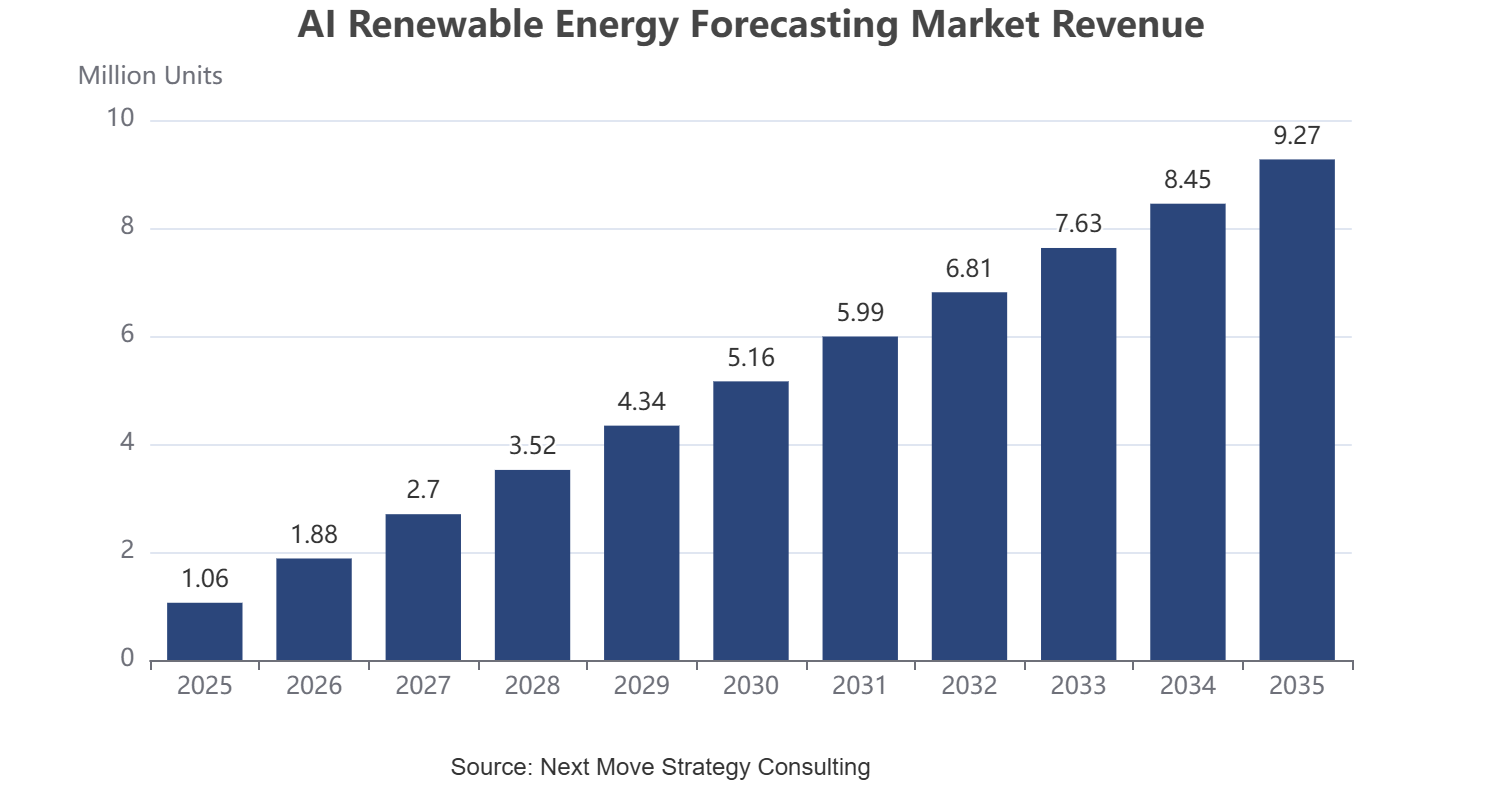
The global AI Renewable Energy Forecasting Market size was valued at USD 1.06 Billion in 2025 and is estimated at USD 1.32 Billion in 2026, forecast to reach USD 9.27 Billion by 2035, expanding at a 24.32% CAGR between 2026 and 2035. North America leads with approximately 34% share, while under offering, Forecast Software dominates with approximately 32% share.
We observed that growth is broad-based across every segmentation axis, with cloud-native platforms and fully managed forecasting services driving the dominant structural shift through 2035.
|
Key Takeaways |
|
By Offering: Forecast Software held the largest share of approximately 32% (USD 339 Million) in 2025; Managed Forecasting is the fastest-growing sub-segment at 28.7% CAGR from 2026–2035. |
|
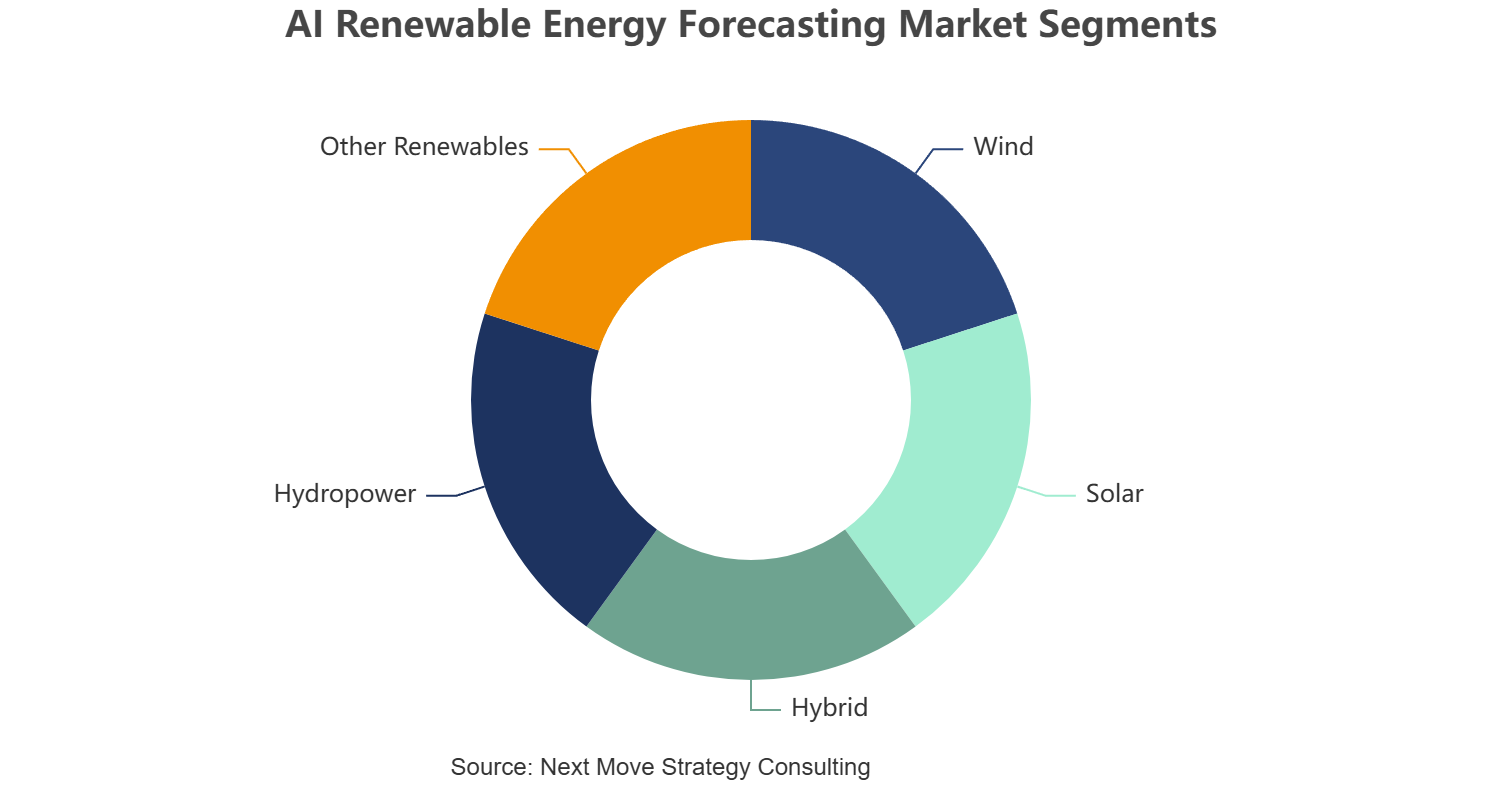
By Asset Scope: Solar held the largest share of approximately 38% (USD 403 Million) in 2025; Hybrid is the fastest-growing sub-segment at 30.8% CAGR from 2026–2035. |
|
By Forecast Horizon: Day Ahead held the largest share of approximately 26% (USD 276 Million) in 2025; Nowcast is the fastest-growing sub-segment at 29.2% CAGR from 2026–2035. |
|
By Deployment Mode: Cloud held the largest share of approximately 58% (USD 615 Million) in 2025; Hybrid is the fastest-growing sub-segment at 28.8% CAGR from 2026–2035. |
|
By Monetization: Subscription held the largest share of approximately 42% (USD 445 Million) in 2025; Usage Based is the fastest-growing sub-segment at 28.2% CAGR from 2026–2035. |
|
By End User: Utility and Grid Operator held the largest share of approximately 30% (USD 318 Million) in 2025; Trader and Retailer is the fastest-growing sub-segment at 28.0% CAGR from 2026–2035. |
|
Dominant Region: North America dominated with approximately 34% revenue share (USD 360 Million) in 2025. |
|
Fastest-Growing Region: Asia-Pacific is expected to register the highest CAGR of 28.2% during 2026–2035. |
|
Dominant Country: U.S. led with approximately USD 281 Million in 2025. |
|
Fastest-Growing Country: India is the fastest-growing country at approximately 30.6% CAGR from 2026–2035. |
Between 2026 and 2035, the AI Renewable Energy Forecasting Market is set to generate an absolute dollar opportunity of USD 7.95 Billion, positioning cloud-native, AI-driven forecasting platforms as a compelling area for capital allocation.
According to Next Move Strategy Consulting analysis, sustained investment in nowcasting and hybrid-asset forecasting models is reshaping procurement criteria for grid operators, as forecast-error-linked service level agreements increasingly determine vendor shortlisting across utility and trading end markets.
What Does the AI Renewable Energy Forecasting Market Encompass?
The market encompasses software, data, and service offerings that apply machine learning to predict wind, solar, hybrid, and hydropower output across nowcast, intraday, day-ahead, week-ahead, sub-seasonal, and long-term horizons. Our assessment indicates that the scope spans forecast data feeds, standalone forecasting software, fully managed forecasting services, and advisory and integration engagements supplied to utilities, grid operators, independent power producers, traders, developers, and investors. The category has evolved from standalone meteorological reporting into an operationally embedded grid-reliability and trading discipline, driven by accelerating wind and solar capacity additions worldwide.
Regulatory frameworks such as the U.S. Federal Energy Regulatory Commission's Order No. 901 and subsequent reliability standards for inverter-based resources shape model validation requirements for variable generation forecasting, while the European Network of Transmission System Operators for Electricity coordinates cross-border balancing rules that depend on accurate renewable output forecasts. We observed that technology adoption is shifting toward cloud-native, AI-augmented nowcasting models that reduce reliance on traditional supercomputer-based numerical weather prediction. Next Move Strategy Consulting's analysis indicates that this structural shift, combined with rising grid congestion and data-center-driven demand growth, is redefining sourcing criteria across the AI Renewable Energy Forecasting Market.
|
Parameters |
Details |
|
Market Size in 2025 |
USD 1.06 Billion |
|
Market Size in 2026 |
USD 1.32 Billion |
|
Revenue Forecast in 2035 |
USD 9.27 Billion |
|
Growth Rate |
CAGR of 24.32% from 2026 to 2035 |
|
Analysis Period |
2025–2035 |
|
Base Year Considered |
2025 |
|
Forecast Period |
2026–2035 |
|
Market Size Estimation |
Revenue (USD Billion) |
|
Companies Profiled |
20 |
|
Countries Covered |
37 |
|
Market Share |
Available for Top 10 Companies |
Key Emerging Trends
Based on research conducted by Next Move Strategy Consulting, we found that four structural trends are reshaping model architecture, procurement, and stakeholder engagement across the market.
How Is Generative and Deep-Learning AI Transforming Nowcasting Accuracy?
Deep-learning and foundation-model-based nowcasting are replacing traditional numerical weather prediction for near-term renewable output forecasts. We observed that Vaisala's June 2026 agreement to acquire Atmo, a San Francisco-based AI weather forecasting specialist, is intended to combine decades of atmospheric measurement with foundation-model forecasting to accelerate accuracy gains for wind and solar operators. Grid operators are adopting these models to manage minute-to-minute ramping events, while forecast providers retool architectures to process satellite, sensor, and market data simultaneously across solar and wind portfolios.
Why Are Utilities Embedding AI Forecasting Directly Into Grid Planning Software?
Utilities are integrating AI-based generation and load forecasting directly into grid planning and operations platforms rather than purchasing forecasts as a standalone feed. Our findings suggest that GE Vernova's GridOS platform update, introduced in 2026, packages interconnection analysis, risk management, and advanced load and generation forecasting into a single digital grid twin. This trend is elevating demand for embedded forecast modules among utility and grid-operator end users, while software vendors expand application programming interface integrations with existing energy management systems.
How Is AI Reshaping Weather-Risk Management for Solar Asset Owners?
Solar asset owners are adopting AI-driven severe-weather forecasting to manage hail, cloud-cover, and curtailment risk across large-scale portfolios. We observed that Vaisala Xweather's advanced hail-forecasting launch responds to hail damage accounting for a majority of extreme-weather-related solar claim costs in the United States and Canada. This trend is pushing independent power producers and investors to specify weather-risk analytics alongside standard production forecasts, positioning risk-adjusted forecasting as a differentiated, higher-margin service category.
What Role Does Standardized AI Data Tagging Play in Portfolio-Scale Forecasting?
Standardized, AI-classified asset data is emerging as a prerequisite for portfolio-scale forecasting across diverse turbine and inverter fleets. Our analysis shows that DNV's GreenPowerMonitor launched an AI-powered Energy Data Tagger in October 2025 to standardize inconsistent SCADA signal naming across solar, wind, and battery assets. This trend is reducing integration costs for managed forecasting providers serving multi-vendor portfolios, while asset owners increasingly treat standardized data taxonomies as a precondition for reliable, portfolio-wide forecast accuracy.
Consumer Behavior Analysis of the AI Renewable Energy Forecasting Industry
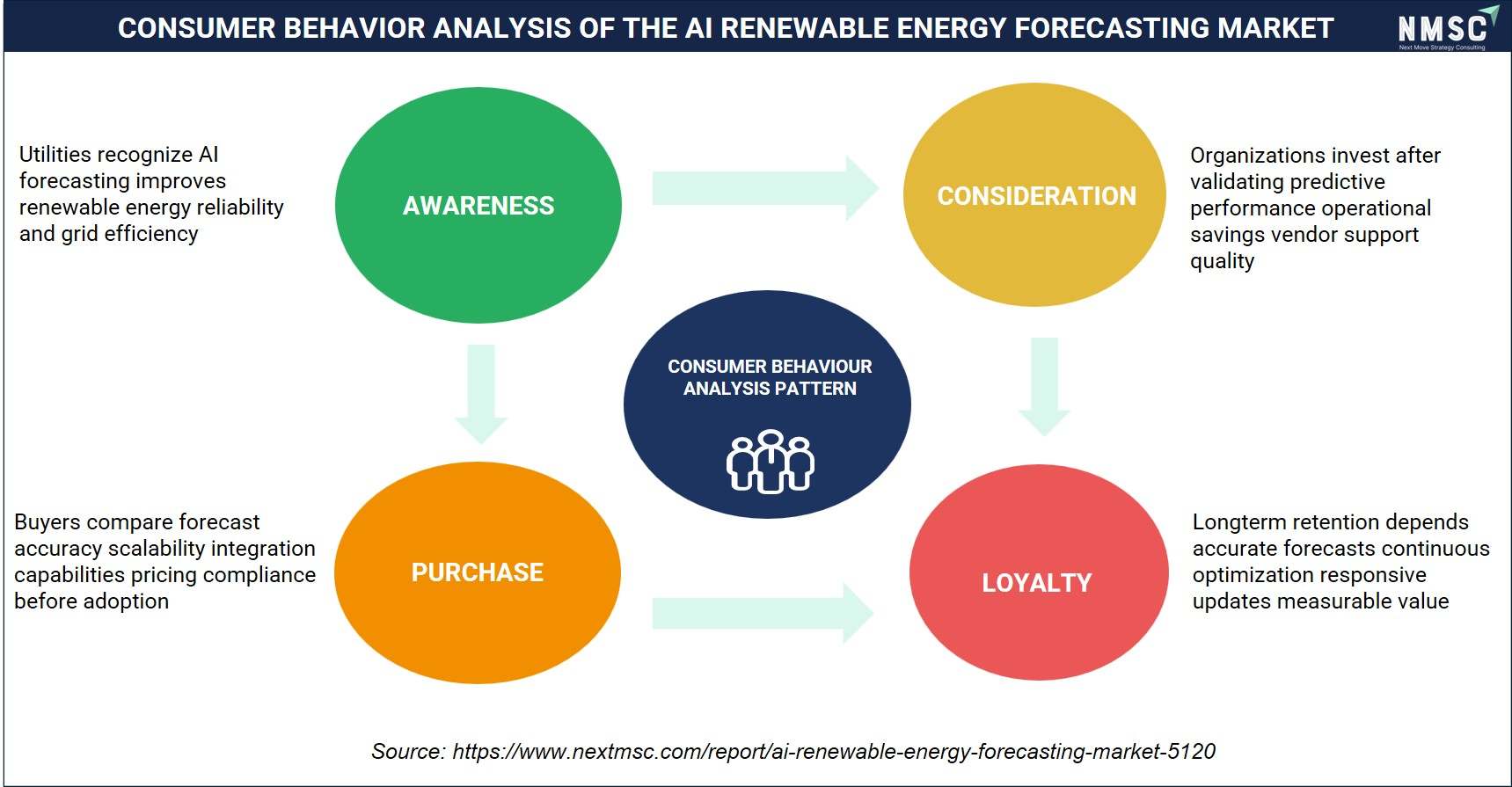
The infographic illustrates the consumer behavior journey in the AI Renewable Energy Forecasting Market, highlighting the progression from awareness to long-term loyalty. Organizations first recognize the benefits of AI in improving renewable energy reliability and grid efficiency, then evaluate forecasting accuracy, operational performance, and vendor capabilities before purchase. Customer retention is driven by accurate forecasts, continuous platform optimization, responsive support, and measurable improvements in operational and financial outcomes.
Growth Drivers and Restraints
Growth Catalyst and Risk Assessment Matrix
|
Factors |
Type |
(+/−) % Impact on CAGR |
Geographic Relevance |
Impact Timeline |
|
Accelerating global wind and solar capacity additions |
Driver |
+2.3% |
Global |
2026–2035 |
|
Rising data-center and AI-driven electricity demand growth |
Driver |
+1.9% |
Global |
2026–2035 |
|
FERC Order No. 901 reliability standards for inverter-based resources |
Driver |
+1.7% |
North America |
2026–2035 |
|
Falling cost and rising accuracy of foundation-model AI forecasting |
Driver |
+1.6% |
Global |
2026–2032 |
|
EU cross-border balancing and REMIT market-transparency rules |
Driver |
+1.5% |
Europe |
2026–2035 |
|
Expansion of hybrid wind-solar-storage co-located projects |
Driver |
+1.2% |
Asia-Pacific, North America |
2026–2035 |
|
Shortage of qualified energy-meteorology and AI talent |
Restraint |
−1.1% |
Global |
2026–2032 |
|
Fragmented, inconsistent SCADA and telemetry data standards |
Restraint |
−0.9% |
Global |
2026–2030 |
|
Grid interconnection and permitting delays limiting new renewable capacity |
Restraint |
−0.7% |
North America, Europe |
2028–2035 |
What Is the Primary Growth Driver of the AI Renewable Energy Forecasting Industry?
Accelerating wind and solar capacity additions represent the primary driver of the AI Renewable Energy Forecasting Market. The International Energy Agency recorded record renewable capacity additions in recent years, with solar photovoltaics accounting for the majority of new installations globally. We observed that this buildout directly expands the addressable base of assets requiring forecasting, sustaining baseline demand for forecast data, software, and managed services across mature and emerging grid systems alike.
How Is Grid Reliability Regulation Driving Market Growth?
Grid reliability regulation addressing inverter-based resources is accelerating adoption of validated forecasting models across the AI Renewable Energy Forecasting Market. The U.S. Federal Energy Regulatory Commission's approval of new reliability standards for inverter-based generators in 2025 requires planning coordinators to validate generation models against actual operating behavior. Our assessment indicates that this regulatory pressure, combined with the European Network of Transmission System Operators for Electricity's cross-border balancing requirements, is compressing adoption timelines for AI-validated forecasting platforms across North America and Europe.
What Is Restraining AI Renewable Energy Forecasting Market Expansion?
A shortage of qualified energy-meteorology and applied-AI talent restrains scaling across the market supply chain. Vendors report extended development cycles for proprietary forecasting models as demand for hybrid meteorology-data-science expertise outpaces available talent pools. We found that smaller regional forecasting providers face particular exposure, as limited scale reduces their ability to compete for scarce technical talent against larger, well-capitalized global software and measurement groups.
Segmentation Analysis
Segment Sizing: By Offering
|
Segment |
2025 (USD) |
2035 (USD) |
CAGR% (2026–2035) |
|
Forecast Data |
USD 318 Million |
USD 2.04 Billion |
20.0% |
|
Forecast Software |
USD 339 Million |
USD 2.87 Billion |
23.7% |
|
Managed Forecasting |
USD 254 Million |
USD 3.06 Billion |
28.7% |
|
Advisory and Integration |
USD 148 Million |
USD 1.30 Billion |
24.2% |
|
Total |
USD 1.06 Billion |
USD 9.27 Billion |
24.32% |
Which Offering Segment Dominates the AI Renewable Energy Forecasting Market?
Forecast Software led the AI Renewable Energy Forecasting Market with USD 339 Million in 2025, supported by utilities and grid operators embedding forecasting engines directly into planning and operations platforms. We observed that Managed Forecasting is the fastest-growing offering, expanding at a 28.7% CAGR from 2026 to 2035, as asset owners and traders increasingly outsource forecast-error risk to fully managed, SLA-backed service providers rather than operating in-house modeling teams.
Segment Sizing: By Asset Scope
|
Segment |
2025 (USD) |
2035 (USD) |
CAGR% (2026–2035) |
|
Solar |
USD 403 Million |
USD 3.34 Billion |
23.4% |
|
Wind |
USD 350 Million |
USD 2.50 Billion |
21.4% |
|
Hybrid |
USD 159 Million |
USD 2.22 Billion |
30.8% |
|
Hydropower |
USD 95 Million |
USD 742 Million |
22.6% |
|
Other Renewables |
USD 53 Million |
USD 464 Million |
24.2% |
|
Total |
USD 1.06 Billion |
USD 9.27 Billion |
24.32% |
Which Asset Scope Segment Leads AI Renewable Energy Forecasting Demand?
Solar remained the leading asset scope within the AI Renewable Energy Forecasting Market, valued at USD 403 Million in 2025 on the back of record global photovoltaic capacity additions. Our findings suggest that Hybrid installations are the fastest-growing asset scope, registering a 30.8% CAGR from 2026 to 2035, as co-located wind-solar-storage projects require integrated forecasting models that account for combined output profiles and storage dispatch optimization.
Segment Sizing: By End User
|
Segment |
2025 (USD) |
2035 (USD) |
CAGR% (2026–2035) |
|
Utility and Grid Operator |
USD 318 Million |
USD 2.60 Billion |
23.2% |
|
IPP and Asset Owner |
USD 254 Million |
USD 2.04 Billion |
23.0% |
|
Trader and Retailer |
USD 170 Million |
USD 1.95 Billion |
28.0% |
|
Developer |
USD 127 Million |
USD 1.11 Billion |
24.2% |
|
Commercial and Industrial |
USD 85 Million |
USD 742 Million |
24.2% |
|
Investor and Lender |
USD 64 Million |
USD 556 Million |
24.2% |
|
OEM |
USD 42 Million |
USD 278 Million |
20.3% |
|
Total |
USD 9.27 Billion |
24.32% |
Which End User Segment Leads the AI Renewable Energy Forecasting Market?
Utility and Grid Operator end users led the AI Renewable Energy Forecasting Market with USD 318 Million in 2025, reflecting mandatory reliability planning obligations tied to rising renewable penetration. Based on research conducted by Next Move Strategy Consulting, we found that Trader and Retailer end users are the fastest-growing segment, expanding at a 28.0% CAGR from 2026 to 2035, as power market participants increasingly rely on granular forecasts to manage imbalance exposure and bidding strategy.
Growth Opportunities
Our analysis shows that three forward-looking opportunities stand out for stakeholders positioning within the AI Renewable Energy Forecasting Market over the 2026-2035 forecast period.
How Are Foundation-Model Nowcasting Platforms Creating Opportunities for Grid Operators?
Foundation-model-based nowcasting presents a whitespace opportunity for grid operators seeking sub-hourly visibility into renewable ramping events. Vendors that commercialize deep-learning nowcasting engines validated against operational data stand to capture recurring software and data subscription revenue as operators shift from statistical to AI-native models, particularly across grid systems with rapidly rising wind and solar penetration requiring tighter balancing tolerances.
Why Are Managed Forecasting Contracts Emerging as a Growth Opportunity for Independent Power Producers?
Independent power producers and asset owners represent an underpenetrated opportunity for SLA-backed managed forecasting services that transfer forecast-error risk away from internal teams. Providers that offer alerting, penalty-linked accuracy guarantees, and portfolio-wide monitoring can secure long-term contracts with IPPs and investors, benefiting from recurring revenue tied to expanding installed renewable capacity under management.
How Is Hybrid Asset Forecasting Unlocking Opportunities for Storage-Integrated Developers?
Developers building co-located wind-solar-storage projects create an opportunity for vendors offering integrated hybrid-asset forecasting and dispatch-optimization models. Early movers that combine generation forecasting with storage-state-of-charge modeling can differentiate with developers and OEMs pursuing bankable, storage-integrated project structures across capital-constrained markets seeking optimized revenue stacking.
Pestel Analysis of the AI Renewable Energy Forecasting Market
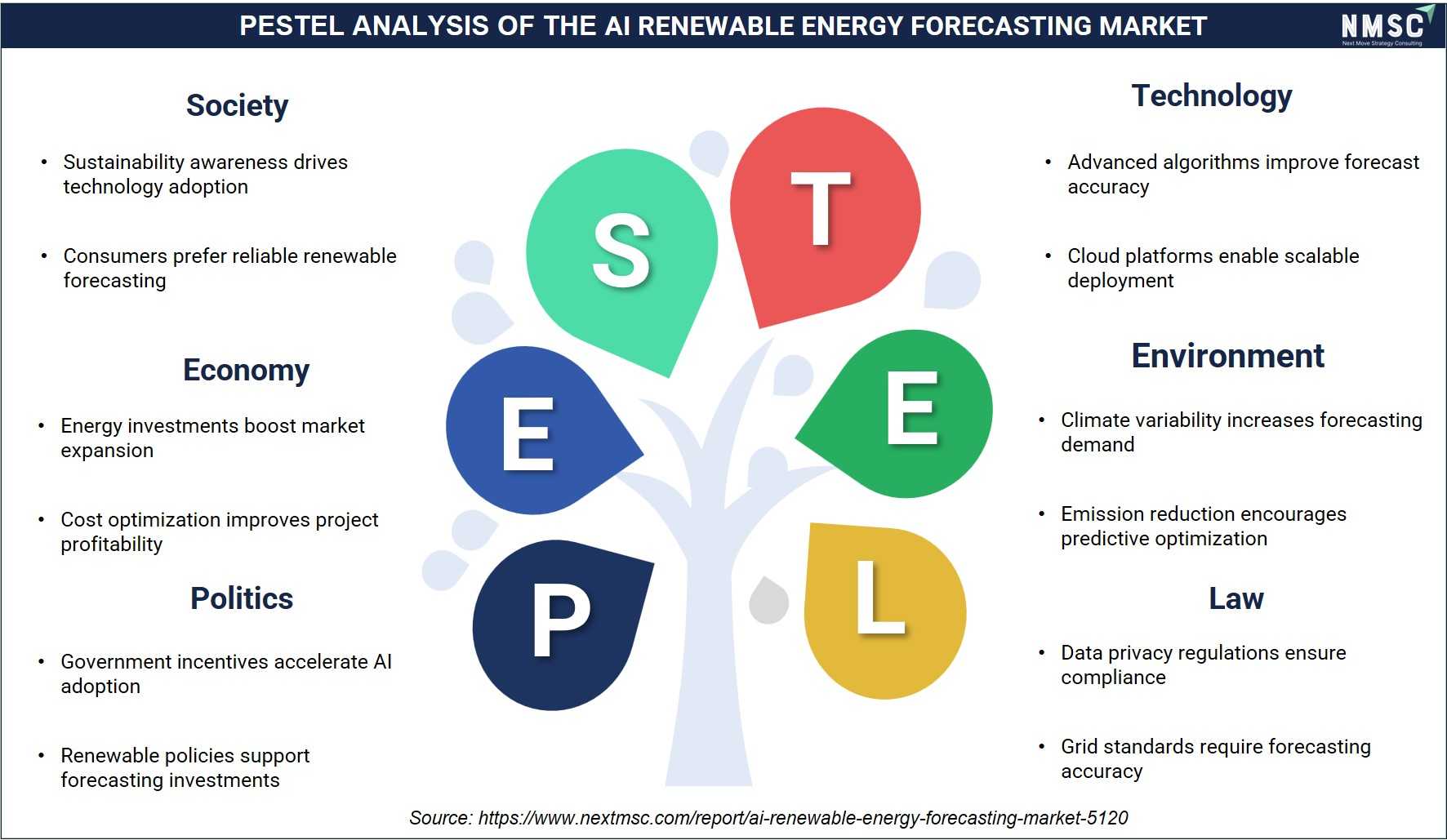
The infographic presents a PESTEL analysis of the AI Renewable Energy Forecasting Market, highlighting the key external factors shaping market growth. Political support for renewable energy, economic investments in grid modernization, societal demand for clean energy, advancements in AI and forecasting technologies, environmental sustainability goals, and evolving regulatory frameworks collectively influence the adoption, innovation, and commercialization of AI-powered renewable energy forecasting solutions worldwide.
Regional Outlook
Geographic Performance Snapshot
|
Region |
2025 (USD) |
2035 (USD) |
CAGR% (2026–2035) |
Key Driver |
|
North America |
USD 360 Million |
USD 2.69 Billion |
22.0% |
FERC/NERC reliability standards for inverter-based resources and mature grid-operator AI adoption |
|
Europe |
USD 276 Million |
USD 2.04 Billion |
21.9% |
ENTSO-E cross-border balancing rules and REMIT market-transparency requirements |
|
Asia-Pacific |
USD 254 Million |
USD 2.97 Billion |
28.2% |
Record wind and solar capacity additions in China and India |
|
Middle East & Africa |
USD 95 Million |
USD 927 Million |
25.6% |
National renewable diversification strategies and grid-modernization investment |
|
Latin America |
USD 74 Million |
USD 649 Million |
24.2% |
Expanding wind and solar buildout and grid-operator forecasting mandates |
|
Total |
USD 1.06 Billion |
USD 9.27 Billion |
24.32% |
– |
North America AI Renewable Energy Forecasting Market Outlook
North America leads the AI Renewable Energy Forecasting Market with an established base of grid operators and mature reliability-planning frameworks. We observed that the U.S. Federal Energy Regulatory Commission's approval of new reliability standards for inverter-based generators is accelerating adoption of validated, AI-based forecasting models among planning coordinators and transmission owners. Technology adoption remains advanced, with utility and grid-operator end users driving demand for cloud-native forecasting platforms integrated directly into grid-management software across the region's data-center-driven demand growth.
Europe AI Renewable Energy Forecasting Market Outlook
Europe's AI Renewable Energy Forecasting Market reflects a mature but coordination-intensive landscape shaped by the European Network of Transmission System Operators for Electricity's cross-border balancing framework. Our findings suggest that Germany, France, and the UK are accelerating adoption of AI-based day-ahead and intraday forecasting to satisfy REMIT market-transparency obligations and rising wind and solar penetration. Technology adoption favors cloud and hybrid deployment models, supported by regional transmission system operators investing in AI-validated forecasting infrastructure.
Asia-Pacific AI Renewable Energy Forecasting Market Outlook
Asia-Pacific is the fastest-growing AI Renewable Energy Forecasting Market region, propelled by record wind and solar capacity additions across China and India. We found that regulatory frameworks remain less harmonized than in Europe, giving forecasting vendors flexibility to scale cloud-based platforms rapidly across diverse grid systems. Technology adoption is accelerating as regional grid operators, including several China-based transmission entities, expand forecasting infrastructure to manage rising renewable curtailment risk.
Middle East & Africa AI Renewable Energy Forecasting Market Outlook
The Middle East & Africa AI Renewable Energy Forecasting Market is expanding as Gulf Cooperation Council economies diversify into utility-scale solar and wind generation under national renewable-energy strategies. Our analysis shows that Saudi Arabia and the UAE are attracting forecasting investment tied to giga-scale solar project development. Regulatory influence remains developing, while technology penetration is gradually shifting toward cloud-based forecasting platforms as regional utilities align with international grid-reliability expectations.
Latin America AI Renewable Energy Forecasting Market Outlook
Latin America's AI Renewable Energy Forecasting Market is supported by expanding wind and solar buildout in Brazil and Argentina and growing grid-operator sophistication. We observed that regulatory frameworks are less stringent than in North America or Europe, though national grid operators are introducing forecasting mandates to manage rising renewable penetration. Technology adoption remains centered on cloud-based day-ahead forecasting, with competitive intensity increasing as global vendors partner with regional distributors.
U.S. AI Renewable Energy Forecasting Market
Based on our engagements, the U.S. AI Renewable Energy Forecasting Market was valued at approximately USD 281 Million in 2025 and is projected to reach USD 2.22 Billion by 2035, growing at a 22.8% CAGR. Demand is anchored by FERC-driven reliability planning, high renewable capacity additions, and rising data-center electricity demand. Technology penetration favors cloud-native AI forecasting platforms, and competitive intensity remains high among established vendors serving national grid operators and power traders.
Canada AI Renewable Energy Forecasting Market
Through our analysis, Canada's AI Renewable Energy Forecasting Market reached roughly USD 49 Million in 2025 and is forecast to hit USD 337 Million by 2035 at a 21.0% CAGR. Demand structure mirrors U.S. grid-reliability and wind-forecasting requirements, while provincial utilities increasingly specify AI-validated models for hydropower-wind balancing. Technology penetration is rising as national grid operators request integrated forecasting platforms, with competitive intensity moderate given reliance on cross-border vendor supply.
UK AI Renewable Energy Forecasting Market
From our assessment, the UK market stood at about USD 52 Million in 2025, advancing toward USD 368 Million by 2035 at a 21.2% CAGR. Demand is driven by offshore wind capacity growth and national grid balancing requirements. Regulatory influence is significant, technology penetration favors cloud-based day-ahead forecasting, and competitive intensity remains steady among domestic and European forecasting vendors serving UK transmission operators.
Germany AI Renewable Energy Forecasting Market
According to evaluation, Germany's market was valued near USD 65 Million in 2025 and is set to reach USD 483 Million by 2035, expanding at a 22.0% CAGR. Demand structure benefits from a strong domestic wind and solar generation base under the Energiewende transition. Germany's transmission system operators drive regulatory influence through ENTSO-E-aligned balancing rules, while technology penetration favors AI-based intraday forecasting among leading vendors.
France AI Renewable Energy Forecasting Market
Based on our engagements, France's market reached approximately USD 41 Million in 2025, projected to climb to USD 282 Million by 2035 at a 20.8% CAGR. Demand is supported by France's nuclear-renewable balancing requirements and expanding offshore wind pipeline, which shape day-ahead and week-ahead forecasting adoption. Regulatory influence from national transmission balancing rules is notable, and competitive intensity remains high given the concentration of European forecasting vendors serving French transmission planning.
China AI Renewable Energy Forecasting Market
Through our analysis, China's AI Renewable Energy Forecasting Market stood at roughly USD 76 Million in 2025 and is forecast to reach USD 840 Million by 2035, registering a 27.4% CAGR. Demand is fueled by the world's largest installed wind and solar capacity base and rising curtailment-management requirements. Regulatory influence is increasing gradually under national grid-dispatch guidelines, technology penetration is accelerating through domestic AI platform development, and competitive intensity remains elevated among numerous regional forecasting providers.
India AI Renewable Energy Forecasting Market
From our assessment, India's AI Renewable Energy Forecasting Market was valued at about USD 37 Million in 2025, projected to reach USD 508 Million by 2035 at a 30.6% CAGR, the fastest among covered countries. Demand structure reflects rapid utility-scale solar and wind capacity additions and monsoon-driven generation variability requiring sophisticated forecasting. Regulatory influence remains developing, while technology penetration is rising quickly as national and state grid operators localize forecasting infrastructure to manage renewable integration.
Japan AI Renewable Energy Forecasting Market
According to evaluation, Japan's market reached close to USD 29 Million in 2025 and is expected to hit USD 181 Million by 2035, growing at a 19.5% CAGR. Demand is supported by Japan's offshore wind expansion and grid-balancing needs following its post-Fukushima energy transition. Regulatory influence is well established, technology penetration is advanced among domestic utilities, and competitive intensity remains high among long-standing meteorological and grid-technology vendors.
South Korea AI Renewable Energy Forecasting Market
Based on our engagements, South Korea's market stood at approximately USD 22 Million in 2025, forecast to reach USD 184 Million by 2035 at a 23.8% CAGR. Demand structure benefits from the country's expanding offshore wind pipeline and government-backed renewable procurement targets. Technology penetration is rising, with domestic grid operators piloting AI-based forecasting platforms, and competitive intensity remains moderate amid growing vendor interest in the Korean market.
Australia AI Renewable Energy Forecasting Market
Through our analysis, Australia's market reached about USD 17 Million in 2025 and is projected to reach USD 127 Million by 2035, expanding at a 22.4% CAGR. Demand is supported by the Australian Energy Market Operator's integration of forecasting into national electricity market dispatch processes. Regulatory influence stems from AEMO's renewable-integration frameworks, while technology penetration favors cloud-based forecasting platforms amid rising competitive intensity.
UAE AI Renewable Energy Forecasting Market
From our assessment, the UAE market was valued near USD 17 Million in 2025, projected to reach USD 165 Million by 2035 at a 25.9% CAGR. Demand structure is shaped by the UAE's giga-scale solar project pipeline and national clean-energy diversification strategy. Regulatory influence remains moderate, technology penetration is improving through cloud-based forecasting platforms, and competitive intensity is rising as global vendors expand regional distribution.
Saudi Arabia AI Renewable Energy Forecasting Market
According to evaluation, Saudi Arabia's market reached roughly USD 20 Million in 2025 and is expected to hit USD 211 Million by 2035, growing at a 27.1% CAGR. Demand is driven by Vision 2030-linked renewable capacity targets and giga-scale solar and wind project development. Regulatory influence is developing under national energy-diversification guidelines, and technology penetration is advancing as domestic utilities scale forecasting infrastructure.
South Africa AI Renewable Energy Forecasting Market
Based on our engagements, South Africa's market stood at about USD 10 Million in 2025, forecast to reach USD 77 Million by 2035 at a 23.0% CAGR. Demand structure reflects a developing renewable generation base serving regional Southern African grid systems under National Energy Regulator of South Africa oversight. Regulatory influence remains moderate, technology penetration is gradually improving, and competitive intensity is limited given reliance on imported forecasting platforms.
Brazil AI Renewable Energy Forecasting Market
Through our analysis, Brazil's AI Renewable Energy Forecasting Market reached approximately USD 30 Million in 2025 and is projected to reach USD 268 Million by 2035, registering a 24.6% CAGR. Demand is underpinned by Brazil's large wind and hydropower generation base and Operador Nacional do Sistema Elétrico's grid-balancing requirements. Regulatory influence stems from national grid-dispatch coordination, technology penetration favors cloud-based forecasting, and competitive intensity remains moderate among regional and global vendors.
Argentina AI Renewable Energy Forecasting Market
From our assessment, Argentina's AI Renewable Energy Forecasting Market was valued near USD 12 Million in 2025, projected to reach USD 88 Million by 2035 at a 22.3% CAGR. Demand structure is supported by steady wind capacity growth despite macroeconomic volatility, with CAMMESA coordinating grid-balancing requirements. Regulatory influence remains limited, technology penetration is modest, and competitive intensity is centered on a small number of regional distributors serving domestic grid operators.
Competitive Landscape
We observed that the Market features a moderately fragmented competitive landscape, with diversified industrial and grid-technology groups competing alongside specialized meteorology and data-analytics firms on model accuracy, data breadth, and integration depth.
|
Key Takeaways |
|
Market Structure — Moderately fragmented; the top companies profiled in this report collectively account for a significant share of global AI Renewable Energy Forecasting Market revenue, while numerous specialized meteorology and analytics firms serve regional and niche asset-class demand. |
|
Innovation Focus — Foundation-model nowcasting, standardized AI data tagging, and integrated hybrid-asset forecasting dominate current innovation pipelines across leading vendors. |
|
M&A Activity — Selective consolidation through capability acquisitions, exemplified by Vaisala's 2026 agreement to acquire Atmo to strengthen its AI-driven weather forecasting capabilities. |
How Do Companies Compete in the AI Renewable Energy Forecasting Market?
Companies compete primarily on forecast accuracy, data breadth, and integration flexibility across the Market. Global players such as GE Vernova and Siemens Energy leverage broad grid-software portfolios to serve utility and grid-operator customers, while specialized meteorology firms such as Meteomatics and Solargis compete on model precision and site-specific accuracy for wind and solar asset owners and developers.
Which Competitive Archetypes Dominate the AI Renewable Energy Forecasting Market?
Two archetypes dominate the AI Renewable Energy Forecasting Market: diversified industrial and grid-technology groups offering integrated planning and forecasting software, and specialized meteorology and data-analytics firms focused on high-precision forecast accuracy. Hitachi Energy and Schneider Electric exemplify the diversified archetype through integrated grid-software portfolios, while Meteomatics and AleaSoft Energy Forecasting exemplify the specialized archetype serving asset-level forecasting demand.
How Are Companies Differentiating Through Innovation in AI Renewable Energy Forecasting?
Innovation and differentiation strategy increasingly center on foundation-model AI and validated nowcasting accuracy. Vaisala's planned integration of Atmo's deep-learning forecasting technology and DNV's GreenPowerMonitor AI data-tagging platform both illustrate how vendors are embedding advanced AI directly into measurement and monitoring workflows. Our analysis shows that vendors unable to demonstrate validated model accuracy risk exclusion from utility and grid-operator procurement shortlists in North America and Europe.
What M&A and Expansion Activity Is Shaping the AI Renewable Energy Forecasting Market?
Mergers, acquisitions, and platform expansion continue to consolidate forecasting capabilities within the Market. Vaisala's agreement to acquire Atmo broadens its Xweather forecasting portfolio with foundation-model AI technology, while GE Vernova's continued integration of forecasting and risk-management tools into its GridOS platform illustrates how diversified groups pursue capability expansion and cross-selling across utility, trading, and asset-owner end markets.
Key Market Players
Our assessment indicates that the following 20 companies represent the validated competitive set actively shaping model innovation, data infrastructure, and service delivery within the global AI Renewable Energy Forecasting Market.
-
Siemens Energy AG
-
GE Vernova Inc.
-
Vestas Wind Systems A/S
-
DNV
-
UL Solutions Inc.
-
Hitachi Energy Ltd.
-
Envision Energy Co., Ltd.
-
Vaisala Oyj
-
Clean Power Research, L.L.C.
-
DTN LLC
-
Energy Exemplar Pty Ltd
-
REsurety, Inc.
-
Meteomatics AG
-
Solargis s.r.o.
-
AleaSoft Energy Forecasting, S.L.
-
Reuniwatt SAS
-
WindSim AS
-
meteocontrol GmbH
-
Schneider Electric SE
Latest Developments
We found that recent product and technology developments within the AI Renewable Energy Forecasting Market are concentrated on foundation-model AI integration and standardized data infrastructure, reflecting the industry's shift toward validated, AI-native forecasting.
|
Date |
Event |
|
Nov 2024 |
Hitachi Energy launched Nostradamus AI, an AI-powered energy forecasting platform that provides highly accurate forecasts for wind generation, solar generation, electricity demand, and energy prices. The solution is designed specifically for utilities, renewable energy developers, grid operators, and energy traders. |
|
Oct 2024 |
IBM acquired Prescinto, an AI-powered renewable energy asset performance management company. Prescinto's platform uses AI, weather analytics, predictive forecasting, automation and real-time monitoring to optimize the performance of solar, wind and battery energy assets. |
|
April 2026 |
Meteomatics announced its collaboration with NVIDIA to deliver AI-based weather forecasting capable of producing forecasts within minutes. The company stated the solution helps renewable energy companies improve wind and solar generation forecasting and energy trading decisions. |
Expert Insights

"With wind generation becoming an increasingly essential component of the energy grid, accurate and granular forecasts are mission-critical. Our new wind forecasting solutions not only improve operational reliability but also equip asset owners with the confidence to navigate increasingly volatile electricity markets."
— Sean Kelly, CEO & Co-Founder, Amperon
Statement made in: Amperon Unveils Advanced Wind Forecasting Solutions to Optimize Renewable Energy Operations, Official Company Press Release, November 12, 2024.
Market Interpretation
The statement underscores the growing reliance on AI-powered renewable energy forecasting as wind generation becomes a larger share of global electricity production. Increasing weather volatility and electricity market fluctuations are driving utilities, independent power producers, and grid operators to adopt AI-enabled forecasting platforms that improve generation accuracy, reduce balancing costs, optimize bidding strategies, and strengthen grid reliability. This trend is expected to significantly accelerate demand for AI renewable energy forecasting solutions worldwide.
Investment Opportunities
What Capital Inflows Are Targeting the AI Renewable Energy Forecasting Market?
Capital inflows into the Market are increasingly directed toward foundation-model AI capability and data-infrastructure acquisitions. Strategic acquirers continue to fund capability consolidation, as seen in Vaisala's agreement to acquire Atmo. We observed that investors favor vendors demonstrating validated forecast-accuracy improvements, viewing model performance as a proxy for long-term contract retention with utility and grid-operator customers.
How Is Infrastructure Investment Supporting AI Renewable Energy Forecasting Deployment?
Infrastructure investment is expanding cloud computing and sensor-network capacity to support AI-native forecasting platforms, particularly across Asia-Pacific's rapidly growing renewable capacity base. Our findings suggest that vendors are investing in expanded satellite, weather-station, and SCADA data ingestion to improve model training data quality, supporting the granularity required for nowcast and intraday forecasting across diverse asset classes.
What ESG Considerations Are Shaping AI Renewable Energy Forecasting Investment Decisions?
Environmental, social, and governance considerations are central to investment decisions across the AI Renewable Energy Forecasting Market, with grid-reliability contribution and curtailment reduction as key criteria. The International Energy Agency's renewable capacity data continues to inform investor sustainability disclosures. We found that investors increasingly favor vendors whose forecasting accuracy demonstrably reduces renewable curtailment and fossil-fuel backup reliance, treating it as a governance and impact indicator alongside data-privacy compliance.
Key Benefits for Stakeholders
How Does This Report Benefit Enterprise and Industry Leaders?
Enterprise and industry leaders gain access to validated segmentation, competitive benchmarking, and regional demand forecasts that support product-portfolio and go-to-market decisions across the AI Renewable Energy Forecasting Market. Our analysis shows that detailed offering, asset-scope, and end-user breakdowns help product teams align development roadmaps with regulatory and grid-reliability requirements while identifying underserved segments for portfolio expansion.
How Does This Report Benefit Investors and Financial Analysts?
Investors and financial analysts benefit from consistent, single-point market size and CAGR estimates that support valuation and capital-allocation decisions across the Market supply chain. We observed that the report's regional and segment-level growth differentials help identify which vendors are best positioned to capture above-market growth in managed forecasting and hybrid-asset categories through 2035.
How Does This Report Benefit Technology Vendors and Product Teams?
Technology vendors and product teams gain insight into emerging requirements, including foundation-model nowcasting, standardized data tagging, and hybrid-asset forecasting, that are reshaping the AI Renewable Energy Forecasting Market. Our findings suggest that this analysis helps research and development teams prioritize roadmaps around validated accuracy improvements and API-based integration increasingly required by utility and grid-operator procurement processes.
Key Market Segments
By Offering
-
Forecast Data
-
API Feeds
-
Datasets
-
Reports
-
-
Forecast Software
-
SaaS
-
On Premise
-
Embedded Module
-
-
Managed Forecasting
-
Managed Service
-
SLA Backed Delivery
-
Alerting
-
-
Advisory and Integration
-
Consulting
-
Model Development
-
Implementation
-
Training
-
By Asset Scope
-
Wind
-
Solar
-
Hybrid
-
Hydropower
-
Other Renewables
By Forecast Horizon
-
Nowcast
-
Intra Day
-
Day Ahead
-
Week Ahead
-
Sub-Seasonal
-
Long Term
By Deployment Mode
-
Cloud
-
On Premise
-
Hybrid
By Monetization
-
Subscription
-
Usage Based
-
License
-
Service Fee
-
Project Fee
-
Retainer
By End User
-
Utility and Grid Operator
-
IPP and Asset Owner
-
Trader and Retailer
-
Developer
-
Commercial and Industrial
-
Investor and Lender
-
OEM
By Region
-
North America: U.S., Canada, Mexico
-
Europe: UK, Germany, France, Italy, Spain, Sweden, Denmark, Finland, Netherlands, Rest of Europe
-
Asia-Pacific: China, India, Japan, South Korea, Taiwan, Indonesia,Vietnam, Australia, Philippines, Malaysia, Rest of APAC
-
Middle East & Africa: Saudi Arabia, UAE, Egypt, Israel, Turkey, Nigeria, South Africa, Rest of MEA
-
Latin America: Brazil, Argentina, Chile, Colombia, Rest of LATAM
Conclusion and Recommendations
What Is the Long-Term Outlook for the AI Renewable Energy Forecasting Market?
The long-term outlook for the AI Renewable Energy Forecasting Market remains strongly positive, with global revenue projected to expand nearly ninefold from USD 1.06 billion in 2025 to USD 9.27 billion by 2035 at a 24.32% CAGR. We observed that accelerating renewable capacity additions, tightening grid-reliability regulation, and rapid foundation-model AI adoption will continue underpinning demand across utility, trading, and asset-owner end markets through the forecast period.
What Strategic Positioning Should AI Renewable Energy Forecasting Vendors Pursue?
Vendors should prioritize foundation-model nowcasting capability and managed, SLA-backed service delivery to secure long-term utility and grid-operator contracts. Our assessment indicates that providers investing early in standardized data-ingestion infrastructure and hybrid-asset forecasting models will be best positioned to capture premium pricing within the Market.
How Attractive Is the AI Renewable Energy Forecasting Market for New Investment?
The Market presents an attractive investment case, supported by a USD 7.95 billion absolute dollar opportunity between 2026 and 2035 and above-average growth in Asia-Pacific and managed-service categories. We found that investment attractiveness is highest for vendors combining validated forecast accuracy with cloud-scale delivery infrastructure, positioning them to serve both cost-sensitive and premium utility segments simultaneously.
What Market Shifts and Key Risks Should Stakeholders Monitor?
Stakeholders should monitor AI talent scarcity, fragmented data standards, and grid interconnection delays as key risks to the Market. Our analysis shows that vendors unable to adapt to standardized data-tagging and validated-model requirements risk losing share to competitors with proven, foundation-model-based platforms, particularly within North America's increasingly reliability-regulated grid environment.
What Are the Key Growth Pathways for the AI Renewable Energy Forecasting Market?
Key growth pathways include expanding managed forecasting service portfolios, scaling foundation-model nowcasting capability, and deepening penetration into hybrid-asset and power-trading applications. Next Move Strategy Consulting's analysis indicates that vendors pursuing these pathways while maintaining cost competitiveness in standard forecast-data categories will be best positioned to capture the AI Renewable Energy Forecasting Market's projected growth through 2035.
About the Author
 Liza Phukan
— Liza Phukan is Research Associate at Next Move Strategy Consulting, where she has covered emerging industries and market research across sectors for 3.5 years. Her work includes analyzing industry developments, validating market data, and developing structured business content from research findings. She uses secondary research and data-validation practices to turn complex market information into clear decision-useful market analysis for business audiences and support report development and B2B.
Liza Phukan
— Liza Phukan is Research Associate at Next Move Strategy Consulting, where she has covered emerging industries and market research across sectors for 3.5 years. Her work includes analyzing industry developments, validating market data, and developing structured business content from research findings. She uses secondary research and data-validation practices to turn complex market information into clear decision-useful market analysis for business audiences and support report development and B2B.
About the Reviewer
 Supradip Baul
— Supradip Baul is an accomplished business consultant and strategist with over a decade of rich experience in market intelligence, strategy, technology, and business transformation. His work has included rigorous qualitative and quantitative analysis across multiple industries, helping clients shape investment decisions and long-term roadmaps. Earlier in his career, he was associated with Gartner, where he contributed to industry-leading reports and market share analyses. He has worked with leading global companies and holds an MBA with a dual specialization in Marketing and Finance.
Supradip Baul
— Supradip Baul is an accomplished business consultant and strategist with over a decade of rich experience in market intelligence, strategy, technology, and business transformation. His work has included rigorous qualitative and quantitative analysis across multiple industries, helping clients shape investment decisions and long-term roadmaps. Earlier in his career, he was associated with Gartner, where he contributed to industry-leading reports and market share analyses. He has worked with leading global companies and holds an MBA with a dual specialization in Marketing and Finance.
At Next Move Strategy Consulting, we understand that insightful market research is the cornerstone of successful business decisions. That's why we employ a robust and multifaceted approach, combining various methodologies to deliver the most accurate and actionable data for our clients.

Research Landscape
We navigate the world of research with two primary approaches:
Qualitative Approach
Our qualitative research methodologies involve immersive techniques such as in-depth interviews, focus groups, and observational studies. By engaging directly with individuals and stakeholders, we uncover valuable insights that quantitative data alone may overlook.

Quantitative Research
In tandem with qualitative methodologies, NMSC leverages the power of Quantitative Research to provide a robust foundation of numerical insights. Through systematic data collection and analysis, we quantify patterns, preferences, and market trends, offering a comprehensive view of the business landscape.
Our quantitative research approach employs diverse tools, including surveys, experiments, and statistical modelling. These methodologies enable us to gather data from a large and representative sample, ensuring the statistical significance of our findings. By employing structured questionnaires and standardized data collection methods, we guarantee the reliability and validity of the information we present to our clients.
Quantitative research is particularly effective in measuring the prevalence of trends, assessing market size, and gauging the impact of various factors on consumer behavior. The numerical precision attained through this approach equips our clients with actionable insights, facilitating data-driven decision-making and strategy formulation.


Our Specialized Toolbox for Industry-Specific Market Research
We deploy a specialized arsenal of techniques tailored to meet your unique requirements. Here's a glimpse into our comprehensive toolbox:

Information Procurement
The stage entails acquiring market data or relevant information through various sources and methodologies.


Market Research Approach
We utilize both top-down and bottom-up approaches in market research analysis to achieve a comprehensive understanding of the market dynamics, leveraging the broad perspective of industry trends and macroeconomic factors alongside detailed insights from specific segments and individual companies.

Porters Five Forces Analysis
We conduct Porter's Five Forces analysis to evaluate the competitive landscape of an industry, providing us with insights into factors that affect profitability and strategic positioning.

SWOT Analysis

Forecasting
We utilize a forecasting model to predict future consumption by considering parameters like population, economics, regulations, market competition, drivers, constraints, technology, and pricing. We also employ statistical techniques such as multilinear regression, exponential smoothing, moving average, ARIMA, and Monte Carlo simulations for accurate predictions. In econometric forecasting, we analyzed short-term and long-term event impacts, attributing values based on regulatory frameworks, economic factors, and market events.





 Speak to Our Analyst