Marketing Technology Market By Product and Solution {Software Products (Data and Identity Platforms, Campaign and Engagement Platforms, and Others), and Services}, By Deployment Model (Cloud Based, On-Premise, and Hybrid), By Buyer Type (Large Enterprises, Small and Medium Businesses, and Others), By Revenue Model (Subscription Licensing, Others), By Industry Vertical (Retail and E-commerce, Healthcare and Life Sciences and Others) – Global Analysis & Forecast, 2025–2035
Industry: ICT & Media | Publishing Date: January 12, 2026 | Last Updated: September 30, 2026 | No of Pages: N/A | No. of Tables: N/A | No. of Figures: N/A | Format: PDF | Report Code: IC3939
Industry Outlook
The global Marketing Technology Market size was valued at USD 589.50 billion in 2025 and is expected to reach USD 3,760.99 billion by 2035, registering a CAGR of 20.4% from 2026 to 2035.
The marketing technology market is experiencing robust growth, driven by the increasing adoption of artificial intelligence across businesses. Organizations are turning to intelligent software to manage customer engagement, personalize campaigns, generate marketing content, and automate workflows across multiple channels. As enterprises rely more on AI-driven capabilities, demand is rising for marketing technology platforms that integrate predictive analytics, natural language processing, and automated decision-making. For vendors, embedding scalable and easy-to-deploy AI functionalities into their solutions has become essential to remain competitive, helping businesses enhance efficiency, improve targeting, and deliver more relevant customer experiences.
In addition to AI adoption, the broader use of digital technologies is further fueling market expansion. As businesses increasingly leverage cloud services, e-commerce platforms, and data analytics, they are better positioned to adopt marketing technology solutions that streamline campaign management and optimize customer interactions. Market vendors that offer seamless integration with existing digital tools and enable businesses to make data-driven marketing decisions are well-placed to capitalize on this trend, supporting the continued growth and digital transformation of enterprises across industries.
Additionally, rapid technological advancements are further transforming the marketing technology market. Innovations in cloud-based deployment, low-code/no-code platforms, API-driven ecosystems, and advanced data security are enabling faster campaign execution, seamless integration across marketing channels, and more resilient MarTech stacks. Vendors are increasingly embedding capabilities such as real-time customer insights, AI-driven automation, personalization engines, and intuitive user interfaces to enhance campaign performance and marketer productivity. These upgrades are empowering organizations to modernize legacy marketing systems, accelerate digital marketing transformation, and adopt more agile, scalable, and future-ready MarTech solutions, thereby intensifying competition and driving continuous innovation across the market.
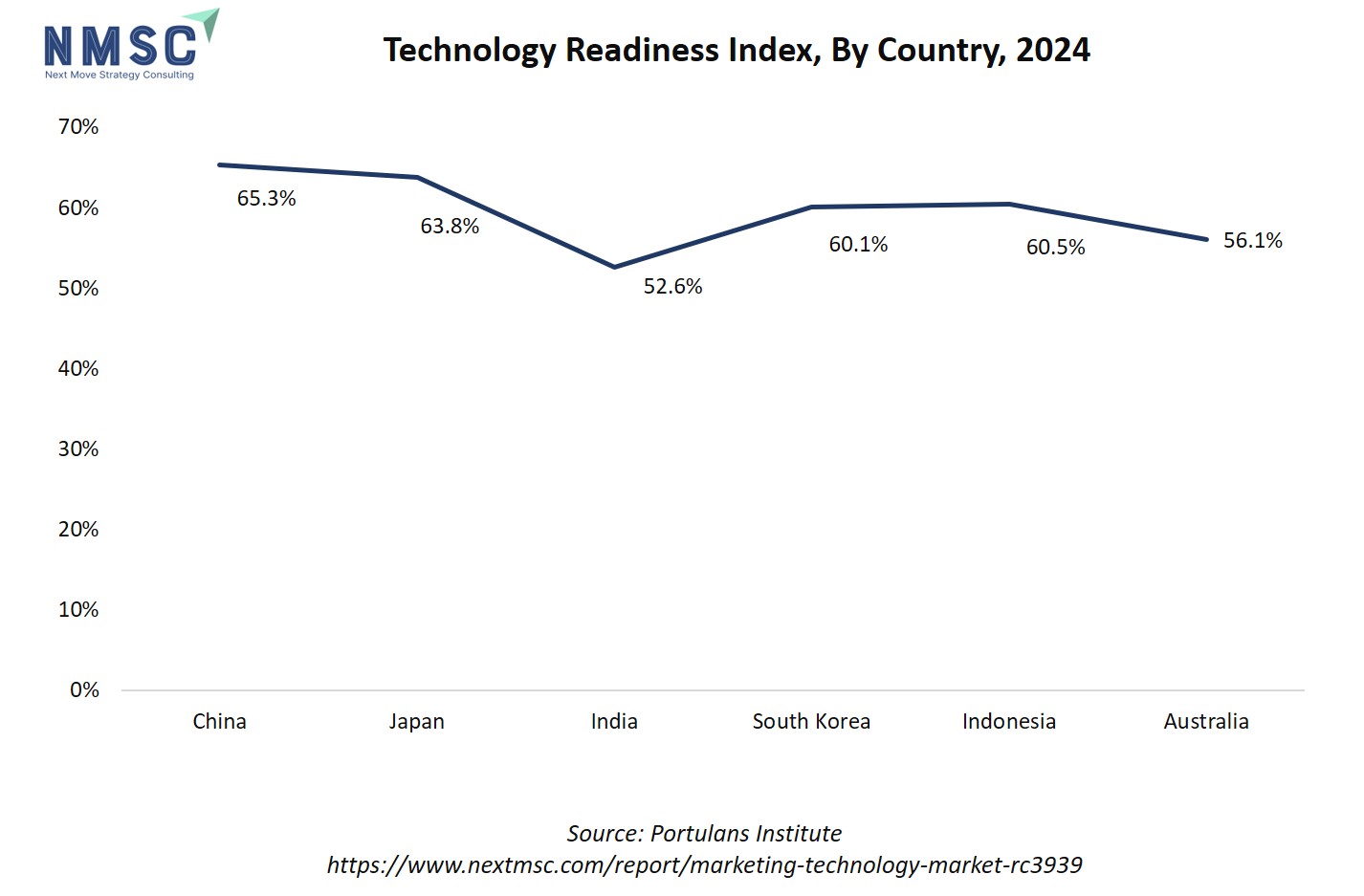
The chart represents a comparative trend in technology adoption or market maturity across different regions over the given period, showing fluctuations that indicate varying levels of readiness, investment, and digital capability in each market. For the marketing technology market, this pattern highlights how uneven adoption influences demand dynamics, with regions showing stronger upward momentum driving higher uptake of advanced MarTech solutions such as customer data platforms, AI-driven personalization, marketing automation, and analytics tools. Conversely, periods or regions with slower growth reflect cautious spending, legacy system dependence, or regulatory and infrastructure constraints, encouraging vendors to offer scalable, modular, and cost-efficient solutions. Overall, these variations shape vendor strategies, pricing models, and innovation focus, reinforcing the need for flexible, region-specific MarTech offerings while intensifying competition and long-term market expansion globally.
What Are the Key Trends in the Marketing Technology Industry?
How is Expanding Global Internet Connectivity Shaping the Marketing Technology Market?
The marketing technology market is increasingly influenced by the expansion of global internet access. According to the International Telecommunication Union, around 6 billion people, nearly three-quarters of the world’s population are online in 2025, up from 5.8 billion in 2024, while 2.2 billion people remain offline. This growth is expanding the digital audience for marketers and driving demand for martech platforms that manage large-scale, always-on digital engagement. As users spend more time on mobile apps, video platforms, and digital services, marketing technologies must support richer, real-time interactions rather than basic reach-based campaigns. At the same time, differences in internet speed and reliability across regions mean that one-size-fits-all marketing approaches are less effective. Martech solutions that enable adaptive content delivery, such as lighter formats for lower-bandwidth users and immersive experiences for highly connected audiences are becoming more valuable. For companies in the marketing technology market, aligning personalization and campaign delivery with connectivity conditions improve engagement outcomes and strengthen market reach across diverse digital environments.
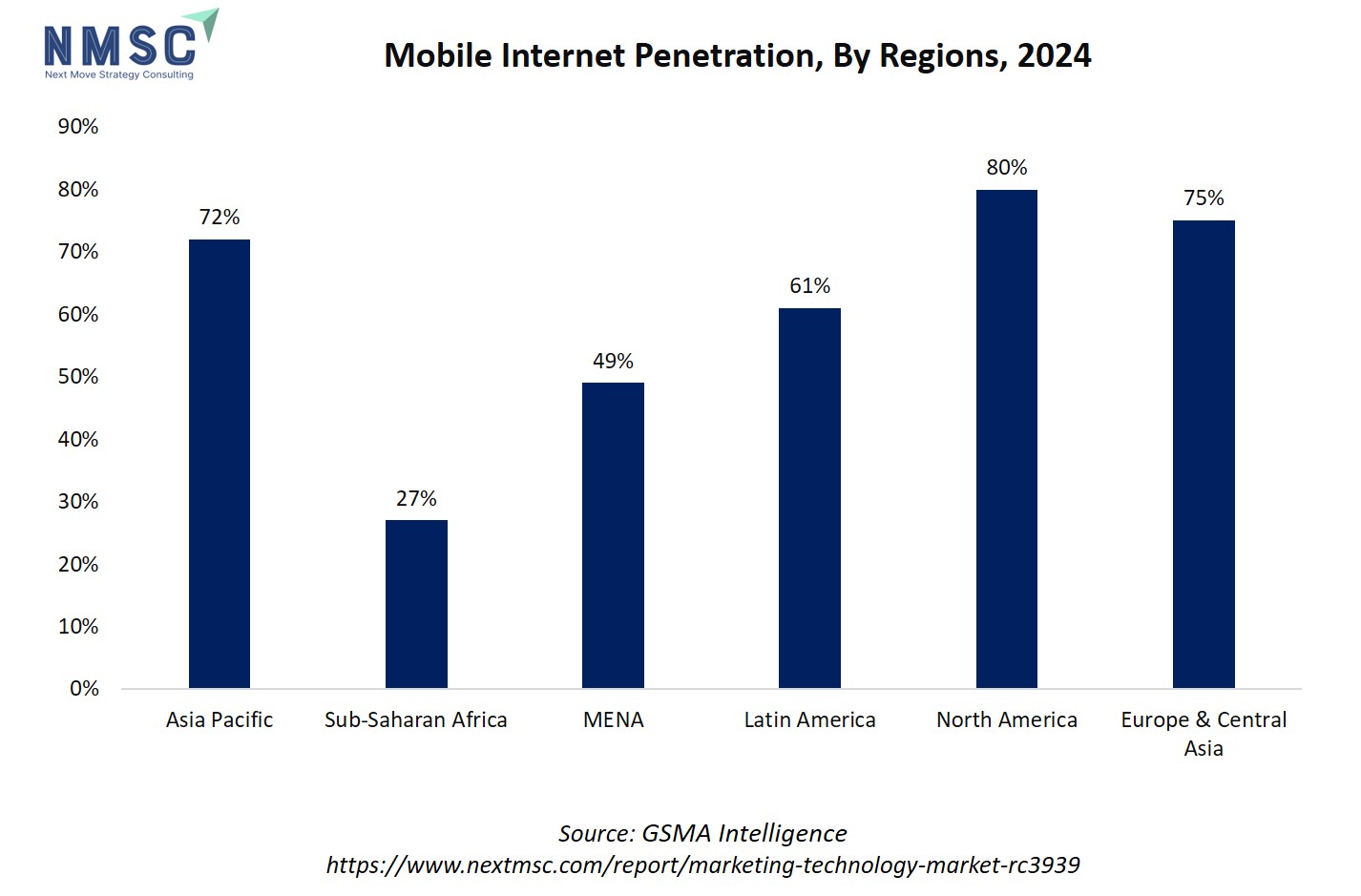
The chart above shows regional disparities in mobile internet penetration in 2024. These differences shape the technology market by dictating where advanced digital services, such as cloud applications, fintech, and mobile-first enterprise tools, scale rapidly versus where basic connectivity and affordable smartphones remain the primary growth opportunity. High‑penetration regions tend to support mature, subscription-based and higher‑ARPU digital ecosystems, while lower‑penetration regions represent long‑term upside for infrastructure vendors, low‑cost device manufacturers, and localized apps aimed at first‑time internet users.
How is Customer Experience Becoming the Central Focus of the Marketing Technology Market?
Customer experience is becoming a central driver of innovation in the marketing technology market as businesses move away from one-time, campaign-focused marketing toward managing ongoing customer journeys. Today’s martech platforms are increasingly built to connect data from multiple touchpoints, such as websites, apps, sales interactions, and customer support, so brands deliver more consistent and personalized experiences. Instead of evaluating success only by channel-specific metrics like clicks or impressions, organizations are now using marketing technology to focus on long-term outcomes such as customer retention, loyalty, and overall satisfaction. This shift is pushing the martech market toward solutions that integrate seamlessly with sales, service, and commerce systems, reducing data silos and improving coordination across teams. As a result, platforms that enable real-time journey orchestration, continuous feedback, and collaboration across functions are gaining greater adoption. For companies operating in the market, they develop tools that simplify customer journey management rather than increase complexity. Easy-to-use, interoperable platforms with clear, actionable insights help marketers respond faster to customer needs and build stronger, more sustainable relationships.
How is Automation Making Marketing Technology Easier to Use?
Automation is playing an important role in the market by helping companies manage marketing activities more efficiently. As campaigns span multiple channels and touchpoints, martech platforms are increasingly automating routine tasks such as campaign execution, lead follow-ups, and performance reporting. This reduces manual work and allows marketing teams to focus more on planning and creativity. Automation also helps ensure consistency and faster responses to customer actions, improving overall engagement. For companies in the marketing technology market, the key opportunity is to offer automation tools that are simple and flexible, not overly complex. Easy-to-configure workflows that respond to real customer behaviour make marketing operations smoother and more effective.
What Are the Key Market Drivers, Breakthroughs, and Investment Opportunities That Will Shape the Marketing Technology Industry in the Next Decade?
The marketing technology industry is experiencing rapid growth, driven by businesses’ increasing focus on delivering personalized, data-driven, and omnichannel customer experiences. Companies are investing in advanced platforms that streamline campaign management, automate workflows, and provide actionable insights across multiple channels. As organizations prioritize customer engagement and efficiency, marketing technology solutions are evolving to meet these demands, offering capabilities such as AI-powered analytics, real-time personalization, and journey orchestration. This growth is further fueled by the need for seamless integration with existing digital tools and enterprise systems, enabling marketers to optimize performance and maximize ROI.
Despite these opportunities, challenges such as data privacy concerns, integration complexities, and the need for consistent measurement across platforms slow adoption. Companies that successfully address these hurdles by offering secure, scalable, and user-friendly solutions stand to gain a competitive advantage. By focusing on innovation, interoperability, and actionable intelligence, marketing technology providers help businesses enhance customer engagement, improve decision-making, and achieve sustainable growth in an increasingly competitive digital landscape.
Growth Drivers:
How is Rising AI Adoption Driving Growth in the Marketing Technology Market?
Rising adoption of artificial intelligence is emerging as a major growth driver for the market, as businesses increasingly rely on intelligent software to manage customer engagement and marketing performance. According to the 2025 Eurostat Digitalisation in Europe report, 20% of EU enterprises with 10 or more employees are using AI in their operations, up from 13.5% in 2024, highlighting a sharp increase within a single year. This growing use of AI reflects how organizations are turning to advanced software to analyse customer data, generate marketing content, personalize campaigns, and automate workflows across channels. As marketing teams depend more on these capabilities, demand is expanding for martech platforms that integrate AI-driven features such as predictive analytics, natural language processing, and automated decision-making. For vendors in the market, AI is no longer an optional add-on but a core requirement to stay competitive. Solutions that offer easy-to-deploy, scalable AI functionalities, while ensuring responsible data use and governance are better positioned to attract customers and capture sustained market growth as AI adoption continues to rise across industries.
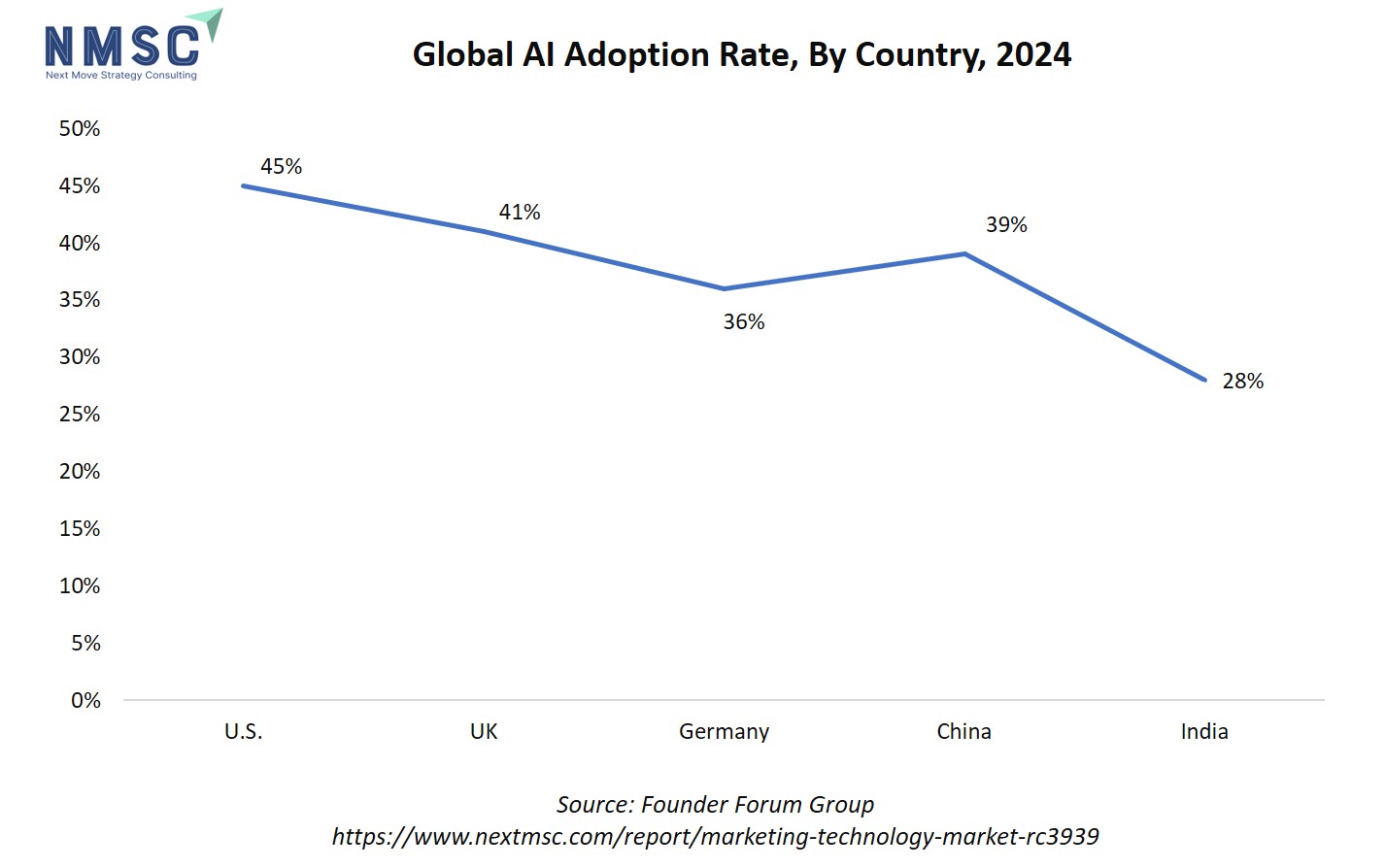
The chart depicts the variation in global AI adoption rates by country in 2024, highlighting differences in how rapidly nations are integrating artificial intelligence into business operations and digital ecosystems, with some countries emerging as clear leaders while others lag behind. For the marketing technology market, this disparity has a direct and strategic impact, as higher AI adoption levels translate into stronger demand for advanced MarTech solutions such as AI-driven personalization, customer analytics, programmatic advertising, and marketing automation platforms. Leading countries create innovation hubs where vendors pilot and scale cutting-edge capabilities, while lower-adoption markets represent long-term growth opportunities requiring education, localization, and cost-effective solutions. Overall, the uneven adoption landscape shapes investment priorities, product development strategies, and competitive positioning across the global market.
How is Increasing Digital Intensity Driving Growth in the Marketing Technology Market?
The growing use of digital technologies by businesses is a key driver for the marketing technology market. According to Eurostat 2024, 73 % of small and medium-sized enterprises (SMEs) in the EU reached at least a basic level of digital intensity, using tools like cloud services, e-commerce platforms, and data analytics in their operations. This means more companies are ready to adopt marketing technology solutions that help manage customer interactions, automate campaigns, and analyze results. For martech vendors, offering platforms that easily integrate with existing digital tools and provide actionable insights capture this rising demand and support business growth as enterprises continue their digital transformation.
Growth Inhibitors:
How are Rising Cybersecurity Threats Acting as a Growth Inhibitor for the Marketing Technology Market?
Rising cybersecurity risks are increasingly limiting the pace of growth in the marketing technology market, particularly as martech platforms handle large volumes of sensitive customer and behavioural data. According to the European Union Agency for Cybersecurity Threat Landscape 2025 report, the EU recorded distributed denial-of-service (DDoS) attacks accounting for around 77% of all incidents, while phishing and ransomware remain among the most damaging threats. This heightened threat environment makes many organizations cautious about adopting or expanding data-intensive marketing technology systems. Concerns over data breaches, service disruptions, and regulatory penalties slow purchasing decisions and extend implementation timelines. For the market, these security challenges delay investments, increase compliance and infrastructure costs, and reduce adoption among risk-averse enterprises. As a result, cybersecurity concerns act as a significant inhibitor, requiring vendors to invest heavily in security-by-design features and assurance mechanisms, which constrain market expansion despite strong demand for advanced marketing capabilities.
How is the Growing Demand for Measurable Marketing ROI Creating an Opportunity in the Marketing Technology Market?
The increasing pressure on marketing teams to clearly demonstrate return on investment is creating a strong growth opportunity in the marketing technology industry. As marketing budgets face closer scrutiny, organizations are looking for tools that directly link marketing activities to business outcomes such as revenue growth, customer acquisition, and retention. This shift is pushing companies to adopt marketing technologies that offer advanced analytics, performance tracking, and attribution capabilities across channels. Martech platforms that help marketers move beyond vanity metrics and provide clear, actionable insights into campaign effectiveness are becoming more valuable. Vendors that enable transparent measurement, real-time reporting, and outcome-based decision-making support organizations in justifying marketing spend and improving efficiency. As accountability becomes central to marketing strategies, demand for marketing technology solutions that deliver measurable results continues to grow.
How Is the Marketing Technology Market Segmented in This Report, and What Are the Key Insights from the Segmentation Analysis?
By Product and Solution Insights
Is the Marketing Technology Industry in 2025 Shaped by Diverse Products and Solutions?
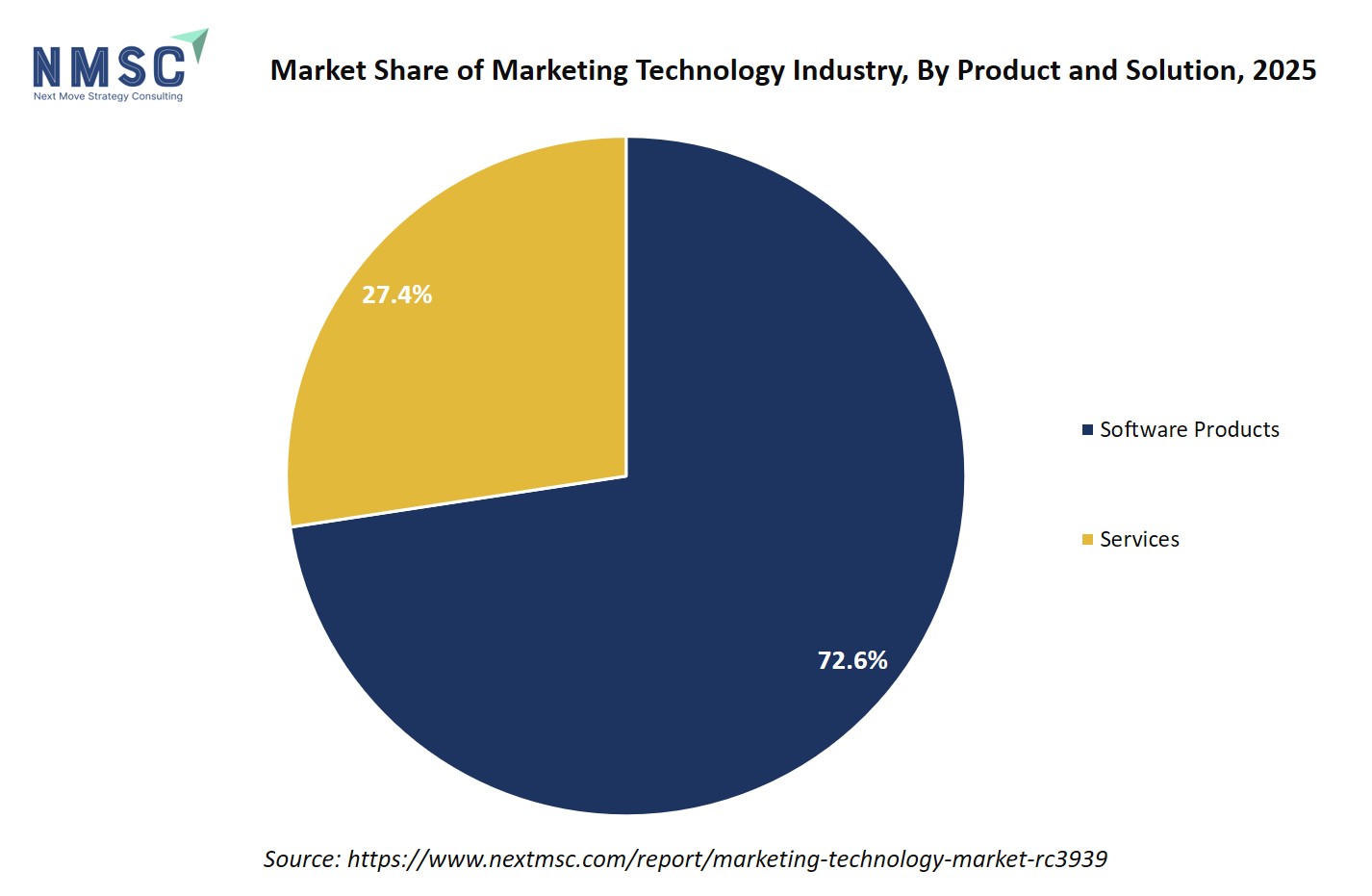
Based on product and solution, the market is segmented into software products and services.
The software products segment represents the core of digital marketing solutions, encompassing a wide range of platforms designed to help businesses manage, automate, and optimize their marketing activities. This segment includes software for data and identity management, campaign and engagement orchestration, advertising technology, content and experience management, commerce and sales enablement, analytics and insights, personalization, search and discovery, social media and community management, operations and governance, and integration and infrastructure. These products enable organizations to collect and unify customer data, execute targeted campaigns, optimize advertising performance, deliver personalized experiences, and measure marketing effectiveness.
The services segment complements software products by providing the expertise and support necessary to implement, manage, and maximize the value of these platforms. It includes professional services such as consulting, strategy, implementation, integration, managed services, campaign and creative services, and training, as well as data and audience services like third-party data provision, audience enrichment, measurement panels, and identity graph services. Services help businesses operationalize software platforms, improve targeting and personalization, maintain data quality, and achieve strategic marketing objectives. Together, the software products and services segments create a comprehensive ecosystem that enables enterprises to fully leverage marketing technology for growth, engagement, and competitive advantage.
By Deployment Model Insights
Is the Marketing Technology Market in 2025 Being Shaped by Deployment Model?
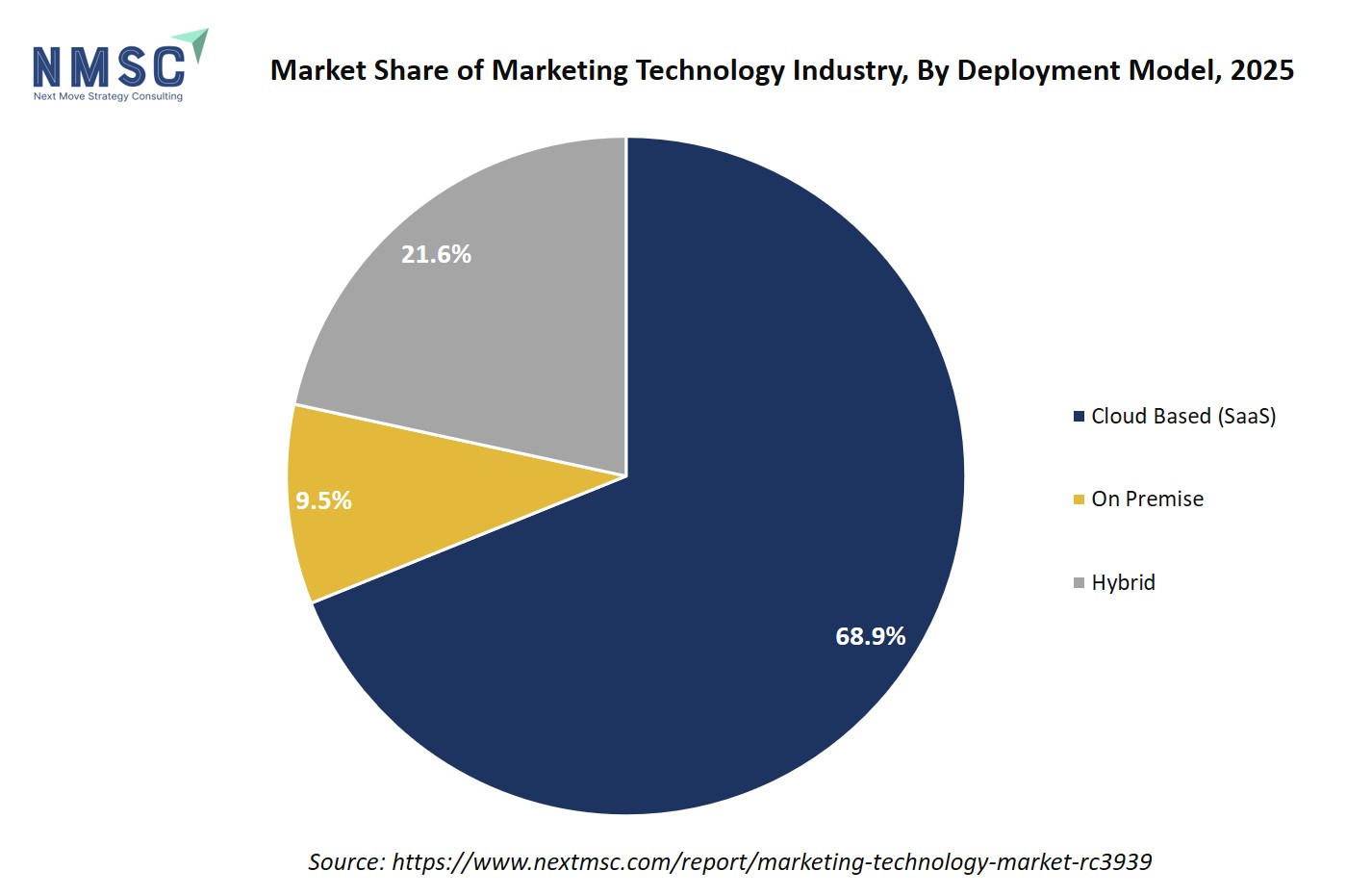
On the basis of deployment model, the market is segmented into cloud-based (SaaS), On Premise and Hybrid.
Cloud-based (SaaS) deployment allows marketing technology platforms to be hosted on the vendor’s servers and accessed via the internet. This model offers scalability, lower upfront costs, rapid deployment, automatic updates, and ease of access from anywhere, making it ideal for businesses seeking flexibility and reduced IT overhead. SaaS solutions are particularly popular for companies that require frequent updates, real-time analytics, and collaboration across geographically distributed teams.
On-premise deployment involves installing and managing marketing technology software on the organization’s own servers and infrastructure. This model provides greater control over data security, compliance, and customization, which is important for enterprises with strict regulatory requirements or sensitive customer data. While offering enhanced control, on-premise solutions typically require higher upfront investment, internal IT resources, and longer deployment timelines.
Hybrid deployment combines elements of both cloud-based and on-premise models, allowing organizations to maintain critical or sensitive data on their own infrastructure while leveraging cloud-based services for scalability and flexibility. This approach provides a balance between security, compliance, and agility, enabling enterprises to optimize their marketing technology stack according to operational needs, regulatory considerations, and growth objectives.
By Buyer Type Insights
Are Buyer Types Shaping the Marketing technology Market in 2025?
On the basis of buyer type, the market is segmented into large enterprises, small and medium businesses, agencies and resellers.
Large enterprises typically have complex marketing operations, multiple teams, and extensive customer data across various channels. They require robust, scalable, and integrated marketing technology platforms that handle high volumes of data, support multi-channel campaigns, and provide advanced analytics and personalization capabilities. Large enterprises prioritize security, compliance, and interoperability with existing enterprise systems, making them key adopters of comprehensive and feature-rich martech solutions.
Small and medium businesses usually have more limited budgets, fewer internal resources, and simpler marketing needs. They prefer marketing technology solutions that are easy to deploy, cost-effective, and require minimal technical expertise. SaaS-based platforms, pre-built automation tools, and user-friendly interfaces are particularly attractive to SMBs, as these allow them to compete effectively in digital marketing without large IT investments.
Agencies and resellers act as intermediaries between technology vendors and end-users, implementing, customizing, and managing marketing technology solutions for clients. They require platforms that support multi-client management, reporting, and integration capabilities. Agencies leverage martech solutions to deliver value-added services, including campaign management, analytics, content personalization, and marketing automation, enabling them to serve multiple clients efficiently while expanding their service offerings.
By Industry Vertical Insights
Which Industry Vertical Is Driving the Marketing Technology Market in 2025?
On the basis of industry vertical, the market is segmented into retail and e-commerce, BFSI, healthcare and life sciences, technology, media and telecom, travel and hospitality, manufacturing, education and public sector, other industries.
The retail and E-commerce vertical are one of the most active adopters due to the highly competitive and customer-centric nature of the sector. Retailers and online merchants rely heavily on martech solutions to deliver personalized shopping experiences, manage omnichannel campaigns, optimize promotions, and track customer behavior across digital touchpoints. Marketing technology platforms help these businesses enhance customer engagement, improve conversion rates, and increase loyalty through targeted messaging, recommendation engines, and data-driven analytics. The rise of mobile commerce, social media shopping, and direct-to-consumer strategies has further accelerated demand for advanced martech solutions in this vertical.
The BFSI sector increasingly leverages marketing technology to manage customer relationships, drive cross-selling and upselling, and ensure compliance with strict regulatory standards. Martech platforms in this vertical support personalized communication, automated campaign management, and real-time analytics, enabling financial institutions to deliver relevant offers, improve customer retention, and enhance engagement across multiple channels. Additionally, BFSI organizations benefit from AI-driven insights and predictive analytics to anticipate customer needs, identify risk factors, and optimize marketing ROI while maintaining stringent data privacy and security requirements.
Regional Outlook
The Marketing technology market is geographically studied across North America, Europe, Asia Pacific, the Middle East & Africa, and Latin America, and each region is further studied across countries.
Marketing Technology Market in North America
North America remains at the forefront of the marketing technology market, supported by a highly developed digital ecosystem and a strong focus on technology-led customer engagement. Organizations across the region actively adopt cloud-based platforms, automation tools, and AI-driven solutions to improve personalization, campaign efficiency, and decision-making. Marketing strategies are closely aligned with performance measurement and optimization, making martech an essential component of business operations rather than a supplementary function. Well-established digital infrastructure and early acceptance of emerging technologies allow enterprises to integrate sophisticated martech platforms with relative ease. At the same time, a structured regulatory environment has encouraged disciplined and strategic investment, reinforcing North America’s position as a mature market that continues to evolve through rapid innovation and expanding use cases within the marketing technology landscape.
Marketing Technology Market in the United States
A key driver of marketing technology adoption in the United States is the growing emphasis on personalized customer experiences and engagement strategies. As businesses strive to meet increasingly sophisticated consumer expectations, they are investing in martech solutions that enable real-time personalization, targeted messaging, and seamless multi-channel interactions. This focus on delivering relevant, timely, and consistent experiences encourages organizations to adopt advanced marketing platforms, automation tools, and analytics solutions, making martech an essential part of customer-centric business strategies rather than a supplementary function.
Marketing Technology Market in Canada
Canada’s marketing technology market is fueled by widespread digital adoption among enterprises and supportive government initiatives promoting digital transformation. Businesses across the country are increasingly turning to martech solutions to manage omnichannel customer engagement and streamline marketing operations across a geographically dispersed population. A strong focus on data privacy and ethical use of AI further encourages the adoption of robust, enterprise-grade marketing technologies, positioning martech as a critical component of Canada’s modern business landscape.
Marketing Technology Market in Europe
Europe’s marketing technology market is driven by widespread digital adoption and a strong emphasis on regulatory compliance. Businesses across the region increasingly seek martech solutions that unify customer data, automate engagement, and support trust-building with their audiences. The focus on transparency, consent, and long-term customer relationships encourages the adoption of structured, compliant marketing platforms, making martech an essential tool for organizations aiming to balance innovation with regulatory adherence.
Marketing Technology Market in the United Kingdom
The increasing integration of artificial intelligence and digital tools into business operations is driving marketing technology adoption in the United Kingdom, expanding the demand for martech solutions that support automation, personalization, and analytics. Official statistics from the Office for National Statistics show that the proportion of UK businesses using some form of AI technology has steadily increased, rising from around 15% in late 2024 to about 21% by mid 2025, with larger firms particularly likely to deploy AI capabilities as part of their digital strategies highlighting how AI adoption is becoming a foundation for more sophisticated marketing technology investments.
Marketing Technology Market in Germany
Germany’s marketing technology market is fueled by increasing enterprise digitalization and the country’s strong manufacturing and B2B sectors moving toward digital marketing. As businesses expand their digital customer touchpoints, there is a growing demand for martech solutions that integrate seamlessly with ERP and CRM systems, supporting lead management, analytics, and omnichannel engagement. This shift positions marketing technology as a critical tool for German companies seeking to enhance efficiency, optimize customer interactions, and drive business growth in a digitally connected marketplace.
Marketing Technology Market in France
France’s marketing technology market is driven by the widespread adoption of digital tools among enterprises and strong government initiatives supporting digital innovation. Businesses are increasingly turning to martech platforms to enable personalization, marketing automation, and effective customer data management, particularly as online commerce and digital services continue to grow. This trend underscores the critical role of marketing technology in helping French companies enhance customer engagement, streamline operations, and remain competitive in a rapidly evolving digital landscape.
Marketing Technology Market in Italy
The growing emphasis on delivering exceptional customer experiences and multi-channel engagement is a key driver of marketing technology adoption in Italy. Italian businesses are prioritizing strategies that deliver personalized, seamless interactions, both online and offline, which encourages investment in martech platforms capable of managing customer journeys, automating campaigns, and analyzing behaviour. This focus on customer-centric marketing drives demand for advanced marketing technologies as companies seek to strengthen loyalty, improve satisfaction, and differentiate themselves in a competitive market.
Marketing Technology Market in Spain
The growing need for businesses to differentiate their brands and strengthen competitive positioning is a key driver of marketing technology adoption in Spain. Spanish companies are increasingly leveraging martech solutions to deliver targeted messaging, optimize campaign performance, and create cohesive brand experiences across digital channels. By adopting advanced marketing platforms, organizations better understand customer preferences, respond to market trends quickly, and enhance their brand presence, making marketing technology essential for maintaining a competitive edge.
Marketing Technology Market in the Nordics
The Nordic countries’ high level of digital maturity and widespread internet accessibility provide a strong foundation for marketing technology adoption. Enterprises in the region are well-positioned to leverage advanced martech capabilities, including AI-driven personalization and real-time analytics, fostering an environment of innovation and making marketing technology a central component of business strategies across the Nordics.
Marketing Technology Market in the Asia-Pacific
The increasing focus on delivering personalized and seamless customer experiences is a key driver of marketing technology adoption in the Asia-Pacific region. Companies across the region are investing in martech platforms that enable targeted messaging, automated campaigns, and data-driven insights to meet the expectations of diverse consumer segments. This emphasis on omnichannel engagement and relevance is fueling demand for advanced marketing technologies and positioning the region as a hub for innovation in customer-centric marketing.
Marketing Technology Market in China
China’s marketing technology market is being propelled by extensive digital consumer engagement and the increasing reliance of enterprises on data-driven platforms to manage their operations and customer interactions. As consumers increasingly engage through mobile and online channels, businesses are turning to martech solutions to efficiently handle high-volume, mobile-centric customer journeys. These technologies enable companies to deliver personalized experiences, optimize marketing campaigns in real time, making marketing technology an essential component for sustaining growth and competitiveness in China’s rapidly evolving digital landscape.
Marketing Technology Market in Japan
A significant driver of marketing technology adoption in Japan is the growing focus on efficiency and process optimization within marketing operations. Japanese companies are increasingly investing in martech solutions to automate repetitive tasks, streamline campaign management, and analyze customer data more effectively. This emphasis on operational efficiency allows businesses to reduce costs, respond faster to market trends, and deliver more precise and impactful marketing initiatives, making marketing technology a critical component of modern business strategy in Japan.
Marketing Technology Market in India
A major driver of marketing technology adoption in India is the growing need for businesses to optimize marketing efficiency and streamline operations. Companies are increasingly turning to martech solutions to automate repetitive tasks, coordinate multi-channel campaigns, and gain actionable insights from large volumes of customer data. This focus on operational effectiveness allows organizations to reduce costs, improve decision-making, and deliver more timely and targeted marketing initiatives, making marketing technology an essential tool for business growth in India.
Marketing Technology Market in South Korea
The growing demand for seamless mobile and digital experiences is a key driver of marketing technology adoption in South Korea. With consumers increasingly interacting through smartphones, apps, and social media platforms, businesses are investing in martech solutions that enable real-time engagement, personalized messaging, and automated marketing workflows. This focus on delivering smooth, integrated digital experiences encourages the adoption of advanced marketing technologies to meet evolving consumer expectations and maintain competitive advantage.
Marketing Technology Market in Taiwan
The growing focus on data-driven decision-making and marketing analytics is a key driver of marketing technology adoption in Taiwan. Taiwanese businesses are leveraging customer data to gain insights, optimize campaigns, and measure marketing performance more effectively. Martech solutions that enable advanced analytics, audience segmentation, and performance tracking help companies make informed decisions, enhance customer targeting, and improve overall marketing efficiency, driving the adoption of sophisticated marketing technologies.
Marketing Technology Market in Indonesia
The rapid expansion of the e-commerce ecosystem and digital retail landscape is a key driver of marketing technology adoption in Indonesia. Indonesian businesses are increasingly investing in martech solutions to manage online sales channels, personalize customer interactions, and automate marketing campaigns. By leveraging these technologies, companies enhance customer engagement, streamline operations, and stay competitive in a rapidly growing digital marketplace, making marketing technology an essential part of their growth strategy.
Marketing Technology Market in Australia
A key driver of marketing technology adoption in Australia is the strategic focus on leveraging advanced analytics to maximize marketing effectiveness and ROI. Organizations are increasingly deploying martech platforms to gain deep insights into customer behaviour, optimize campaign performance, and make data-driven decisions. By integrating sophisticated analytics, automation, and performance tracking capabilities, Australian businesses are able to enhance operational efficiency, deliver highly targeted marketing initiatives, and secure a competitive advantage in a market that increasingly demands measurable and outcome-oriented marketing strategies.
Marketing Technology Market in Latin America
The expanding influence of social media and digital influencer marketing is a key driver of marketing technology adoption in Latin America. Businesses across the region are increasingly leveraging martech platforms to manage campaigns, track engagement, and personalize interactions across social networks. By integrating automation, analytics, and campaign management tools, companies effectively reach diverse audiences, amplify brand presence, and drive customer loyalty in a market where digital and social channels play a central role in consumer decision-making.
Marketing Technology Market in the Middle East & Africa
A key driver of marketing technology adoption in the Middle East and Africa is the increasing focus on regional market expansion and cross-border customer engagement. Businesses are turning to martech solutions to manage campaigns across multiple countries, navigate diverse consumer preferences, and maintain consistent brand messaging. Advanced marketing platforms enable companies to analyse market trends, automate communications, and optimize strategies for different regions, making marketing technology essential for growth in a geographically and culturally diverse market.
Competitive Landscape
Which Companies Dominate the Marketing Technology Industry and How do they Compete?
Leading companies in the marketing technology industry, such as Google LLC, Meta Platforms, Inc., Adobe Inc., Salesforce, Inc., Microsoft Corporation, Oracle Corporation, and SAP SE, have established themselves as key players through continuous innovation, strategic acquisitions, and global expansion. Google and Meta dominate in digital advertising and data-driven marketing solutions, offering platforms that enable precise audience targeting and campaign optimization. Adobe and Salesforce focus on comprehensive marketing clouds and customer experience platforms, providing tools for personalization, automation, and analytics. Microsoft, Oracle, and SAP leverage their enterprise software ecosystems to integrate marketing technology with CRM, ERP, and data management systems, enhancing enterprise-wide marketing capabilities. These companies compete by differentiating their offerings, enhancing platform functionality, and expanding their global presence to capture larger market shares.
Other prominent players, including AppsFlyer Ltd., Braze, The Trade Desk, Tealium Inc., HubSpot, Freshworks, Adjust GmbH, and Twilio Inc., focus on niche and specialized solutions that cater to specific marketing needs. AppsFlyer and Adjust specialize in mobile attribution and analytics, while Braze and HubSpot emphasize customer engagement, journey orchestration, and automation. The Trade Desk leads in programmatic advertising, and Tealium excels in data integration and tag management solutions. Freshworks and Twilio provide communication and customer interaction platforms that enhance multichannel marketing strategies. Collectively, these companies strengthen the marketing technology ecosystem by offering innovative, scalable, and specialized solutions that address diverse marketing challenges across industries worldwide.
Market Dominated by Marketing Technology Giants and Specialists
The marketing technology industry is characterized by a mix of global leaders and specialized firms, each establishing strengths across different regions and product categories. Companies like Google LLC, Meta Platforms, Adobe Inc., Salesforce, Microsoft, Oracle, and SAP dominate the global landscape with comprehensive platforms, extensive resources, and integrated enterprise solutions that address a wide spectrum of marketing needs. In contrast, specialized firms such as AppsFlyer, Braze, The Trade Desk, Tealium, HubSpot, Freshworks, Adjust, and Twilio focus on niche areas like mobile attribution, customer engagement, programmatic advertising, data integration, and multichannel communications, offering tailored solutions for specific marketing challenges. This dual structure drives innovation and healthy competition, as global giants leverage scale and technological capabilities, while specialists advance targeted solutions, enabling businesses to adopt platforms that best suit their operational and strategic marketing objectives.
Innovation and Adaptability Drive Market Success
Innovation is a key driver of success in the marketing technology market, with companies continually developing new products and applications to meet evolving consumer demands. For example, Adobe Firefly Foundry exemplifies how innovation and adaptability drive market success in the sector. By integrating generative AI into Creative Cloud and GenStudio, Adobe enables enterprises to create AI-powered, on-brand content at scale, allowing marketers to deliver highly personalized, data-driven campaigns efficiently. This capability highlights how companies that embrace emerging technologies and adapt their offerings to evolving customer needs enhance engagement, streamline workflows, and maintain a competitive edge, reinforcing the importance of continuous innovation in achieving sustainable growth in the marketing technology industry.
Market Players to Opt for Merger & Acquisition Strategies to Expand their Presence
Merger and acquisition (M&A) strategies have become pivotal for companies aiming to strengthen their position in the industry. Market players in the marketing technology sector are increasingly leveraging mergers and acquisitions as a key strategy to expand their presence, enhance product portfolios, and enter new markets. By acquiring specialized platforms or complementary technologies, companies quickly integrate advanced capabilities such as AI-driven analytics, customer engagement tools, or data management solutions into their offerings. This approach not only accelerates innovation but also helps firms scale their operations, strengthen competitive positioning, and deliver more comprehensive solutions to clients. As the market becomes more dynamic and technology-driven, strategic acquisitions remain a critical pathway for companies to grow, diversify, and maintain relevance in a rapidly evolving marketing landscape.
List of Key Marketing Technology Companies
-
Google LLC
-
Meta Platforms, Inc.
-
Adobe Inc.
-
Salesforce, Inc.
-
Microsoft Corporation
-
AppsFlyer Ltd.
-
Braze, Inc.
-
The Trade Desk, Inc.
-
Tealium Inc.
-
HubSpot, Inc.
-
Freshworks, Inc.
-
Adjust GmbH
-
Twilio Inc.
What Are The Latest Key Industry Developments?
-
July 2025 - Google has expanded its AI-powered marketing tools to India following the repeal of the local Google tax, enabling Indian advertisers to access advanced campaign creation and optimization features tailored to regional needs. This move reinforces Google’s commitment to growing its marketing technology footprint in key international markets by making its AI enhanced advertising solutions more accessible to a wider range of businesses.
What Are The Key Factors Influencing Investment Analysis & Opportunities In The Marketing Technology Market?
Investment in the industry is increasingly driven by the growing need for businesses to deliver personalized, data-driven, and omnichannel customer experiences. Investors are drawn to companies that offer innovative martech platforms, including AI-powered analytics, automation, and customer engagement tools, which help organizations optimize marketing performance and drive measurable ROI. Funding trends favor solutions that integrate easily with existing enterprise systems, provide actionable insights, and enhance efficiency across marketing operations. Scalability, user-friendly interfaces, and the ability to address complex, multi-channel marketing challenges are key factors that influence investor interest and long-term growth potential in this dynamic sector.
Valuations in the marketing technology space are shaped by product differentiation, intellectual property related to proprietary algorithms, and the ability to support enterprise-wide adoption. Investment opportunities are concentrated in regions with mature digital infrastructure and high levels of enterprise digitization, such as North America, Europe, and select Asia-Pacific markets. Companies that focus on innovation, integration capabilities, and measurable marketing outcomes attract higher investor attention, while strategic partnerships, R&D collaborations, and global expansion strategies further enhance growth prospects in this rapidly evolving industry.
Key Benefits for Stakeholders:
Next Move Strategy Consulting (NMSC) presents a comprehensive analysis of the Marketing technology market, covering historical trends from 2020 through 2025 and offering detailed forecasts through 2035. Our study examines the market at regional and country levels, providing quantitative projections and insights into key growth drivers, challenges, and investment opportunities across all major marketing technology segments.
The industry creates value for a wide range of stakeholders by linking digital transformation with business performance. Investors gain from strong growth potential, recurring revenue models, and opportunities to back innovative, scalable, and AI-driven platforms. Businesses and marketers benefit from tools that streamline campaigns, enhance targeting, and improve measurable ROI, while customers enjoy more personalized, relevant, and seamless experiences across digital channels. Technology partners and developers also benefit from steady demand for software solutions and integrations, enabling them to create differentiated, high-value products. Overall, the ecosystem fosters mutual growth, where innovation, automation, and data-driven insights drive value for investors, enterprises, and end-users alike, reinforcing adoption and market expansion.
Report Scope
|
Parameters |
Details |
|
Market Size in 2026 |
USD 709.52 Billion |
|
Revenue Forecast in 2035 |
USD 3760.99 Billion |
|
Growth Rate |
CAGR of 20.4% from 2026 to 2035 |
|
Analysis Period |
2025–2035 |
|
Base Year Considered |
2025 |
|
Forecast Period |
2026–2035 |
|
Market Size Estimation |
Billion (USD) |
|
Growth Factors |
|
|
Companies Profiled |
15 |
|
Countries Covered |
33 |
|
Market Share |
Available for 10 companies |
|
Customization Scope |
Free customization (equivalent to up to 80 analyst-working hours) after purchase. Addition or alteration to country, regional & segment scope. |
|
Pricing and Purchase Options |
Avail customized purchase options to meet your exact research needs. |
|
Approach |
In-depth primary and secondary research; proprietary databases; rigorous quality control and validation measures. |
|
Analytical Tools |
Porter's Five Forces, SWOT, value chain, and Harvey ball analysis to assess competitive intensity, stakeholder roles, and relative impact of key factors. |
Marketing Technology Market Key Segments
By Product and Solution
-
Software Products
-
Data and Identity Platforms
-
Customer Data Platforms
-
Data Management Platforms
-
Identity Resolution Systems
-
Data Clean Rooms
-
Tag Management Systems
-
-
Campaign and Engagement Platforms
-
Marketing Automation Platforms
-
Customer Journey Orchestration Platforms
-
Email Marketing Platforms
-
Mobile Marketing Platforms
-
Conversational Platforms
-
-
Advertising Technology Platforms
-
Demand Side Platforms
-
Supply Side Platforms
-
Ad Servers and Exchanges
-
Ad Verification and Measurement Platforms
-
Native and Display Advertising Platforms
-
Search Advertising Platforms
-
-
Content and Experience Platforms
-
Content Management Systems
-
Digital Experience Platforms
-
Headless Content Management Systems
-
Digital Asset Management Systems
-
Creative Production Tools
-
Landing Page and Form Builders
-
-
Commerce and Sales Enablement Platforms
-
Ecommerce Platforms
-
Conversion and Checkout Tools
-
Customer Relationship Management
-
Sales Enablement Platforms
-
Account Based Marketing Platforms
-
-
Analytics and Insights Platforms
-
Marketing Analytics Platforms
-
Attribution and Measurement Tools
-
Experimentation Platforms
-
Predictive Analytics Engines
-
-
Personalization and Recommendations Platforms
-
Personalization Engines
-
Recommendation Engines
-
Real Time Decisioning Platforms
-
-
Search and Discovery Tools
-
Search Engine Optimization Tools
-
Site Search Platforms
-
Content Discovery Networks
-
-
Social Media and Community Platforms
-
Social Media Management Platforms
-
Social Listening and Analytics Tools
-
Influencer Marketing Platforms
-
Community Platforms
-
-
Operations and Governance Platforms
-
Marketing Resource Management Tools
-
Consent and Privacy Management Platforms
-
Governance and Workflow Tools
-
Tag and Release Governance Tools
-
-
Integration and Infrastructure Platforms
-
Integration Platform as a Service
-
API and Data Integration Tools
-
Marketing Data Infrastructure
-
Event and Streaming Infrastructure
-
-
-
Services
-
Professional Services
-
Consulting and Strategy Services
-
Implementation and Integration Services
-
Managed Services
-
Campaign and Creative Services
-
Training and Support Services
-
-
Data and Audience Services
-
Third Party Data Providers
-
Audience Enrichment Services
-
Measurement Panels and Panel Data Services
-
Identity Graph Services
-
-
By Deployment Model
-
Cloud Based (SaaS)
-
On Premise
-
Hybrid
By Buyer Type
-
Large Enterprises
-
Small and Medium Businesses
-
Agencies and Resellers
By Revenue Model
-
Subscription Licensing
-
Perpetual Licensing
-
Usage and Transaction-Based
-
Services Revenue
By Industry Vertical
-
Retail and Ecommerce
-
BFSI
-
Healthcare and Life Sciences
-
Technology, Media and Telecom
-
Travel and Hospitality
-
Manufacturing
-
Education and Public Sector
-
Other Industries
Geographical Breakdown
-
North America: U.S., Canada, and Mexico.
-
Europe: UK, Germany, France, Italy, Spain, Sweden, Denmark, Finland, the Netherlands, and rest of Europe.
-
Asia Pacific: China, India, Japan, South Korea, Taiwan, Indonesia, Vietnam, Australia, Philippines, Malaysia and rest of APAC.
-
Middle East & Africa (MEA): Saudi Arabia, UAE, Egypt, Israel, Turkey, Nigeria, South Africa, and Rest of MEA.
-
Latin America: Brazil, Argentina, Chile, Colombia, and rest of LATAM.
Conclusion & Recommendations
Our report equips stakeholders, industry participants, investors, and consultants with actionable intelligence to capitalize on the transformative potential of the industry. By combining in-depth analysis with strategic frameworks, NMSC’s marketing technology market report serves as a critical resource for navigating a rapidly evolving landscape. The market is poised for sustained growth, driven by increasing enterprise demand for data-driven insights, automation, and personalized customer engagement across digital channels. Strategic takeaways emphasize the importance of product innovation, seamless system integration, and robust analytics capabilities, as these factors enhance platform value and competitiveness. Companies that focus on AI-driven solutions, scalable automation, and comprehensive customer journey management are positioned to capture larger marketing technology market share and strengthen long-term growth prospects.
For executives and investors, capitalizing on these trends requires identifying high-potential segments, investing in R&D for innovative marketing technologies, and fostering strategic partnerships to expand market reach. Prioritizing markets with high digital adoption and mature infrastructure optimizes deployment and performance. Additionally, emphasizing user-friendly interfaces, measurable ROI, and cross-platform interoperability enhances client trust and accelerates adoption, unlocking significant opportunities for value creation in the market.


About the Author
 Jayanta Das
— Jayanta Das is Senior Analyst at Next Move Strategy Consulting, where he has spent 4.5 years covering the firm's full industry taxonomy — spanning aerospace and defense, healthcare, BFSI, energy and power, semiconductors, and beyond — rather than one specialization. His work follows NextMSC's research model, combining data mining, analytics, and secondary research to build market sizing and forecasts behind NextMSC's 2,000-plus research reports, trusted by more than 3,000 organizations globally.
Jayanta Das
— Jayanta Das is Senior Analyst at Next Move Strategy Consulting, where he has spent 4.5 years covering the firm's full industry taxonomy — spanning aerospace and defense, healthcare, BFSI, energy and power, semiconductors, and beyond — rather than one specialization. His work follows NextMSC's research model, combining data mining, analytics, and secondary research to build market sizing and forecasts behind NextMSC's 2,000-plus research reports, trusted by more than 3,000 organizations globally.
About the Reviewer
 Supradip Baul
— Supradip Baul is an accomplished business consultant and strategist with over a decade of rich experience in market intelligence, strategy, technology, and business transformation. His work has included rigorous qualitative and quantitative analysis across multiple industries, helping clients shape investment decisions and long-term roadmaps. Earlier in his career, he was associated with Gartner, where he contributed to industry-leading reports and market share analyses. He has worked with leading global companies and holds an MBA with a dual specialization in Marketing and Finance.
Supradip Baul
— Supradip Baul is an accomplished business consultant and strategist with over a decade of rich experience in market intelligence, strategy, technology, and business transformation. His work has included rigorous qualitative and quantitative analysis across multiple industries, helping clients shape investment decisions and long-term roadmaps. Earlier in his career, he was associated with Gartner, where he contributed to industry-leading reports and market share analyses. He has worked with leading global companies and holds an MBA with a dual specialization in Marketing and Finance.
At Next Move Strategy Consulting, we understand that insightful market research is the cornerstone of successful business decisions. That's why we employ a robust and multifaceted approach, combining various methodologies to deliver the most accurate and actionable data for our clients.

Research Landscape
We navigate the world of research with two primary approaches:
Qualitative Approach
Our qualitative research methodologies involve immersive techniques such as in-depth interviews, focus groups, and observational studies. By engaging directly with individuals and stakeholders, we uncover valuable insights that quantitative data alone may overlook.

Quantitative Research
In tandem with qualitative methodologies, NMSC leverages the power of Quantitative Research to provide a robust foundation of numerical insights. Through systematic data collection and analysis, we quantify patterns, preferences, and market trends, offering a comprehensive view of the business landscape.
Our quantitative research approach employs diverse tools, including surveys, experiments, and statistical modelling. These methodologies enable us to gather data from a large and representative sample, ensuring the statistical significance of our findings. By employing structured questionnaires and standardized data collection methods, we guarantee the reliability and validity of the information we present to our clients.
Quantitative research is particularly effective in measuring the prevalence of trends, assessing market size, and gauging the impact of various factors on consumer behavior. The numerical precision attained through this approach equips our clients with actionable insights, facilitating data-driven decision-making and strategy formulation.


Our Specialized Toolbox for Industry-Specific Market Research
We deploy a specialized arsenal of techniques tailored to meet your unique requirements. Here's a glimpse into our comprehensive toolbox:

Information Procurement
The stage entails acquiring market data or relevant information through various sources and methodologies.


Market Research Approach
We utilize both top-down and bottom-up approaches in market research analysis to achieve a comprehensive understanding of the market dynamics, leveraging the broad perspective of industry trends and macroeconomic factors alongside detailed insights from specific segments and individual companies.

Porters Five Forces Analysis
We conduct Porter's Five Forces analysis to evaluate the competitive landscape of an industry, providing us with insights into factors that affect profitability and strategic positioning.

SWOT Analysis

Forecasting
We utilize a forecasting model to predict future consumption by considering parameters like population, economics, regulations, market competition, drivers, constraints, technology, and pricing. We also employ statistical techniques such as multilinear regression, exponential smoothing, moving average, ARIMA, and Monte Carlo simulations for accurate predictions. In econometric forecasting, we analyzed short-term and long-term event impacts, attributing values based on regulatory frameworks, economic factors, and market events.





 Speak to Our Analyst